
Did you know that 87% of companies now use AI in their recruitment process? It's a staggering figure that explains why your efforts in ats resume optimization often feel like they're disappearing into a digital black hole. You've likely spent hours manually tailoring your career history, only to wonder if a human ever actually saw it. We understand the exhaustion of facing conflicting advice while trying to stay visible. It's frustrating to feel like a cold algorithm is standing between you and your next big opportunity.
This guide is your roadmap to mastering the modern hiring landscape in 2026. We'll show you how to align your professional experience with modern hiring algorithms to secure more interviews without ever compromising the truth. You'll discover a clear, repeatable system for getting past automated filters and a centralized way to manage your tailored CV versions. We're moving beyond old tricks and focusing on strategic clarity. Let's transform your job search from a game of chance into a series of confident steps toward your next role.
Key Takeaways
- Understand how modern hiring systems have shifted from simple keyword matching to semantic Natural Language Processing to better represent your professional truth.
- Learn why effective ats resume optimization requires a strategic mix of hard technical keywords and achievement-based context to satisfy both bots and recruiters.
- Protect your application from technical rejection by identifying the hidden formatting dangers that often lead to automatic filtering.
- Implement a repeatable four-step workflow to deconstruct job descriptions and highlight your most relevant professional wins with precision.
- Scale your search efficiency by using a centralized dashboard to track optimized versions and avoid repeating past application mistakes.
The 2026 ATS Landscape: Why Your Resume is Getting Filtered
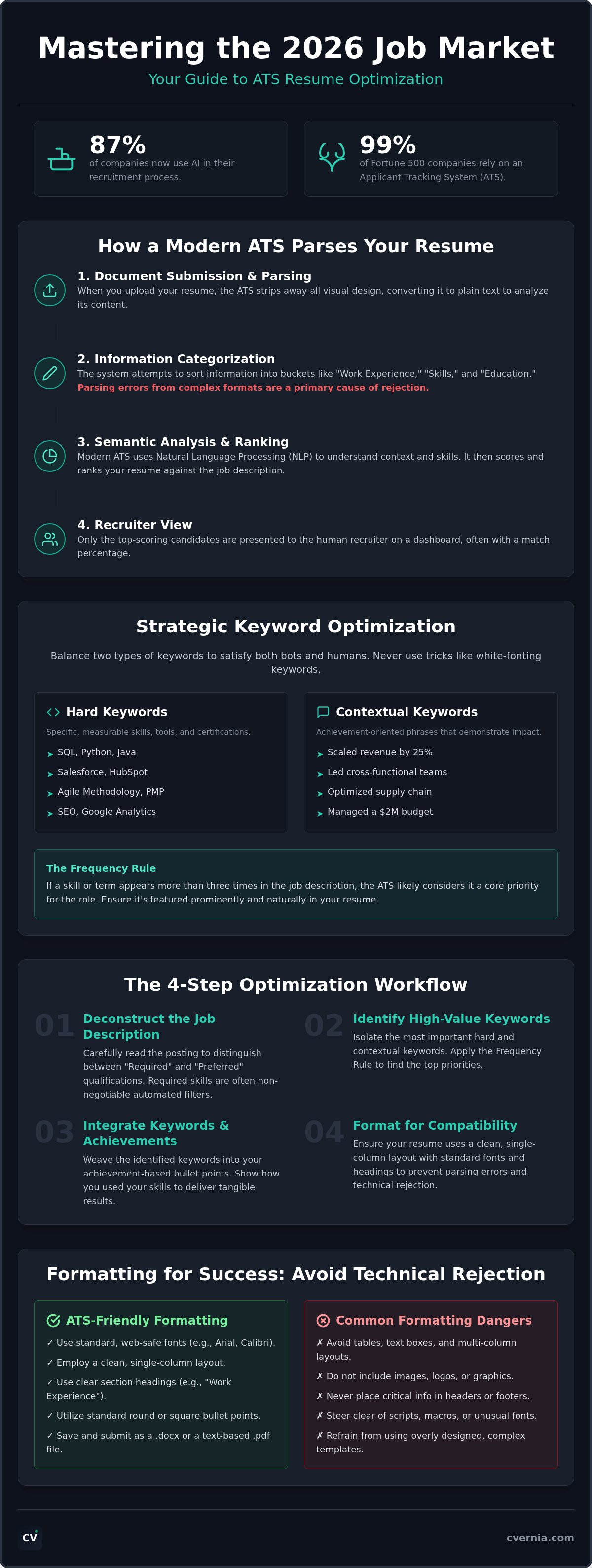
Imagine spending hours polishing your career history only to have it vanish instantly. This is the reality for millions of applicants facing the digital gatekeeper. An Applicant Tracking System (ATS) acts as the primary filter for 99% of Fortune 500 companies. While these systems are designed for efficiency, they often create a "black hole" effect that leaves qualified professionals feeling invisible. Success in 2026 requires a shift in perspective. You aren't just writing for a person; you're writing for a sophisticated algorithm that demands precision. Master ats resume optimization to ensure your hard work actually reaches human eyes.
The technology has evolved rapidly. Older systems relied on simple keyword matching, where the bot looked for exact phrases like "Project Management." Modern platforms now use Natural Language Processing (NLP) to understand the context of your achievements. Despite this intelligence, the number one reason for rejection isn't a lack of qualification; it's a parsing error. If the system can't read your data, it can't rank you. This technical barrier causes immense emotional fatigue, but a strategic approach can turn the tide in your favor.
How Modern ATS Parses Your Experience
When you upload a document, the system strips away the design to create a plain text version for its database. It then attempts to categorize your information into specific buckets such as "Work Experience," "Skills," and "Education." If your layout is too complex, the bot might place your job titles in the education section or miss your skills entirely. Semantic search allows systems to recognize that "budget oversight" and "financial management" represent the same core competency even if the specific phrasing differs. Your goal is to provide a clean structure that lets the algorithm identify these connections without friction.
The Role of Recruiters in the Automated Process
A human still makes the final hiring call, but they only see the candidates the bot recommends. Most companies use "knockout questions" as a first line of defense. These are the mandatory checkboxes about years of experience or specific certifications. If you don't meet these baseline requirements, the system rejects you before a recruiter ever sees your name. Once you pass these filters, you appear on a "Recruiter View" dashboard. This interface ranks candidates with percentage scores based on ats resume optimization. You must aim for a high compatibility score to land at the top of that list, where recruiters focus the majority of their attention.
Strategic Keyword Optimization: Beyond Word Stuffing
Effective ats resume optimization isn't about tricking a computer; it's about making your real achievements legible to a digital system. In 2026, modern algorithms differentiate between "Hard Keywords" and "Contextual Keywords." Hard keywords include specific tools, certifications, or technical skills like "SQL," "Salesforce," or "Agile Methodology." Contextual keywords, however, provide the narrative proof of your impact. Phrases like "scaled revenue," "led cross-functional teams," or "optimized supply chain" tell the system not just what you know, but how you've applied it. Balancing these two types ensures you satisfy both the initial automated scan and the recruiter who eventually reads your file.
You might have heard of "hacks" like white-fonting, where candidates hide blocks of keywords in white text to boost their score. Don't do it. Modern systems easily detect these tactics and often flag your profile as spam or blacklist you from future roles. Instead, focus on keyword density and placement. Research from ATS-friendly resume formatting experts suggests that placing your most relevant keywords within the first third of your document and repeating them naturally in your work history carries more weight than a long, disconnected list at the bottom. Use a CV compatibility & ATS analysis tool to identify exactly which terms are missing from your current draft before you hit submit.
Identifying High-Value Keywords in Job Descriptions
Read the job post with a critical eye to distinguish between "Required" and "Preferred" qualifications. Systems prioritize required skills as non-negotiable filters. Look for industry-specific jargon that appears frequently throughout the text. Apply the Frequency Rule: if a specific term or competency appears more than three times, the algorithm likely treats it as a core priority for that specific role. Identifying these patterns allows you to prioritize which experiences to highlight in your limited space.
Mapping Your Truthful Experience to Job Requirements
Use the "Mirroring Technique" to align your history with the employer's specific vocabulary. If a job description asks for "Client Success" experience and you've always called it "Account Management," adopt their phrasing to ensure the semantic search engine makes the connection. When you encounter a skill gap, don't invent experience. CVernia is built on the principle of truthful representation; instead of faking a skill, emphasize transferable wins that prove your capacity to learn. You can analyze your CV's alignment to see how well your existing story matches these modern semantic variations.
Formatting for Compatibility: Eliminating Technical Rejection
Technical rejection is often the cruelest part of the job search. You've done the work and possess the skills, but a formatting error prevents the system from ever seeing them. In 2026, the standard reverse-chronological format remains the gold standard for bots. It provides a logical timeline that algorithms can easily map to their databases. While creative layouts might look stunning to a human eye, they often confuse the software. Focus on ats resume optimization by prioritizing a clean, linear structure that guides the parser from your most recent win to your foundational education.
Many applicants try to save space by using headers, footers, or sidebars. This is a mistake. Most systems skip these areas entirely, meaning your contact information or key skills might never be indexed. When it comes to file types, the debate between PDF and DOCX has largely settled. Modern portals handle both well, but a text-based PDF is generally safer for preserving your layout. Avoid using images, charts, or complex graphics. A bot can't "see" a bar chart representing your proficiency in Java; it just sees a block of unreadable code that might trigger a parsing failure.
The Problem with Multi-Column Layouts
Multi-column designs are a major source of data corruption. Most parsers read a document from left to right, across the entire page. If you have a skills list on the left and your work history on the right, the system may merge the two lines into a single, nonsensical string. For example, a parser might read:
Python | Senior Developer
SQL | 2022-2026
It interprets this as "Python Senior Developer SQL 2022-2026," which fails to categorize your skills or dates correctly. Stick to a single-column layout to ensure your data remains intact and accurately ranked. This simple change is one of the most effective steps in ats resume optimization you can take today.
Fonts and Special Characters That Break the Bot
Your choice of typeface matters more than you think. Stick to web-safe, standard fonts like Arial, Calibri, or Georgia. These are universally recognized and won't cause the system to substitute your text with junk code. Similarly, avoid using ornate icons or non-standard bullet points. A simple solid circle is always safer than a decorative arrow or checkmark. When naming your sections, use standard headers like "Work Experience" or "Education." Don't get creative with titles like "My Professional Journey" or "Where I've Been." The bot is looking for specific labels to categorize your life, so help it find them quickly.
The 4-Step ATS Optimization Workflow
Mastering a repeatable workflow is the final piece of the ats resume optimization puzzle. You don't need to guess what the system wants; you simply need to follow a logical process that aligns your truth with the employer's needs. This four-step system ensures you remain visible to the algorithm while proving your value to the recruiter. By the time you hit submit, you'll feel a sense of professional confidence that comes from knowing your application is technically sound and strategically targeted.
- Step 1: Deconstruct the Job Description. Identify the "Primary Five" requirements. These are the core skills or experiences mentioned most frequently or listed at the very top of the post.
- Step 2: Tailor Your Summary and Bullets. Don't just list tasks. Adjust your professional summary and work history to emphasize wins that directly relate to those Primary Five requirements.
- Step 3: Run a Compatibility Scan. Use a digital tool to identify missing technical or soft skills. This isn't about faking experience; it's about finding gaps in your language that might cause a bot to overlook your actual qualifications.
- Step 4: Final Human-Readability Check. Read your resume aloud. If it sounds like a list of robotic keywords, it's not ready. Ensure the narrative flows naturally for the person who will eventually conduct your interview.
Start your journey toward a better response rate by using our ATS analysis tool to verify your alignment today.
Quantifying Achievements for Both Bots and Humans
Algorithms love numbers because they provide concrete data points for comparison. When you quantify your achievements, you give the system a way to rank the scale of your impact. Use the "Action + Context + Result" formula to transform passive bullet points into high-performing data. For instance, "Managed a budget" is too vague for a modern system. "Managed a $5M annual marketing budget across three regions, resulting in a 12% reduction in overhead" provides the specific context the bot needs to categorize your seniority.
Optimization Example:
Before: Responsible for managing the customer support team.
After: Led a cross-functional support team of 15; implemented a new ticketing workflow that improved average response times by 30% in six months.
Managing Multiple Optimized Versions
Sending a generic resume is a losing strategy in 2026. Every role has a unique digital signature, and your application must match it. However, tailoring every single resume can quickly become overwhelming without a system. Use an application tracking dashboard to stay organized. This allows you to see exactly which version of your CV you sent to which company. Establish a strict naming convention for your files, such as "Name_Company_Role_Date.pdf," so you never walk into an interview prepared for the wrong version of your own story. Centralizing your search this way turns a chaotic process into a streamlined career journey.
Scaling Your Success with Centralized Application Management
Effective ats resume optimization isn't a one-time task; it's a lifecycle. Your optimization strategy fails the moment you lose track of which CV version you sent to which recruiter. Walking into an interview without knowing exactly which skills you highlighted creates unnecessary stress. You need a centralized system to manage your professional narrative. Treat your career search as a series of data-driven improvements rather than a game of chance. This organized approach ensures you're always prepared for the next step in the hiring process.
CVernia provides a strategic advantage through Smart Reapplication Detection. This technology recognizes when you're applying to similar roles or returning to a previous employer. It ensures you don't repeat past mistakes or send conflicting information. Think of an ats compliant resume as the start of your journey, not the final destination. Once you beat the bot, you must be ready to back up your digital profile with a human connection. Use your application tracking dashboard to store interview notes and feedback to refine your future resume iterations with precision.
Leveraging Reapplication Insights
Analyze why a specific version of your CV didn't land an interview to improve your next attempt. Did you miss a core technical requirement, or was the formatting slightly off? Seeing all your "Optimized Truths" in one dashboard provides a massive psychological boost. It reminds you of your value and the strategic effort you've invested. You're no longer just "applying" for jobs; you're actively managing your career growth. This shift in mindset from passive seeker to active manager is what separates successful professionals from the rest.
Continuous Learning through the CVernia Career Academy
Recruitment technology changes fast, and you need to stay ahead of the curve. Access expert resources through the CVernia Career Academy to understand the latest shifts in hiring algorithms. These tools help you prepare for the "Human Phase" once your ats resume optimization successfully opens the door. Learn how to translate your digital wins into compelling interview stories that resonate with hiring managers. You've mastered the machine; now it's time to win over the person behind the screen. Optimize your next application with CVernia today and take control of your professional future.
Take Control of Your Career Narrative
The transition from sending resumes into a black hole to landing consistent interviews starts with a shift in strategy. You now understand that ats resume optimization is not about tricking a bot; it's about translating your professional truth into a format that modern hiring systems can actually read. By focusing on clean formatting, contextual keywords, and a repeatable workflow, you've bypassed the most common technical hurdles that stop qualified candidates in their tracks.
Success in 2026 requires more than just a single optimized document; it demands a managed lifecycle for your applications. CVernia stands by you as a digital mentor, providing truth-focused CV tailoring and a smart application tracking dashboard to centralize your search. Our advanced version management ensures you never lose track of your optimized CVs when reapplying. Start your ATS-optimized application journey with CVernia today. You have the experience and the drive. Now, you have the tools to ensure the world sees them. Your next big career move is within reach.
Frequently Asked Questions
Is it better to submit a resume as a PDF or a Word document for ATS?
It's generally better to submit a text-based PDF to preserve your formatting, though most modern systems handle .docx files effectively. Experts recommend text-based PDFs to ensure that your carefully chosen layout doesn't shift during the upload process. Always verify that your file isn't a scanned image. If the text can be highlighted and copied, the system can read it, securing your efforts in ats resume optimization.
How do I know if my resume is ATS friendly without paying for a tool?
Perform a simple "copy and paste" test to check your document's readability without a paid tool. Open your resume, select all text, and paste it into a plain text editor like Notepad. If the text appears scrambled, contains weird symbols, or merges unrelated sections, the system will struggle to parse your data. This manual check helps you identify technical blockers like multi-column layouts or complex headers that cause automatic rejection.
Can I get blacklisted for applying to the same company with different resume versions?
You won't be blacklisted for applying with different versions, but radical inconsistencies in your job history can raise red flags. Recruiters value tailored applications that highlight relevant wins for specific roles. Use a centralized dashboard to manage these versions effectively. CVernia includes smart reapplication detection to help you maintain a truthful and consistent professional narrative while ensuring your experience aligns perfectly with every new job description you target.
Does the ATS score actually matter if a human eventually reads my resume?
The ATS score is critical because it determines your rank on the recruiter's dashboard. A human eventually makes the final call, but they typically only review the top-ranked candidates the system recommends. If your score is low, your application might stay buried at the bottom of a list of hundreds. Achieving a high compatibility score ensures your resume actually makes it to the human review phase of the hiring process.
Should I include a skills section at the top or bottom of my resume for better optimization?
Place your core skills near the top of your resume within a professional summary or a dedicated competencies section. This placement helps the system identify your primary qualifications immediately during the initial scan. Modern algorithms often weigh keywords found in the upper third of the document more heavily. Including these terms early in your document improves your ats resume optimization and makes it easier for recruiters to spot your value during a quick scan.
What happens if the ATS cannot read my resume formatting?
If a system cannot read your formatting, it creates a parsing error that often results in automatic rejection. The bot may skip over your contact information, miscategorize your work history, or fail to index your skills entirely. This technical failure means you won't appear in relevant searches even if you're the most qualified candidate. Stick to a single-column, reverse-chronological layout to ensure every piece of your professional story is correctly identified and stored.
How many keywords should I include in my resume to pass the filter?
Focus on contextual relevance rather than a specific number of keywords. Aim to include the primary requirements from the job description naturally throughout your summary and work history. Avoid keyword stuffing, as modern systems now penalize repetitive or hidden text. Use the frequency rule to identify core priorities. If a term appears multiple times in the job post, it should appear at least once or twice in your document to show alignment.
Does CVernia use AI to write my resume for me?
CVernia is a career application management platform that provides tools for tailoring and analysis, but it doesn't write your resume for you. We prioritize truthful representation and strictly avoid inventing fake skills or qualifications. Our technology acts as a digital mentor, helping you align your real experience with hiring algorithms. You remain the author of your career story while our system provides the technical precision and tracking tools needed to succeed.


