

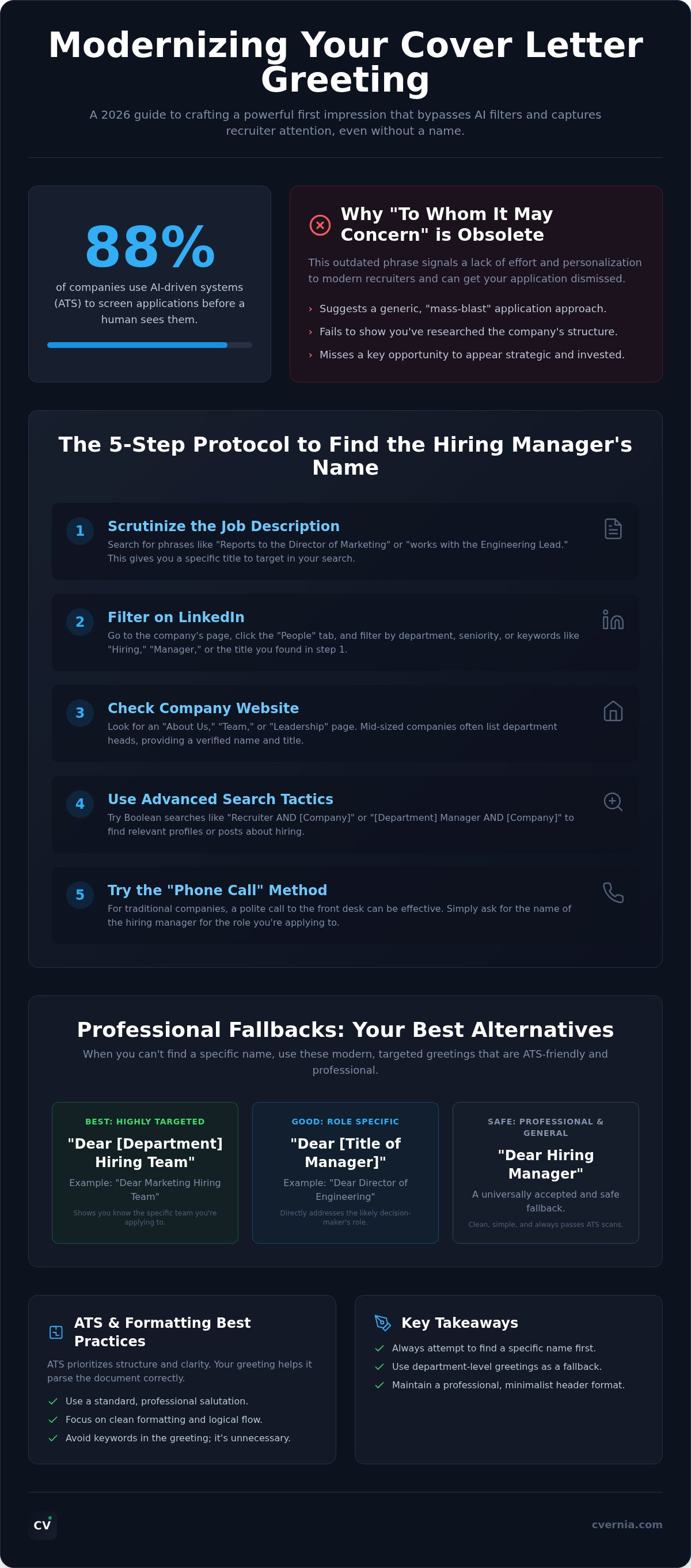
Did you know that 88% of companies now use AI-driven systems to screen your application before a human even sees it? It's natural to feel anxious that a generic greeting like "To Whom It May Concern" will get your CV tossed into the digital bin. You want to sound personal and professional, but sometimes the hiring manager's name is simply nowhere to be found. Learning how to address a cover letter without a name shouldn't feel like a high-stakes guessing game that puts your career on the line. You deserve to feel confident that your application reflects your strategic advantage from the very first line.
This 2026 guide provides you with the most effective, modern alternatives to outdated salutations and a step-by-step protocol for uncovering the right contact. We'll explore safe, professional greetings that pass the ATS test and a proven method to find the name that actually works. By the end, you'll have a polished, modern application that aligns perfectly with what recruiters are looking for today. Let's turn that uncertainty into readiness and ensure your cover letter stands out for all the right reasons.
Key Takeaways
- Master a systematic research protocol using LinkedIn and job descriptions to find the specific individual behind the job post.
- Identify the most effective modern fallbacks that replace "To Whom It May Concern" with targeted, department-level greetings.
- Learn how to address a cover letter without a name while maintaining high ATS compatibility and a professional, personalized feel.
- Apply modern minimalist formatting rules to your header to ensure your application looks organized and sophisticated to hiring teams.
- Optimize your search strategy by tracking different greeting versions through a centralized application management dashboard.
The Impact of Your Cover Letter Greeting in 2026
Your salutation serves as your digital first impression. It's the very first beat of your professional narrative. While addressing a specific person remains the gold standard for personalization, 2026 hiring portals often obscure names to maintain privacy or prevent direct outreach. This makes knowing how to address a cover letter without a name a critical skill for the modern job seeker. Recruiters typically decide your fate in about six seconds during an initial review. A sharp, professional greeting ensures those seconds work in your favor. Understanding What is a Cover Letter? means viewing it as a tool for strategic alignment, and that alignment starts at the very top of the page.
We understand the stress of searching for a name that isn't there. It's a common hurdle in the digital age. However, don't let that uncertainty stall your application progress. A well-chosen fallback shows you've considered the department's needs even without a direct contact. It demonstrates a level of preparedness that sets you apart from candidates who rely on outdated templates. You're not just sending a document; you're initiating a professional conversation.
Why "To Whom It May Concern" is Dead
Recruiters today view "To Whom It May Concern" as a clear signal of low effort. It suggests a "mass-blast" approach where you haven't taken the time to research the company culture or its internal structure. This phrase feels like a relic from a different era. It fails to acknowledge the specific, agile nature of modern departments. When you use it, you miss a vital opportunity to show you're a strategic thinker who understands the role. Modern hiring demands individualization, and a generic template is the fastest way to look like just another number in the pile.
The Role of ATS in Greeting Recognition
Modern applicant tracking systems are sophisticated, but they still rely on clear document architecture to function. These bots scan your header to identify where your contact information ends and your actual letter begins. Using a standard, professional greeting helps the software parse your application accurately and prevents data errors in the recruiter's dashboard. Don't fall for the myth that you need "keywords" in your salutation to please the bot. The ATS cares about formatting, readability, and logical flow. Focus on clean, professional structures to ensure your message reaches human eyes without technical hitches.
The 2026 Research Protocol: How to Find the "Hidden" Name
Finding a specific name requires a tactical mindset. Don't settle for a generic salutation until you've exhausted a systematic search. If you're wondering how to address a cover letter without a name, remember that even a 10-minute deep dive can reveal the decision-maker. This effort signals to recruiters that you're resourceful and genuinely invested in the role. A targeted greeting transforms your application from a standard submission into a direct professional outreach.
Follow this five-step protocol to uncover the right contact:
- Scrutinize the job description: Look for "Reports to" keywords. Phrases like "reporting to the Director of Marketing" give you a specific title to search for.
- Filter LinkedIn's "People" tab: Navigate to the company page and filter employees by department and seniority. Look for titles like "Department Head" or "Team Lead."
- Check "Leadership" pages: Mid-sized firms often list departmental heads on their official website. This is a reliable source for verified names.
- Cross-reference roles: Utilize a tailored cover letter generator to identify common hiring titles within your specific industry.
- The "Phone Call" method: Call the front desk if the company is traditional. Ask, "I'm applying for the Analyst role and want to address my letter correctly. Could you share the hiring manager's name?"
Manage your found contacts and application versions effortlessly using a centralized application tracking dashboard.
Advanced LinkedIn Search Tactics
Use Boolean search strings to narrow your results quickly. Try searching for "Recruiter AND [Company Name]" or "[Department] Manager AND [Company Name]" in the main search bar. Often, managers post "We are hiring" status updates that don't appear in standard job listings. For non-profit or academic roles, identify the Search Committee chair through public meeting minutes or faculty directories. These specific details show you've gone beyond the surface level of the application.
Using AI and Digital Tools for Research
Prompt AI tools with the job description to predict the likely reporting structure. This helps you narrow your search to specific job titles. When selecting professional cover letter greetings, playing it safe is better than guessing wrong. If you find a name but aren't 100% sure of the individual's role, shift to a departmental greeting. To maintain your professional boundaries, follow the Safe Research Limit: stop searching once you move beyond professional platforms into personal social media profiles.
Professional Fallbacks: Best Greetings When the Name Stays Hidden
Sometimes your research hits a dead end. Even with the best tools, a hiring manager's name might remain a mystery. When this happens, don't panic. Knowing how to address a cover letter without a name is about choosing the most targeted alternative possible. A specific fallback shows you understand the company's internal structure even if you haven't met the individual behind it. Your goal is to remain professional while signaling that your application is a tailored effort, not a generic template sent to dozens of firms.
The gold standard for a nameless greeting in 2026 is "Dear [Department] Hiring Manager." For example, "Dear Marketing Hiring Manager" is far more effective than a simple "Dear Hiring Manager." It immediately tells the reader that you know exactly where this role sits within the organization. If the position is high-level or academic, "Dear [Role] Search Committee" is an excellent choice. This acknowledges that the hiring process is a collaborative effort rather than a single person's decision. It shows respect for the collective expertise of the team you're hoping to join.
Avoid these outdated greetings at all costs to protect your professional reputation:
- To Whom It May Concern: This signals a lack of effort and often feels like a mass-blast application.
- Dear Sir or Madam: This is overly formal, stiff, and risks alienating non-binary professionals.
- Gentlemen: This is presumptive and has no place in a modern, inclusive workforce.
- Dear [Name] (Misspelled): A misspelled name is significantly worse than using a professional fallback.
The "Role-Specific" Greeting Strategy
Match your greeting to the company's specific culture. A fast-growing startup might prefer "Dear [Department] Team" because it reflects their collaborative environment. In contrast, a legacy corporate firm usually responds better to "Dear [Job Title] Hiring Manager." If the job description mentions a specific challenge, such as "expanding our regional sales," you can even lean into that. Using "Dear Sales Growth Team" shows you've read the job description carefully and are ready to contribute to their specific goals from day one.
Comparison Table: Nameless Greetings Ranked
Use this table to select the most appropriate greeting based on your specific application context. It's better to be slightly more formal than too casual when you're unsure of the team's vibe.
| Greeting | Professionalism Score | Best Use Case |
|---|---|---|
| Dear [Job Title] Hiring Manager | 10/10 | High-stakes corporate or technical roles. |
| Dear [Department] Hiring Team | 9/10 | Collaborative or startup environments. |
| Dear [Role] Search Committee | 9/10 | Academic, executive, or non-profit roles. |
| Dear Hiring Manager | 7/10 | General applications when the department is unclear. |
Choosing a gender-neutral option isn't just about being polite; it's a strategic necessity. Gendered greetings are a major risk in modern hiring because they can appear out of touch with current workplace standards. Stick to role-based titles to ensure your application remains inclusive and professional.
Formatting and Placement: Structuring Your Nameless Header
Visual hierarchy tells a story before the recruiter reads a single word. In 2026, digital documents prioritize clean, vertical flow. When you're figuring out how to address a cover letter without a name, the physical layout of your header compensates for the missing personal touch by projecting high-level organization. This structure ensures your document remains easy to scan for both human eyes and automated systems. Consistency is your goal. Your cover letter header should mirror your ats compliant resume to create a unified personal brand that looks intentional and prepared.
The Contact Information Block
Modern headers are minimalist and functional. If you're applying for a remote role, don't include your full street address; your City and State are sufficient for tax and time-zone considerations. When the recipient's name is unknown, address the "To" section to the specific department and company name instead of leaving it blank. This provides the document with a professional anchor. Include the current date and the specific Job ID number listed in the posting to help recruiters file your application correctly. A clear subject line acts as a functional bridge that directs the reader’s attention immediately to your intent. Use a format like "RE: Application for Senior Developer (Job ID: #12345)" to provide instant context.
- Your Info: Name, Phone, Email, LinkedIn, City/State.
- The Date: Written in full (e.g., August 12, 2026).
- Recipient Block: [Department Name], [Company Name], [Company City/State].
- Subject Line: Bolded reference to the specific role and ID.
The Salutation and First Paragraph Transition
The transition from your greeting to your opening statement must be seamless. Use your chosen fallback greeting, then move directly into a hook that addresses a company pain point or a major achievement. This approach maintains a confident tone that isn't dependent on knowing exactly who is reading. You don't need a name to sound authoritative; you just need to show you understand the mission. Proper vertical rhythm is essential for digital readability. The Perfect Spacing Rule for 2026 digital documents requires exactly one blank line between your contact block, the date, the recipient's department block, and your salutation. This white space prevents the document from looking cluttered and keeps the reader focused on your qualifications.
Ensure your formatting remains consistent across every version of your application by using an application tracking dashboard to manage your documents effectively.
Scaling Your Success with CVernia’s Application Management
Applying for jobs in 2026 is a high-volume activity that requires surgical precision. Managing dozens of applications can quickly become overwhelming, especially when you're trying to maintain a personal touch. Even if you've mastered how to address a cover letter without a name, keeping track of which greeting you used for which company is a logistical challenge. CVernia's platform acts as your strategic ally, allowing you to monitor which salutations and document versions generate the highest response rates across different industries. Centralizing your workflow reduces the inherent anxiety of the job search by moving you from a state of chaos to one of organized readiness.
One of the most powerful features is Smart Reapplication Detection. Imagine you apply to a firm today with a nameless greeting, but you discover the hiring manager's name a week later through a new LinkedIn update. The platform identifies your previous submission and helps you optimize a fresh, personalized version if you decide to re-engage for a different role at the same company. It ensures your history with a brand remains a strategic advantage rather than a repetitive mistake. You can manage 50 or more tailored versions of your application without ever sacrificing the quality that gets you noticed.
Automating the Tailoring Process
Use CVernia to generate role-specific greetings instantly. This saves hours of manual work while maintaining a high standard of professional personalization. The technology ensures your truthful representation remains consistent across every version of your CV and cover letter. It doesn't just look at the greeting; the platform analyzes your document's overall compatibility with the job description. This ensures you aren't just passing the initial screening but are actually aligning with the team's core needs and culture. You get the benefit of speed without the risk of looking like a generic applicant.
Your Dashboard: The Nerve Center of Your Career
Think of your dashboard as the command center for your entire professional journey. Store interview notes, track various attachment versions, and manage your application timeline in one intuitive space. When you're ready to level up your skills, the Career Academy provides learning resources to help you master the hidden rules of modern hiring. This isn't just about filing documents; it's about building a database of your own professional success. Organize your application journey today with CVernia and transform how you approach your next career move.
Secure Your Strategic Advantage in the 2026 Job Market
You now have the tools to transform a common application hurdle into a professional opportunity. By mastering the research protocol and utilizing role-specific fallbacks, you ensure your application resonates with hiring teams even when a direct contact remains hidden. Learning how to address a cover letter without a name is simply the first step in a broader strategy of alignment and precision. Your digital presentation, from header spacing to ATS compatibility, signals your readiness for high-level roles in a competitive landscape.
Efficiency is key to maintaining this level of quality across multiple submissions. You don't have to manage the stress of version control or research alone. Master your application journey with CVernia’s tracking tools to leverage smart reapplication detection and a centralized application dashboard. Our ATS compatibility analysis ensures your documents are optimized for modern hiring bots while you focus on making a genuine human connection. Stay persistent and trust your preparation. You're no longer just applying; you're strategically positioning yourself for the success you've earned.
Frequently Asked Questions
Is "Dear Hiring Manager" still acceptable in 2026?
Stick with "Dear Hiring Manager" as a solid, professional choice for your 2026 applications. It's far superior to outdated phrases because it identifies a specific functional role within the company. While a name is always better, this fallback is universally understood by recruiters and won't penalize your application. Increase your impact by adding the department name, such as "Dear Marketing Hiring Manager," to show a deeper level of role-specific targeting.
Can I address a cover letter to "Dear [Company Name] Team"?
Address your letter to "Dear [Company Name] Team" when applying to modern, collaborative workplaces. Startups and tech firms often value a team-oriented mindset, so this greeting signals that you've researched their specific culture. It feels less stiff than traditional salutations and fits well with a conversational yet professional tone. Ensure the company name is spelled perfectly to maintain your credibility throughout the initial screening and review process.
What happens if I address my cover letter to the wrong person?
Don't worry excessively if you address your letter to the wrong person. Recruiters generally appreciate the research effort even if you didn't identify the exact decision-maker. If the individual is in a relevant department, they'll likely just pass it to the correct colleague. However, if you're unsure, it's often safer to use a department-level greeting. Focus on maintaining a high standard of professional formatting to keep the reader focused on your qualifications.
Should I use "Dear Sir or Madam" if the company is very traditional?
Avoid "Dear Sir or Madam" regardless of how traditional a company seems. This greeting is widely considered archaic and fails to acknowledge the diverse, inclusive nature of the modern workforce. It risks alienating the reader before they even reach your first paragraph. Instead, use "Dear Hiring Manager" or "Dear [Department] Lead." These options maintain a formal tone without sounding out of touch with current 2026 professional standards or corporate expectations.
Is it okay to start a cover letter without any greeting at all?
Never skip the greeting entirely because it makes your application look incomplete or rushed. A professional salutation is a mandatory element of business correspondence that establishes the tone for the rest of your document. Without it, your letter feels like a random block of text rather than a targeted pitch. If you are struggling with how to address a cover letter without a name, choose a role-based fallback to ensure your document looks polished.
How do I find the name of a hiring manager for a blind job posting?
Look for clues in the job description to find a name for a blind job posting. Search LinkedIn for the company's internal recruiters or department heads who have posted about hiring. If the company name is completely hidden, you can't find a specific individual. In these rare cases, use a greeting like "Dear Hiring Team" or "Dear Search Committee." This maintains your professional standards while acknowledging the necessary anonymity of the posting itself.
Does a nameless greeting affect my ATS score?
Trust that a nameless greeting won't lower your ATS score as long as the document structure is clear. These systems prioritize readability and standard formatting over specific salutation text. Knowing how to address a cover letter without a name involves using a recognizable header that the bot can easily parse. Focus on clean vertical spacing and professional fonts to ensure the software identifies your contact information and the start of your letter correctly.
Should I use a gender-neutral greeting like "Dear [Name]" if I only have a last name?
Use the full name if you only have a last name and are unsure of the person's prefix. Writing "Dear [First Name] [Last Name]" is the safest and most professional approach in 2026. If you absolutely cannot find the first name, use a role-based title like "Dear Hiring Manager [Last Name]." This avoids the risk of using an incorrect gendered prefix, which can create an immediate negative impression on the hiring team.


