

What if your meticulously organized spreadsheet is actually the very thing holding back your next big career move? You've likely spent countless hours color-coding cells and manually copying job links; yet, you still feel the weight of data entry fatigue and the constant fear of missing a critical follow-up deadline. It's a common struggle for dedicated professionals, but moving from Google Sheets to a job application system transforms your search from a manual chore into a high-performance strategy. You need a tool that acts as a trusted companion, not just a static list.
In this guide, you'll learn how to transition to a professional management platform that automates your tracking and optimizes your materials for modern recruitment technology. We'll explore how to build a centralized dashboard that provides automatic ATS compatibility scores and smart version management for every CV you send. This transition ensures you stay organized, remain prepared for 2026 hiring standards, and ultimately achieve higher interview conversion rates. It's time to stop managing rows and start managing your success.
Key Takeaways
- Understand why moving from Google Sheets to a job application system is the only way to escape the "illusion of organization" and manual data entry fatigue.
- Identify the critical features spreadsheets lack, such as automated ATS compatibility scores and smart version management for your tailored CVs.
- Evaluate the time-saving benefits of an automated dashboard compared to the high risk of data loss and manual tracking errors in static sheets.
- Master a simple migration strategy to audit your current records and consolidate your documents into a single, high-performance directory.
- Discover how a centralized career management platform serves as a trusted companion that aligns your professional experience with recruiter expectations.
The Spreadsheet Ceiling: Why Google Sheets Fails Job Seekers in 2026
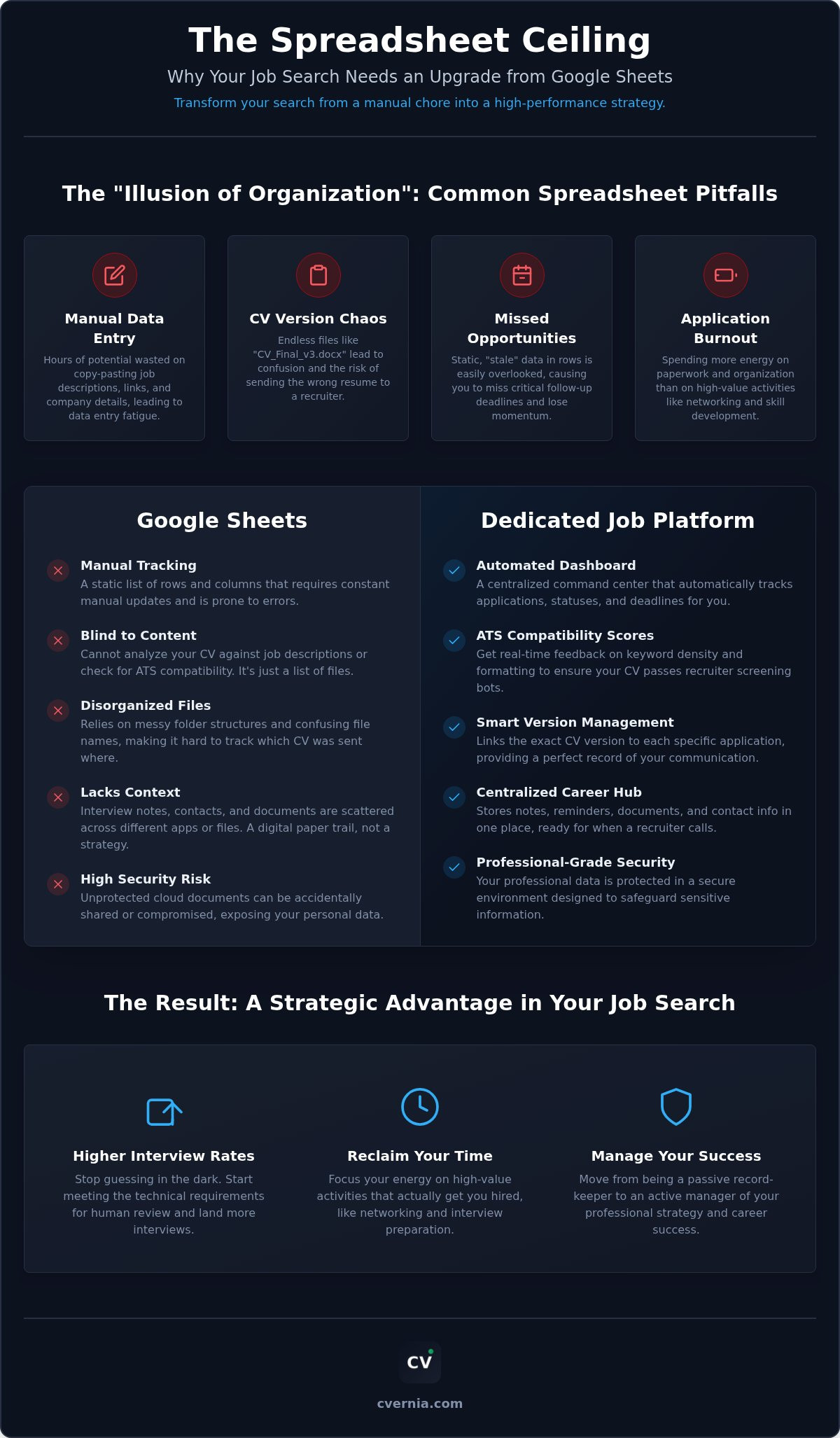
A spreadsheet often feels like a safe harbor when you first start your job search. You create columns for company names, roles, and dates, believing you've built a robust command center. However, this is usually an "illusion of organization." A spreadsheet is a static archive; it records the past but doesn't drive your future. In 2026, moving from Google Sheets to a job application system is about upgrading to a specialized CRM for your career. While a sheet stores data, a dedicated platform manages relationships and optimizes your professional strategy.
Identify the point where your search becomes too complex for manual rows. As your efforts grow to ten, twenty, or fifty applications, manual tracking becomes a liability. You hit the "spreadsheet ceiling" when you can no longer remember which version of your CV you sent to which recruiter. This friction leads to application burnout. You spend more energy on data entry than on the high-value activities that actually land jobs, like networking or skill development. The transition of moving from Google Sheets to a job application system alleviates this mental load, allowing you to focus on your performance rather than your paperwork.
The Problem with Manual Data Entry
Think about the minutes you spend copy-pasting job descriptions and URLs. Over a month, these fragments of time add up to hours of wasted potential. Static sheets also suffer from "stale data." If a hiring manager updates a status or a deadline shifts, your spreadsheet remains frozen in time. Unlike system alerts that prompt you to take action, a row in a sheet is easily ignored. You might miss a follow-up window simply because your eye skipped over a specific cell during a busy morning. It's about reclaiming your time to focus on what matters.
The Missing Context in Spreadsheets
Spreadsheets are fundamentally "blind" to the content of your documents. They cannot analyze your CV to tell you if it aligns with the job description. Most employers today use an Applicant Tracking System (ATS) to filter candidates. If you don't have a tool that mimics this logic, you're guessing in the dark. A list of URLs isn't a strategy; it's a digital paper trail. Dedicated systems allow you to store interview notes and attachments contextually. This ensures that every piece of information is exactly where you need it when the recruiter calls, turning a list of entries into a strategic career management plan.
Beyond the Rows: Critical Features Spreadsheets Can’t Offer
A spreadsheet is a list. A job application system is a strategic engine. While Google Sheets might help you remember a company name, it cannot tell you if your experience actually aligns with their specific needs. When moving from Google Sheets to a job application system, you gain access to technical tools that evaluate your documents against recruiter expectations in real time. This isn't just about record-keeping; it's about gaining a competitive advantage in a crowded market.
The shift from manual tracking to an automated platform also addresses a hidden risk: data security. Dedicated platforms offer a much safer environment for protecting your personal information compared to an unprotected cloud document that might be accidentally shared or compromised. It's about professional-grade safety for your professional-grade data.
ATS Compatibility and Tailoring
Your spreadsheet is blind to the algorithms that govern modern hiring. It cannot predict if your CV will successfully pass through a Greenhouse or Workday ATS. By using a system that integrates an ats resume checker, you receive immediate feedback on keyword density and formatting. This allows for truthful tailoring that highlights your genuine skills without the guesswork. You stop hoping you'll be seen and start knowing you've met the technical requirements for a human review.
Smart Reapplication and Version Control
Managing multiple CV versions in a standard folder often leads to file name chaos. You've likely seen documents named "CV_Final_v3_Marketing_Role" and wondered if that was the one you actually sent. A dedicated system eliminates this by linking specific document versions directly to each job entry. This ensures you always know exactly which narrative you presented to a specific hiring manager.
Smart reapplication detection is another vital feature for the 2026 job market. Large organizations often have strict cooling-off periods for candidates. A spreadsheet won't warn you if you applied to a subsidiary three months ago, but a professional system will. You can also attach interview notes directly to these records. This creates a feedback loop that improves your next application. If you're ready to move beyond manual rows, exploring a centralized platform can provide the strategic edge your career deserves.
Finally, consider the value-add of an integrated Career Academy. A spreadsheet is a silent tool. It doesn't offer resources to refine your interview technique or help you understand new hiring regulations. A modern application system acts as a digital mentor, providing the learning resources you need to stay ahead of the curve while your tracking remains automated.
Google Sheets vs. Dedicated Platform: A Comparative Analysis
Choosing between a free spreadsheet and a specialized platform often comes down to how you value your time. While Google Sheets costs nothing upfront, the hidden tax of manual tracking is high. moving from Google Sheets to a job application system represents a pivot from generic productivity to career-specific optimization. It's the difference between simply recording history and actively engineering your future. You deserve a tool that works as hard as you do.
Feature-by-Feature Comparison
In a spreadsheet, you're the engine. You manually enter every status change, copy every job description, and hope your formulas don't break. In a dedicated system, the platform does the heavy lifting. Instead of jumping between file folders and calendar apps, a dedicated job interview tracker keeps your notes, dates, and attachments in one place. This integration ensures you never walk into an interview unprepared. Data from June 2026 shows that firms using automation report 36% more placements; this suggests that automated systems significantly reduce the time required to reach a successful hire.
Data integrity is another critical differentiator. Shared or local sheets are prone to accidental deletion or "version drift" where you lose track of the most recent updates. One wrong keystroke can wipe out weeks of follow-up history. A professional platform uses secure, cloud-based architecture to protect your records. This reliability allows you to focus on your performance rather than troubleshooting a broken cell or a missing row.
The ROI of a Career Management Platform
Evaluate the subscription cost against the value of your potential salary. Landing a new role just two weeks faster pays for a professional management platform many times over. Beyond the financial gain, consider the psychological return on investment. Centralized management reduces the "application anxiety" that comes from fragmented tracking. You'll feel more in control when every CV version and interview note is accessible with a single click.
Professional tools also signal a professional mindset. When you manage your search with precision, that organization carries over into how you present yourself to recruiters. You aren't just a candidate hoping for a chance. You're a high-value professional who approaches their career with a strategic, data-driven plan. This confidence is often the "Success Gap" that separates those who get ghosted from those who get the offer.
How to Migrate Your Job Search Data Without Losing Momentum
Transitioning your career data shouldn't feel like a chore. It's an opportunity to refine your strategy and clear out the digital clutter that slows you down. If you've been relying on a manual spreadsheet, you likely have a mix of active leads and dead ends. moving from Google Sheets to a job application system is most effective when you start with a clean slate. Follow these steps to ensure your migration is seamless and your momentum remains high.
Start by auditing your current spreadsheet. Identify applications that are no longer active to avoid cluttering your new dashboard. Next, consolidate all CV versions and cover letters into a single, organized directory. Once your files are ready, import your data into a professional job search management system. This centralizes your history and prepares you for active monitoring. Finally, configure your dashboard to track upcoming deadlines and follow-up windows automatically.
Auditing and Cleaning Your Data
Don't just copy and paste every row. Use this transition to check for truthful representation in your records. Ensure all past experience dates and job titles are accurate before they enter your new system. This is also the perfect time to organize your interview notes. If you have feedback or observations buried in spreadsheet cells, move them into a format that a professional tracker can categorize. This ensures that the lessons you've learned from past interviews stay accessible for future opportunities.
Setting Up Your New Workflow
A professional system works differently than a static sheet. You'll want to configure alerts for follow-ups and upcoming interview dates immediately. Use the "Smart Reapplication" feature to audit your past efforts; it helps you identify patterns in companies where you've applied before. This insight allows you to adjust your approach for the next attempt.
Connect your tracking dashboard to a tailored cover letter generator to speed up your submission process. Instead of starting from scratch, the system uses your stored data to create aligned documents in seconds. This integration ensures that your search remains fast-paced and highly targeted. If you're ready to stop managing cells and start managing your career, sign up for CVernia today and experience a more intelligent way to track your progress.
Elevating Your Strategy with CVernia’s Application Management
CVernia stands as the comprehensive alternative to the fragmented, manual methods of the past. While spreadsheets record where you've been, our platform focuses on where you're going. By moving from Google Sheets to a job application system, you replace static rows with a dynamic "Smart Dashboard" designed to be the nerve center of your career transition. We provide the professional confidence you need to manage complex applications with ease, ensuring you always feel prepared and empowered.
Our commitment to your success is built on a foundation of truth and precision. We don't believe in fake qualifications or "gaming" the system with dishonest tactics. Instead, we help you present your genuine experience in the best possible light. You'll find that our tools optimize your content for clarity and alignment without ever compromising your professional integrity. It's about being the best version of yourself, not a fabricated one.
A Centralized Nerve Center for Your Career
Manage your interview notes, attachments, and CV versions in one secure cloud location. This centralization eliminates the stress of searching through local folders or buried email threads. As you progress in your professional journey, the platform grows with you. Whether you're an entry-level applicant or a seasoned executive, our infrastructure scales to meet your needs. Use our smart reapplication detection to audit your history and refine your ats compliant resume for every new opportunity. This level of organization ensures that you maintain a strategic advantage throughout the hiring process.
Empowerment Through the Career Academy
Tracking applications is only half the battle; mastering the strategy behind the search is the other. Our integrated Career Academy provides the learning resources that spreadsheets simply can't offer. Access practical, expert guidance on sensitive topics such as explaining "reasons for leaving" or effectively showcasing "financial skills" in non-finance roles. We act as your digital mentor, providing the hidden rules of the modern hiring landscape so you can navigate interviews with authority. This continuous professional growth turns a stressful job hunt into a period of self-assurance and readiness. Don't let your potential stay trapped in a grid of cells. Upgrade your job search from a spreadsheet to CVernia today and experience the difference of a truly professional management system.
Take Control of Your Career Journey Today
Your career is too valuable to be managed by a static list of rows and columns. We've explored how spreadsheets create a ceiling for your progress, hiding the critical insights you need to land your next role. By moving from Google Sheets to a job application system, you transform your search from a manual chore into a strategic operation. You gain the clarity of a centralized dashboard and the confidence of knowing every document is optimized for modern hiring standards.
Professional success in 2026 requires professional tools. CVernia acts as your trusted companion, offering an ATS Compatibility Checker, Smart Reapplication Detection, and our Truthful Tailoring Guarantee. These features ensure your applications are accurate, visible, and highly effective. It's time to stop fighting with broken formulas and start focusing on your future. Start managing your career strategically with CVernia today. You've done the hard work of building your skills; now let us help you showcase them to the world. Your next big opportunity is waiting, and you're ready to meet it with self-assurance.
Frequently Asked Questions
How do I move my job applications from Excel to a management system?
Audit your current data first. Export your spreadsheet as a CSV file and use the import tool in your new platform to map your existing columns. moving from Google Sheets to a job application system becomes seamless when you clean your data before the transfer. This ensures your history remains intact while you gain access to automated tracking. It's the most efficient way to upgrade your search without losing your previous progress.
Is it worth paying for a job application tracker in 2026?
Yes, it's a strategic investment in your future. Landing a role just two weeks faster covers the cost of a professional tracker many times over. In the 2026 hiring landscape, manual sheets can't keep up with the speed of recruitment. A dedicated system provides the alerts and insights you need to stay ahead. It's about moving from a reactive search to a proactive, data-driven career strategy that gets results.
Can a job application system help me beat the ATS?
Yes, by providing real-time feedback on your document's alignment. A professional system analyzes your CV against job descriptions to identify missing keywords and formatting issues. This process ensures your application is readable by the software recruiters use. moving from Google Sheets to a job application system gives you the technical edge needed to ensure your materials reach a human. You'll stop guessing about your compatibility and start submitting with total confidence.
How many CV versions should I keep in my management system?
Keep one master document and specific tailored versions for every role you pursue. Most professionals manage three to five core versions for different industries or job titles. A dedicated system links these files directly to your application entries. This eliminates the file-naming chaos found in standard folders. You can easily track which version was most successful, allowing you to refine your approach and maintain a high level of professional organization.
Does CVernia automatically apply to jobs for me?
No, CVernia is designed for management and optimization rather than autonomous submissions. We provide the tools for tailored CV creation and application tracking, but you remain the final decision-maker. This approach ensures your applications are always truthful and intentional. Automated applications often lead to poor matches and privacy risks. By keeping you in control, we ensure that every job you pursue is a strategic fit for your long-term career goals.
How do I track interview feedback effectively?
Use integrated interview notes to document your experience immediately after each session. Record the names of your interviewers, the questions they asked, and your own reflections on your performance. A professional system stores these notes alongside the specific CV version you used. This creates a complete history of your interaction with the company. You'll enter subsequent rounds with a clear memory of previous conversations, which builds rapport and demonstrates your professionalism.
What is smart reapplication detection?
Smart reapplication detection identifies when you've previously applied to a specific organization or its subsidiaries. This is critical because many companies have cooling-off periods for unsuccessful candidates. The system flags these past attempts to help you time your next move strategically. It prevents you from wasting energy on applications that are likely to be filtered out due to timing. You'll navigate the hiring landscape with a clear, data-driven view of your history.


