
What if the reason your job search feels like a second full-time job isn't the work itself, but the outdated tools you're using to manage it? It's incredibly draining to juggle dozens of open tabs while wondering if you've already applied to a role or if you missed a critical follow-up window. With the average job seeker now submitting between 20 and 50 applications before receiving an offer, relying on messy spreadsheets is a recipe for burnout. You aren't alone in feeling overwhelmed by the sheer volume of data required to land a modern role in 2026.
You deserve a strategic advantage that turns this chaos into absolute clarity. This guide reveals how the right software to keep track of job applications can transform your search from a stressful guessing game into a precision-engineered career move. By moving beyond basic lists, you'll gain a centralized dashboard that manages every stage of your journey with professional accuracy. We'll explore the latest platforms designed to organize your interview notes, track your attachments, and ensure your CV is always optimized for ATS compatibility. Get ready to stop searching and start managing your path to a new role with total confidence.
Key Takeaways
- Move beyond the "static spreadsheet trap" by adopting dedicated tracking tools that keep pace with the rapid speed of modern hiring.
- Utilize high-performance software to keep track of job applications to automate organization and verify ATS compatibility before you submit.
- Implement a version management strategy that links specific CV iterations to individual roles for more effective interview preparation.
- Streamline your daily workflow by centralizing career data and using browser tools to capture job details with a single click.
- Discover how a Career Application Management Platform provides both organizational precision and the professional resources needed for long-term success.
Why Spreadsheets Fail: The Need for Dedicated Job Search Software
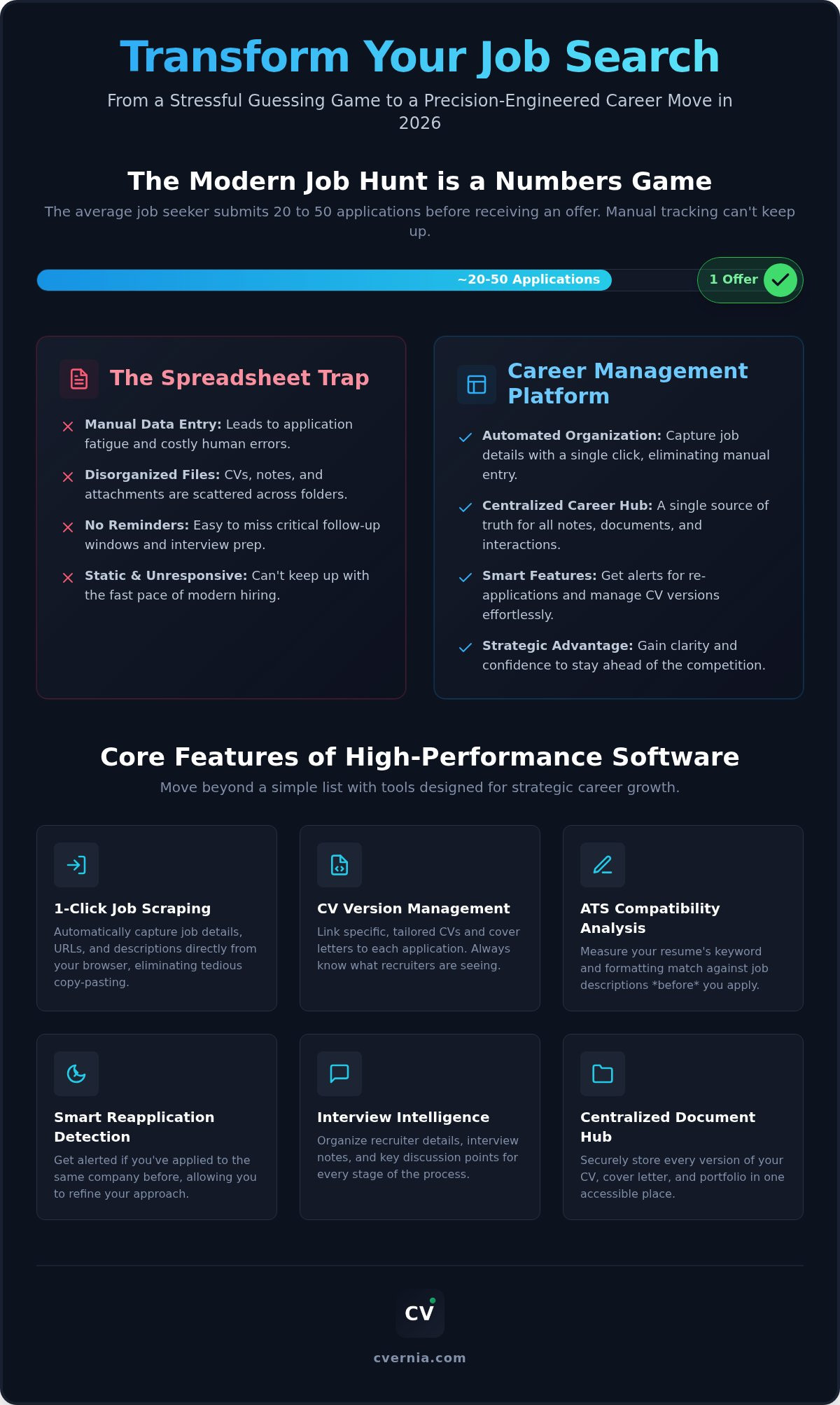
Many job seekers start their journey with a basic Excel file or a Google Sheet. It feels organized at first. However, as your search scales to 30 or 50 roles, that static grid becomes a massive burden. You're manually typing dates, copying URLs, and trying to remember which specific PDF you uploaded to which portal. This is the "static spreadsheet trap." It leads directly to application fatigue because you're spending more time on data entry than on actual career growth. You need a system that works for you, not the other way around.
Modern recruitment in 2026 moves at an incredible pace. Companies expect instant responses, and interview slots often fill up within hours of being posted. If your data is trapped in a non-responsive table, you're fighting with your tools instead of the competition. You need real-time access to your information. Transitioning to dedicated software to keep track of job applications ensures you never miss a beat. It turns a passive list into an active career management strategy that keeps you ahead of the curve.
The Limitations of Manual Tracking in a High-Volume Market
Manual tracking can't handle the dynamic nature of a modern search. Spreadsheets don't offer automated reminders or status updates. When you manage five different interview stages simultaneously, human error becomes a significant risk. You might mix up recruiter names or forget which version of your resume was tailored for a specific role. Basic office software also lacks centralized document storage. You end up with files scattered across folders, making it nearly impossible to find the exact attachment you used. This disorganization carries a hidden cost. It erodes your confidence and wastes precious time that should be spent on interview preparation.
Moving Toward Centralized Career Application Management
Upgrade your search by adopting a professional Career Hub. A dedicated management platform offers far more than a simple list of names and dates. It provides a single source of truth for your entire career journey. You can store every note, attachment, and interaction in one secure dashboard. Most employers today rely on an applicant tracking system (ATS) to filter and organize candidates. You deserve a tool that is just as sophisticated. Using specialized software to keep track of job applications allows you to align your efforts with how companies actually hire. It replaces the stress of disorganization with the clarity of a well-oiled machine. You move from a state of uncertainty to one of total readiness.
Core Features of High-Performance Application Tracking Software
High-performance tools do much more than store a list of company names. They function as a strategic engine for your career. Modern software to keep track of job applications eliminates the friction of manual entry by automatically scraping job details directly from your browser. This ensures your data is always accurate and up to date without the fatigue of repetitive typing. It allows you to focus your energy on high-value activities like networking and interview prep.
Beyond basic organization, look for smart reapplication detection. This feature alerts you if you've applied to the same employer in the past. It gives you the chance to analyze your previous approach and optimize your new strategy rather than repeating the same mistakes. You also need robust version control. Landing a role in 2026 requires hyper-tailored documents. Your platform should link every specific CV version and cover letter to its corresponding job entry. This level of precision ensures you always know exactly what a recruiter is looking at when they call.
The Role of ATS Compatibility and Analysis
Your tracking tool must bridge the gap between your unique skills and employer technology. Consulting a comprehensive ATS resume checker guide 2026 is essential for understanding how to navigate modern filtering systems. High-performance software measures your CV's compatibility against specific job descriptions in real time. It highlights keyword gaps and formatting issues before you submit. This process is not about gaming the system; it's about truthful representation. It ensures your genuine qualifications are actually visible to the human recruiters behind the software.
Interview Intelligence and Attachment Management
Tracking doesn't end once you hit the "submit" button. In fact, the most critical data is often generated during the interview phase. Using the best job interview tracker for 2026 allows you to build a strategic knowledge base for every company you engage with. You should document every question asked, every answer you provided, and the specific feedback received.
Linking attachments like portfolios, certifications, or presentation decks directly to a job entry provides a seamless workflow. You'll never scramble for a file minutes before a video call. This level of organization transforms your search from a chaotic scramble into a precise operation. Utilizing specialized software to keep track of job applications helps you maintain this focus. Explore how an integrated Application Tracking Dashboard can centralize these critical assets and give you a distinct advantage in a crowded market.
CV Version Management: The Missing Link in Your Job Search
The "one-size-fits-all" CV is a relic of the past. In 2026, recruiters expect hyper-relevance, and hiring managers can spot a generic resume in seconds. If you're applying for multiple roles, you're likely managing dozens of different versions of your professional story. Keeping track of which skills you highlighted for which company is a major challenge without professional help. This is where high-quality software to keep track of job applications becomes your secret weapon. It links specific documents to individual job entries, ensuring you're never caught off guard during a surprise screening call.
Imagine getting an interview invite and not knowing which portfolio or project list you shared with that specific team. It's a stressful situation that can undermine your confidence. Mapping CV versions to applications allows you to walk into every conversation fully prepared. You can also significantly reduce the friction of creating a tailored cover letter by using software that stores your previous successful phrasing. This level of precision ensures that your personal branding remains consistent and professional across every touchpoint.
Mastering Smart Reapplication Detection
Success in a competitive market is often iterative. Smart reapplication detection is a specialized tool that identifies when you're engaging with a previous employer or a similar role within a large corporation. It's not just about avoiding repetition; it's about strategic evolution. By reviewing what you submitted six months ago, you can identify why it might have failed and pivot your approach for the current opening. This feature within modern software to keep track of job applications turns past rejections into valuable data points. It provides the clarity needed to refine your alignment with the company's culture and requirements with every new attempt.
Organizing Tailored Documents for Quick Retrieval
A centralized dashboard acts as your professional command center. Instead of digging through cluttered folders or searching your email sent box, you can use job search management systems to retrieve any document in seconds. This organization maintains document integrity across various portals and platforms. You'll always know exactly which recruiter received which version of your credentials. Having this single source of truth eliminates the heavy mental load of document management. It allows you to focus on the human side of the hiring process while your technology handles the complex logistics of your career transition.
How to Set Up Your Job Search Tracking Workflow
Setting up a professional workflow is the difference between reacting to job boards and strategically managing your future. You need a system that minimizes administrative drag so you can focus on making connections. Choosing the right software to keep track of job applications is the first step toward reclaiming your time and sanity. A well-organized dashboard ensures that every resume version, interview note, and follow-up date is exactly where it needs to be when opportunity knocks. It transforms your search from a series of disjointed tasks into a streamlined, goal-oriented operation.
Initial Setup and Data Consolidation
Begin by importing your existing data. If you've been using a spreadsheet or keeping a list on LinkedIn, move that information into your centralized Career Hub immediately. This consolidation creates a single source of truth for your professional history. Organize your dashboard into logical stages like "Wishlist," "Applied," and "Interviewing." This visual clarity helps you identify where your search is stalling and where you're gaining momentum. Focus on creating a truthful, verified record of your experience that stays ready for any application at a moment's notice.
Daily Maintenance and Strategic Review
A high-performance search requires consistent maintenance rather than occasional bursts of effort. Spend just 15 minutes each day updating your application statuses and logging new interactions. This small habit prevents critical information from slipping through the cracks. Before you hit send on a new application, use your software to keep track of job applications to conduct an initial ATS analysis. This ensures your CV aligns with the specific job description before it ever reaches a recruiter. Analyzing these Compatibility Scores allows you to prioritize roles where you have the highest chance of success.
When you reach the interview stage, use your stored notes to prepare. Log every interaction, from the first recruiter email to the final offer letter. This creates a strategic knowledge base that helps you refine your pitch for future rounds. Reviewing your analytics at the end of each week will reveal which resume versions are generating the most interest. This data-driven approach moves you beyond guesswork and into a state of total readiness. Ready to build your own command center? Start your journey with a professional Career Application Management Platform and take control of your search today.
CVernia: Beyond Tracking to Career Empowerment
Choosing the right software to keep track of job applications is a major step toward organization, but CVernia takes this a step further. We don't just provide a dashboard; we offer a comprehensive ecosystem designed to empower your entire professional journey. While other tools focus solely on the mechanics of saving links, our platform acts as a digital mentor. It bridges the gap between managing data and building a career you can be proud of. This "Trusted Companion" approach ensures you feel supported, encouraged, and strategically prepared at every turn.
A successful search is built on truthful representation and personal branding. CVernia helps you curate a professional identity that is both authentic and optimized for the modern market. Our smart version management doesn't just serve your current search; it grows with you. As you progress, your stored notes, tailored CVs, and interview feedback become a valuable historical record of your growth. This long-term perspective allows you to approach every new opportunity with the confidence of someone who has a clear, documented path to success.
Integrating Learning with Application Management
Data alone doesn't land jobs; insight does. This is why we integrated our Career Academy directly into the tracking experience. The Academy provides the essential context that automated tools often lack. You'll find expert guidance on everything from navigating complex hiring cycles to mastering the art of the follow-up. This combination of technology and education facilitates a powerful transition. You stop being a passive job seeker and start acting as a proactive career manager. By understanding the "why" behind the tracking data, you gain a significant advantage over candidates who are simply going through the motions.
The CVernia Advantage: Clarity and Readiness
The emotional weight of a job search can be exhausting. CVernia is specifically designed to reduce this stress by providing absolute clarity. When your documents are organized and your strategy is clear, the uncertainty of the hiring process begins to fade. You become "interview ready" at a moment’s notice because all your intelligence is centralized and accessible. You'll never have to second-guess which version of your story you told a recruiter or scramble to find a specific portfolio piece. This readiness translates into a calmer, more confident presence during high-stakes conversations. It's time to move beyond messy systems and embrace a platform that invests in your future. Join CVernia to start tracking your success today and experience the difference of professional career management.
Elevate Your Career Strategy Today
Stop settling for the limitations of a spreadsheet and start treating your career search like the high stakes operation it is. You've learned that modern hiring in 2026 moves too fast for manual data entry and disjointed files. By adopting professional software to keep track of job applications, you transform every rejection into a valuable data point and every interview into a strategic advantage. You now have the blueprint to organize multiple CV versions and manage follow ups with total precision.
Embrace a system that works as hard as you do. CVernia provides the tools you need to stay ahead, from ATS Compatibility Analysis that ensures your CV is seen to Smart Reapplication Detection that refines your approach. With Centralized Interview Notes at your fingertips, you'll walk into every meeting with the confidence of a candidate who is fully prepared. It's time to move from uncertainty to total readiness.
Master your job search with CVernia’s Application Tracking Dashboard. Your next professional chapter is waiting for you. Take the first step toward a more organized, successful future today.
Frequently Asked Questions
Is it better to use a spreadsheet or dedicated software to track job applications?
Dedicated software is significantly more effective because it automates data entry and provides real-time updates. While spreadsheets are free, they often lead to manual fatigue and lack the integration needed for a high-volume search. Professional software to keep track of job applications offers browser extensions that save roles instantly. This allows you to focus on networking instead of typing company names into a grid. It transforms your search from a passive list into a dynamic career command center.
How does application tracking software help with ATS compatibility?
Tracking platforms integrate analysis tools that compare your CV against specific job descriptions before you apply. They identify keyword gaps and formatting issues that might cause a bot to reject your application. By using these insights, you can ensure your genuine skills are visible to human recruiters. This proactive approach increases your interview conversion rate by aligning your truthful representation with the technical requirements of modern hiring systems. It ensures you never miss an opportunity due to a technicality.
Can I track applications from multiple job boards in one place?
Yes, professional tracking tools allow you to centralize applications from LinkedIn, Indeed, and company portals into one dashboard. You can use browser extensions to clip job details from any site with a single click. This prevents your data from being scattered across different browser tabs or email threads. Having a single source of truth for every platform ensures you never lose track of a deadline or a recruiter's contact information. It creates a seamless workflow for your entire search.
What is smart reapplication detection and why do I need it?
Smart reapplication detection is a feature that alerts you if you've previously engaged with a specific employer. It's essential because it prevents repetitive mistakes and helps you refine your strategy for a second attempt. Instead of blindly submitting the same resume, you can review your previous notes and CV version. This strategic evolution shows the recruiter that you've grown as a professional since your last interaction with their team. It turns past rejections into a roadmap for future success.
How should I manage different versions of my CV for different jobs?
Manage your CV versions by linking each specific file directly to its corresponding job entry in your dashboard. This ensures that when a recruiter calls, you know exactly which skills you highlighted for that role. Using software to keep track of job applications handles this version control automatically. It eliminates the risk of using the wrong resume version during an interview and keeps your tailored cover letters organized for quick retrieval when you need them. This level of organization builds immense professional confidence.
Is my data safe when using a job application tracker?
Most reputable career platforms prioritize security by using encryption and adhering to modern data privacy regulations. As of January 2026, 20 U.S. states have comprehensive consumer privacy laws in effect, providing job seekers with better protection for their personal data. You should look for platforms that offer clear data deletion rights and transparent privacy policies. Keeping your professional documents in a secure, centralized dashboard is often safer than leaving them in unencrypted email attachments or shared cloud folders.
How much does professional job search management software typically cost?
Professional platforms typically follow a freemium model with various price points to suit different needs. Many offer robust free tiers for basic tracking, while premium plans range from $29 to $40 per month for advanced features. For example, some Pro plans are priced around $40 per month or $90 per quarter. You should choose a plan that aligns with your search intensity and provides the specific tools, like ATS analysis or AI-powered tailoring, that you need to stay competitive in a crowded market.
Does tracking software help with interview preparation?
Tracking software significantly improves interview preparation by storing your interaction history and specific notes in one place. You can review the exact job description, your tailored CV, and any previous recruiter feedback before your call. This centralized knowledge base helps you craft more relevant answers and demonstrates a high level of professional organization. Being able to access your interview notes instantly ensures you stay calm and ready for any question. It moves you from a state of uncertainty to total readiness.


