
Your resume summary might be a masterpiece of professional branding, but if a machine can't read it, no human ever will. It's a hard truth in the modern hiring landscape where algorithms act as the first gatekeeper. Learning how to write a resume summary for ats is no longer just a "nice-to-have" skill; it's the essential difference between an empty inbox and a scheduled interview. You've likely spent hours polishing every word, only to feel ignored by recruiters while wondering if a hidden formatting error is sabotaging your hard work. It's frustrating to feel like your career is being judged by a bot that doesn't understand your true value.
We're here to bridge that gap and turn you into a high-scoring candidate. This guide will help you master the technical and strategic adjustments needed to move your resume past the filters and into the hands of hiring managers. You'll gain a clear understanding of ATS logic and walk away with a repeatable system for tailoring your applications with precision. Let's remove the technical friction and start proving your strategic alignment so you can approach your next application with total confidence.
Key Takeaways
- Understand that your ATS score measures technical readability rather than your professional worth. Focus on removing parsing errors to ensure your data is extracted correctly.
- Eliminate formatting friction by using standard H1 and H2 tags and universally recognized fonts like Arial or Roboto. This simple adjustment prevents the bot from misreading your document hierarchy.
- Master how to write a resume summary for ats by strategically aligning hard and soft skills. Use the Frequency Rule to mention core competencies naturally without resorting to keyword stuffing.
- Implement a repeatable system for version management. Track which CV iterations perform best in your industry to refine your approach and avoid repeating failed strategies.
- Transition from a filtered applicant to a high-scoring candidate by using technical analysis tools. Instant compatibility feedback helps you make the strategic adjustments needed to reach hiring managers.
Decoding the 2026 ATS Score: Why Your Experience Isn’t Scanning
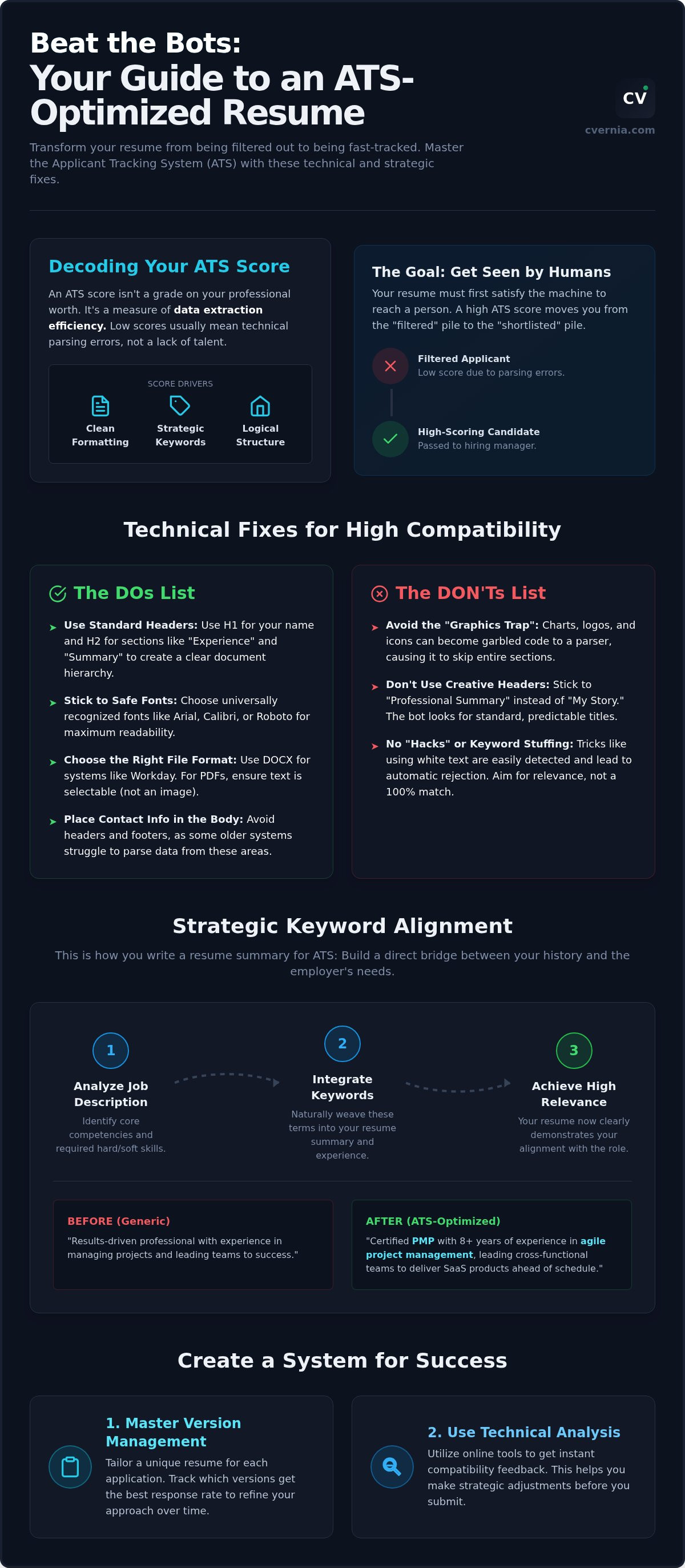
When you see a compatibility score on an application dashboard, don't take it personally. It isn't a grade on your professional worth. Instead, think of it as a measure of data extraction efficiency. Understanding What is an Applicant Tracking System? helps you realize that these bots are essentially digital librarians. If the software can't pull your job title or contact details into the correct database field, your score drops. Most low scores signal technical parsing errors rather than a deficiency in your talent. To succeed, you must focus on the three pillars of high scores: clean formatting, strategic keywords, and logical structure. Mastering how to write a resume summary for ats ensures your most important professional highlights actually get recorded by the machine.
Modern 2026 AI-driven parsers are more sophisticated than the rigid systems of the past. They use natural language processing to understand context, but they still rely on a clear map to categorize your value. If your document is a maze of text boxes and complex layouts, the extraction process fails. This technical friction is what keeps qualified people from getting interviews.
The Difference Between Ranking and Scoring
Systems calculate relevancy by comparing your resume overlap with a specific job description. This is why learning how to write a resume summary for ats involves building a direct bridge between your history and the employer's needs. Surprisingly, aiming for a 100% match isn't always the best strategy. Resumes that perfectly mirror every word of a job post often look like keyword stuffing to human recruiters. You want to be relevant, not robotic. The "Black Hole" myth usually stems from automated filtering thresholds. If your score falls below a specific percentage set by the recruiter, the system archives your application before a human eyes it.
Common Reasons for Score Drops
Technical friction is the primary killer of great applications. Some candidates try "white fonting" or hiding invisible characters to trick the system, but 2026 parsers easily flag these as manipulation attempts. Such "hacks" often result in an automatic rejection. Unrecognized section headers also cause significant issues. Using creative titles like "My Professional Story" instead of "Professional Summary" confuses standard parsing logic. The software simply doesn't know where to categorize that data. A parsing threshold is the minimum score required for the system to pass your resume to a human reviewer. Stick to standard conventions to ensure your data stays where it belongs.
Eliminating Formatting Friction: Technical Fixes for High Compatibility
Standardize your document hierarchy to ensure the bot reads your content in the correct order. Use H1 tags for your name and H2 tags for main sections like "Professional Summary" or "Experience." This clear structure is vital when learning how to write a resume summary for ats because it tells the system exactly where to look for your value. Stick to universally recognized fonts like Arial, Calibri, or Roboto. These typefaces are clean and easy for 2026 systems to scan without errors. Older, serif fonts can occasionally cause character recognition glitches, so modern sans-serif options are your safest bet for high compatibility.
Avoid the "Graphics Trap" at all costs. Charts, icons, and images might look impressive to humans, but they often turn into garbled code during the extraction process. If a bot encounters an image where it expects text, it might skip that entire section. Similarly, follow the Contact Info rule by keeping your email and phone number in the main body of the document. Many older systems still struggle to pull data from the header or footer area. For more expert resume optimization tips for ATS, focus on simplicity over decoration.
PDF vs. DOCX in 2026
Choosing the right file format depends on the system the company uses. Systems like Greenhouse handle structured PDFs well, but Workday often performs better with a standard DOCX file. To check if your PDF is safe, try to highlight and copy the text. If you can't select it, the bot can't read it. Avoid design-heavy graphic software for your master application file. While these templates look great, they often layer text in ways that create a parsing nightmare. You can use CV Compatibility & ATS Analysis to see exactly how a bot interprets your specific file format before you hit submit.
Structural Best Practices
Stick to the reverse-chronological format. It remains the king of ATS scores because it provides a logical timeline that machines understand. Multi-column layouts are a common mistake; they often cause the system to read across the page, mixing your dates with your job descriptions. This results in a nonsensical profile that recruiters will likely discard. Use standard section titles like "Work Experience" rather than creative ones like "Where I've Been." Understanding how to write a resume summary for ats is only half the battle; the rest of your document must follow the same structural discipline to ensure your data ends up in the right database fields.
Strategic Keyword Alignment Without Keyword Stuffing
Hard skills represent your technical toolkit. By contrast, soft skills like communication or leadership provide the human context that explains how you'll fit into a company's culture. When you're figuring out how to write a resume summary for ats, remember that bots prioritize your most relevant technical abilities first. Use the Frequency Rule to mention your core competencies at least two or three times throughout your document. This doesn't mean repeating a list; it means weaving those skills naturally into your summary and your bullet points. To find exactly which terms you're missing, it's helpful to understand how applicant tracking systems work so you can identify specific keyword gaps before you submit.
Truthful representation is your most important ethical boundary. Some outdated advice suggests "keyword stuffing" by copy-pasting the job description in white text, but 2026 systems flag this as a low-trust signal immediately. Always align your real experience with the employer's specific terminology instead of trying to trick the bot. According to MIT's guide to ATS-friendly resumes, balancing these keywords with human readability is essential. You want a document that high-scores in the initial scan but still impresses the hiring manager who eventually reads it. This strategic approach is a cornerstone of how to write a resume summary for ats that actually converts.
The Contextual Keyword Revolution
Modern AI-driven systems look for skills in context rather than just isolated lists. If you claim "Project Management" as a skill, the bot looks for nearby evidence like "budget oversight" or "team coordination" to verify your expertise. For management roles, use strong action verbs like "Architected," "Spearheaded," or "Orchestrated" to trigger higher relevancy scores. Always match acronyms with their full titles. Write "PMP (Project Management Professional)" to ensure the system catches the term regardless of how the recruiter programmed the search filter. This simple step ensures you don't lose points over a technicality.
Tailoring Your CV Efficiently
Don't rewrite your entire resume for every job. Use the 80/20 rule: keep 80% of your core achievements consistent and tailor the remaining 20% to mirror the specific job description. This usually involves adjusting your professional summary and the top few bullet points of your most recent role. You can reinforce this alignment by using a tailored cover letter generator to speak directly to the company's needs. Avoid over-optimization that makes your writing sound robotic. If a sentence feels awkward to read aloud, it will likely turn off a human recruiter even if it passes the bot.
Master Version Management: Improving Success Rates Through Iteration
Stop treating every application like an isolated event. To truly move the needle, you must track which CV version earns the highest response rate for specific industries. A summary that resonates in Fintech might fall flat in a creative agency. By iterating on how to write a resume summary for ats, you can refine your language based on real-world feedback. Analyze your historical application data to spot patterns in score improvements. Did adding a specific technical certification boost your callback rate? Use these insights to build a stronger profile for your next submission. It's about moving from guesswork to a repeatable system that gets results.
The Power of an Application Tracking Dashboard
Managing dozens of applications across various portals is a recipe for burnout. Organizing your attachments and interview notes in a centralized system ensures you never lose track of which version you sent to which recruiter. Check out this job search management system guide to scale your efforts efficiently. Monitoring your score status across different company portals allows you to see how different ATS configurations react to your formatting. Managing interview notes also helps you refine future CV versions. If a recruiter mentions a specific skill that wasn't on your resume, you can add it to your next iteration immediately. Use your Application Tracking Dashboard to keep your search organized and data-driven.
Smart Reapplication Strategies
Timing is everything when you want to try again. Refresh your CV before reapplying to a company that previously rejected you, especially if you've gained new skills or certifications. Smart Reapplication Detection helps you avoid repeating failed strategies by highlighting what didn't work last time. It ensures you aren't sending the exact same document that failed to pass the filters six months ago. Effective version management prevents duplicate candidate flags in an ATS; these flags can sometimes lead to automatic disqualification if the system thinks you're spamming. This level of reapplication detection saves significant time for high-volume seekers who need to stay organized. It's the most efficient way to refine how to write a resume summary for ats without starting from scratch every single time. You'll move forward with the confidence that each version is better than the last.
Transitioning from Applicant to Candidate with CVernia
You've mastered the mechanics of keywords and formatting. Now, it's time to put those principles into practice with a system that handles the technical heavy lifting for you. Leverage CVernia’s CV Compatibility & ATS Analysis for instant feedback on your document's performance before you hit the submit button. This tool doesn't just give you a generic score; it provides a specific roadmap for improvement. By understanding how to write a resume summary for ats through the lens of real-time analysis, you eliminate the guesswork that often leads to application fatigue and frustration. You'll move from a state of uncertainty to one of readiness.
Centralize your entire journey within our dashboard to reduce the inherent stress of a modern job search. When you have your versions, notes, and compatibility reports in one place, you gain a strategic advantage over candidates who are still using siloed documents. Commit to a Truth-First approach that builds long-term professional trust with your future employers. We believe that honest representation, backed by technical optimization, is the fastest way to get hired. This philosophy ensures that once you pass the bot, you have a solid foundation for the human interview process that follows.
Your Digital Career Mentor
CVernia acts as your digital mentor, bridging the gap between technical optimization and human storytelling. While the bot needs clean data to extract, the hiring manager needs a compelling narrative to stay interested. Our platform helps you balance both requirements seamlessly. If you are planning a professional pivot, our 2026 career change resume guide offers specific strategies for remapping your skills for a new industry. Beyond the resume, utilize the Career Academy to move beyond the bot and master your interviews with confidence. If you hit a roadblock, our Help Center is always available to help you navigate the nuances of the 2026 hiring landscape.
Ready to Score Higher?
Start your optimization process by uploading your first CV for a comprehensive analysis. The system scans your document using the same logic as modern recruitment software to identify hidden friction points in your layout. Interpreting the CVernia compatibility report is straightforward. Look for the sections highlighted for adjustment to see exactly where your formatting or keywords need a boost. Once you've refined how to write a resume summary for ats based on our feedback, you'll see your score climb. This improvement signals that your data is finally ready for human eyes. Start optimizing your ATS score with CVernia today and take the first step toward your next career milestone.
Take Command of Your Career Trajectory
You now possess the strategic blueprint to navigate the complex 2026 hiring landscape with total confidence. Success begins with removing technical friction through clean formatting and continues with precise keyword alignment. Mastering how to write a resume summary for ats ensures that your professional story remains intact as it passes through digital filters. Treat your application as a living document. Use logical iteration to refine your approach based on what truly resonates with recruiters in your specific field.
CVernia stands ready to handle the technical heavy lifting so you can focus on your professional growth. Our platform provides Smart Reapplication Detection and Truth-focused CV Tailoring to keep your search efficient and authentic. Track your progress and see which versions perform best using our Comprehensive Application Tracking Dashboard. Boost your ATS score and manage your job search with CVernia today. Your next great opportunity is closer than you think, and you're now fully prepared to claim it.
Frequently Asked Questions
What is a good ATS score to aim for in 2026?
Aim for a compatibility score of 80% or higher to ensure your application reaches a human recruiter. While a perfect 100% score might seem ideal, it often indicates over-optimization, which can appear robotic to hiring managers. Focus on achieving high technical readability and strategic keyword alignment. A score above 80% typically signals that the system has successfully extracted your core data and matched it with the primary requirements of the role.
Can an ATS read columns or tables in a PDF?
Most modern systems in 2026 still struggle to parse multi-column layouts and tables accurately. These elements often disrupt the logical reading order, causing the software to merge text from different sections into a garbled mess. To avoid this parsing nightmare, use a simple, single-column document hierarchy. This ensures that your professional summary and work history are extracted in the correct sequence, preventing technical glitches from lowering your overall compatibility score.
Does the file name of my resume affect my ATS score?
Your file name doesn't directly impact the numerical ATS score, but it significantly affects how easily a recruiter can find your document in their database. Use a professional and descriptive format like "FirstName-LastName-JobTitle-Resume.pdf" to ensure clarity. Avoid generic names like "Resume1.pdf" or "FinalVersion.docx." A clear file name demonstrates attention to detail and helps human reviewers identify your application quickly after it passes the initial automated screening phase.
Is it better to use a PDF or a Word document for ATS compatibility?
Both formats are generally acceptable, though a standard .docx file remains the safest choice for older systems like Workday. Modern platforms like Greenhouse handle structured PDFs well, provided they aren't created in design-heavy graphic software or complex layout tools that layer text improperly. If you choose PDF, ensure the text is selectable and searchable. When learning how to write a resume summary for ats, prioritize the file format that best preserves your document hierarchy and technical readability.
How do I know if a company is using an Applicant Tracking System?
You can identify an ATS by checking the application URL or the "Apply" portal's layout. If the web address includes names like Greenhouse, Lever, or Workday, you're definitely interacting with an automated system. Additionally, if the portal asks you to "Upload Resume" and then prompts you to verify auto-filled fields, an ATS is extracting your data. Most medium-to-large corporate employers use these systems to manage high volumes of candidates efficiently.
Will keyword stuffing in white text help me beat the ATS?
No, using white text for keyword stuffing is a high-risk strategy that modern 2026 parsers easily detect. AI-driven systems flag hidden text as a low-trust signal, which often leads to automatic rejection. Instead of trying to trick the bot, focus on truthful representation by aligning your real experience with the employer's terminology. This ethical approach builds long-term professional trust and ensures your resume remains readable for the human hiring managers who review it.
How often should I update my CV for the same job title?
You should tailor your CV for every single application, even if the job titles are identical. Different companies prioritize different core competencies and keywords within their job descriptions. Use the 80/20 rule: keep 80% of your core achievements consistent and adjust the remaining 20% to mirror the specific requirements of the new role. This targeted approach significantly improves your compatibility score and proves your strategic alignment with each unique employer's needs.
Can an ATS score detect if I used AI to write my resume?
While some 2026 systems can identify common AI writing patterns, they primarily focus on the accuracy and relevance of the data extracted. The real risk isn't using AI as a tool, but submitting generic, robotic content that lacks human storytelling. Use AI to assist with structure and keyword brainstorming, but always refine the output to reflect your unique professional voice. Truthful representation remains the best way to move beyond the bot and succeed in interviews.


