
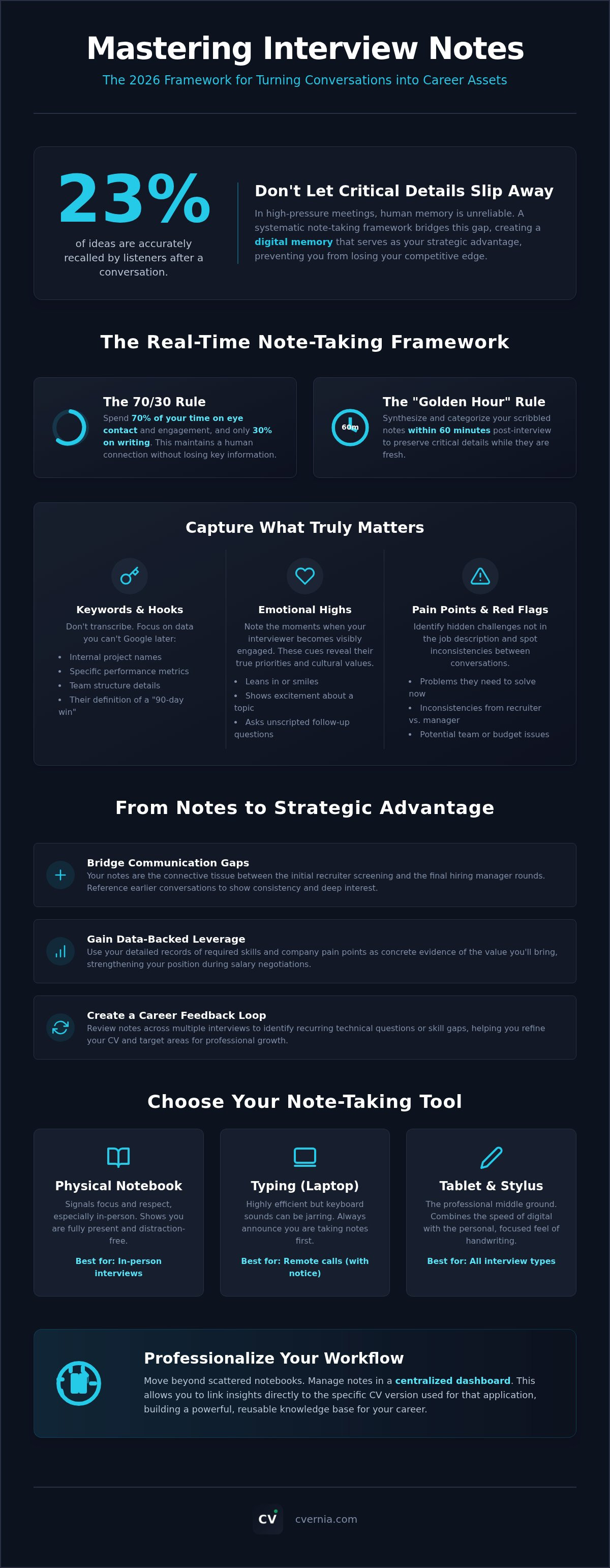
Did you know that most listeners accurately recall only about 23% of the ideas shared during a conversation? When you're in the middle of a high-pressure meeting, it's easy to let critical details slip through the cracks. You might find yourself struggling to balance active listening with the need for documentation, or perhaps you've already felt the sting of forgetting a specific concern raised by a potential manager. It's a common hurdle that leaves even the most qualified candidates feeling unprepared for the next round. Mastering the art of managing interview notes is the most effective way to bridge this gap and maintain your competitive edge.
We understand that the job search is stressful, but your notes should be a source of confidence rather than clutter. This 2026 guide provides a professional framework to transform your initial impressions into a powerful career asset. You'll learn how to build a structured system for capturing insights that directly inform your follow-up strategy. We'll also show you how to use these records as data-backed leverage during salary negotiations. From organizing interviewer names to tracking specific cultural cues, this article ensures you move from uncertainty to total readiness for your next career milestone.
Key Takeaways
- Master the systematic capture of conversation data to bridge the strategic gap between initial recruiter screenings and final hiring manager rounds.
- Use the "Keywords and Hooks" method to identify an interviewer’s emotional triggers without losing focus on the live conversation.
- Commit to the "Golden Hour" rule by synthesizing and categorizing your scribbles within 60 minutes to preserve critical details while they are fresh.
- Professionalize your workflow by managing interview notes in a centralized dashboard that links your insights directly to the specific CV version used for that application.
- Build a "digital memory" that provides data-backed leverage for future salary negotiations and prevents you from starting from scratch during reapplications.
Why Managing Interview Notes is Your Secret Competitive Advantage
Think of managing interview notes as building a strategic intelligence report rather than just keeping a diary. It's the systematic capture and analysis of conversation data that allows you to recall specific nuances that others forget. In a competitive market where human memory is notoriously unreliable, your notes serve as a digital memory that keeps you grounded. You aren't just writing things down; you're building a repository of insights that will define your success in later rounds.
Most hiring processes are marathons. Information often gets lost when you move from a recruiter screening to a technical round with a hiring manager. Your notes act as the vital bridge between these stages. They allow you to reference a specific goal mentioned in the first call, showing the hiring manager that you're already aligned with their vision. This level of consistency suggests a high degree of professional organization and genuine interest in the role.
Companies hire because they have problems to solve. Often, these hidden pain points aren't listed in the job description. They emerge during the natural flow of conversation. By recording these details using various note-taking systems, you can position yourself as the exact solution to their specific friction points. There's a profound psychological benefit here too. Having a reliable external memory reduces the cognitive load during the interview. You don't have to stress about remembering every metric; you can focus on being present and engaging with your interviewer.
The ROI of Organized Interview Data
Precise details make you memorable. Mentioning a specific challenge discussed in the interview within your thank-you email sets you apart from generic candidates. Organized data also helps you spot red flags. You might identify inconsistencies between what the recruiter promised and what the manager expects. When you reach the final stage, these notes provide the evidence of the value you'll bring, giving you the data-backed leverage needed for successful salary negotiations.
Notes as a Feedback Loop for Career Growth
Your notes are a mirror for your professional performance. If you find yourself struggling with the same technical question across three different companies, you've found a specific skill gap to close. This data helps you refine your career change resume for future pivots by highlighting which of your transferable skills resonate most with employers. It’s about turning every interaction into a roadmap for your next career milestone.
The 2026 Framework for Real-Time Note-Taking
Capturing information while maintaining a human connection is a delicate art. The 70/30 Rule is your baseline; spend 70% of your time maintaining eye contact and only 30% writing. This ensures you remain engaged without appearing like a court reporter. When managing interview notes in real-time, focus on the "Keywords and Hooks" method. Don't try to transcribe every word. Instead, write down specific internal project names or metrics that aren't in the job description. These are details you can't look up later, making them your most valuable assets.
Pay close attention to "Emotional Highs." Note exactly when your interviewer leans in, smiles, or shows excitement. These reactions reveal their true priorities and the culture cues that define the team. While general U.S. Department of Labor interview tips provide a solid foundation for standard prep, tracking these subtle human signals gives you a unique edge. Record the team structure and the specific success metrics they mention. Knowing how they define a "win" in the first 90 days allows you to tailor your final-round presentation perfectly.
Digital vs. Analog: Modern Interview Etiquette
Choosing your tools matters. A physical notebook often signals traditional focus and deep respect during in-person meetings. It shows you're entirely present. If you're on a remote call, typing is efficient, but the sound of keys can be jarring. Always announce that you're taking notes first to avoid looking like you're answering emails. A tablet with a stylus offers a professional middle ground, combining the speed of digital with the personal feel of handwriting. Keeping these records in CVernia’s centralized dashboard ensures they never get lost in a pile of paper.
Navigating AI Note-Takers as a Candidate
AI transcription is becoming standard, but you must handle it with care. Always ask for explicit permission before using your own AI tool to record a session. Many companies now use their own agents to handle the heavy lifting. Even if an AI is recording, don't stop taking manual notes. A truly professional approach to managing interview notes involves capturing the subtext that technology hasn't mastered yet, such as a slight hesitation or a specific tone of voice. Your manual notes should capture the human nuances that AI might overlook.
Post-Interview Synthesis: Converting Scribbles into Strategy
The real work begins the moment you leave the room or disconnect from the call. To master the art of managing interview notes, you must follow the "Golden Hour" rule. This principle dictates that you clean up and synthesize your raw scribbles within 60 minutes of the conversation ending. Human memory is fragile; research indicates that a significant portion of detailed information is lost within the first 24 hours. By acting immediately, you ensure that subtle insights, like the specific phrasing an interviewer used to describe a team challenge, remain intact and actionable.
Start by categorizing your thoughts into three distinct buckets: Company Culture, Technical Requirements, and Personal Performance. Culture notes might include observations about how team members interact or the office energy. Technical requirements focus on the specific tools or outcomes the hiring manager prioritized. Finally, personal performance allows you to honestly assess which of your answers landed well and where you felt hesitant. This structured review helps you identify "Gaps in Understanding" that you can proactively address in the next round. Use these gaps to draft sophisticated follow-up questions that prove you were listening deeply and are already thinking about the role's long-term success.
The "Three-Column" Synthesis Method
Transform your raw data into a strategic pitch using a simple three-column format. In the first column, record "The Fact" exactly as they said it. In the second, interpret "The Pain Point" by asking what that fact reveals about their current struggles. In the third, draft "The Pitch," which is a concise statement on how your specific skills solve that exact problem. This method turns passive observations into active selling points that you can use in thank-you notes or subsequent interviews. It moves you from being a candidate who just "took notes" to a strategist who understands the business.
Preparing for the Next Stage
Consistency is your greatest ally in a multi-stage hiring process. Map your synthesized notes to your job interview tracker to see the full timeline of your interactions. Reviewing what you discussed with the recruiter ensures you don't contradict yourself when speaking with the Department Head. Use these insights to tailor your portfolio or presentation for the "Deep Dive" round. When you can reference a specific concern raised in the first week during a final-stage interview in week four, you demonstrate an elite level of preparedness and professional reliability.
Centralizing Your Data: Moving Beyond Scattered Notebooks
Relying on sticky notes or buried email threads creates a "fragmented memory" that fails when you need it most. When you're juggling multiple applications, the details of a specific recruiter's concern can easily blend into another. Centralizing your data transforms these scattered thoughts into a cohesive strategy. Think of this as a "Career CRM." It isn't just about the current job; it's about managing your long-term professional relationships and history.
Managing interview notes within a centralized system ensures that every insight is searchable and actionable. This approach powers smart reapplication detection. It allows you to see exactly why a previous attempt at a company succeeded or stalled. You gain a high-level view of your progress that a physical notebook simply cannot provide. To start organizing your journey, use CVernia’s centralized dashboard to link your notes to every application.
Linking Notes to Application Versions
Precision is critical during a high-stakes call. You must know exactly which CV version the interviewer is referencing. If you've tailored your resume to highlight specific leadership skills, you need to be on the same page as the hiring manager instantly. Use a centralized platform to link your notes directly to the specific tailored cover letter and resume used for that role. This organization allows you to track which specific hooks resonated most. Manage your attachments alongside your notes, keeping portfolios and assignment briefs in one accessible location.
Long-Term Value: The Reapplication Advantage
Your notes have a shelf life far longer than the hiring cycle. Imagine applying for a new opening at the same company two years later. Using your historical notes allows you to reference past conversations and show incredible growth. You can also track "Hiring Manager Turnover." If a manager moves to a new firm, your previous notes on their preferences become a secret weapon for a new application. Over time, you'll build a personal knowledge base of industry-specific interview questions. This prevents the "starting from scratch" feeling and makes managing interview notes a long-term investment in your career.
Maximizing Success with CVernia’s Interview Management Tools
Managing interview notes effectively requires more than just a pen and paper; it demands a centralized system that grows with your career. CVernia’s dashboard acts as your digital memory, ensuring that every insight you capture is linked directly to your professional history. By using our Interview Notes & Attachment Management feature, you can store specific observations alongside the exact CV version and cover letter used for that application. This level of organization eliminates the stress of searching through multiple folders or apps when a recruiter calls for an unscheduled follow-up.
Your strategic notes are yours alone. Keeping your data separate from company-owned platforms or social media trackers is vital for maintaining a competitive edge. CVernia provides a secure environment where you can record honest assessments of company culture and internal challenges without worrying about privacy. These insights also integrate seamlessly with our Career Academy. If your notes reveal a recurring struggle with a specific technical topic, you can immediately access targeted learning resources to bridge that gap before your next meeting. This creates a proactive cycle of improvement that turns every interview into a stepping stone toward readiness.
A Step-by-Step Workflow in CVernia
Streamline your process by uploading the job description and your tailored CV to the dashboard before the call begins. This creates a dedicated workspace for that specific opportunity. During or immediately after the conversation, add your real-time notes directly into the "Notes & Attachment Management" section. Record the names of your interviewers and the specific success metrics they mentioned. Finally, set automated reminders for follow-ups based on the "Next Steps" discussed. This methodical approach ensures you never miss a deadline or forget a critical detail.
Why a Dedicated Platform Beats a Spreadsheet
Manual spreadsheets often fail because they lack automated version control. CVernia handles this for you, ensuring your notes stay attached to the correct resume version even as you iterate. Our platform offers a seamless integration between tracking, notes, and ATS compatibility checking, providing a holistic view of your application journey that a simple table cannot replicate. This automation saves you hours of administrative work, allowing you to focus on the human side of the interview. Start managing your interview notes professionally with CVernia today.
Take Control of Your Professional Narrative
Transforming your casual scribbles into a strategic career asset is the key to outperforming the competition in 2026. By capturing emotional highs during the call and committing to the "Golden Hour" of synthesis immediately after, you ensure that no critical detail is lost. Professionalizing your approach to managing interview notes allows you to bridge the gap between different hiring stages and present a consistent, high-value narrative to every stakeholder. You aren't just recording the past; you're building a data-backed blueprint for your future salary negotiations.
Stop relying on scattered notebooks and fragmented memory. Professionals trust CVernia for centralized application tracking and integrated ATS compatibility analysis that ensures every submission is optimized. Our platform provides secure, private note management that keeps your strategic insights entirely separate from company-owned systems. Master your job search with CVernia’s Interview Management Dashboard and move from uncertainty to total readiness. Your next career milestone is within reach, and with the right tools, you'll be prepared to claim it.
Frequently Asked Questions
Is it okay to take notes during a job interview?
Yes, it's absolutely acceptable and often encouraged to take notes during a job interview. Recording key details demonstrates that you're an active listener who values the information being shared. Most hiring managers view this as a sign of professional organization and genuine interest in the role. Just remember to maintain eye contact and keep your notes brief so you don't lose the flow of the conversation.
Should I use a laptop or a notebook for interview notes in 2026?
The choice depends on the interview setting and your personal comfort level. A physical notebook is often preferred for in-person meetings because it signals traditional focus and respect without a screen acting as a barrier. For remote calls, a laptop is efficient, but you should always announce that you're taking notes to explain the sound of typing. Tablets with styluses offer a modern middle ground that many professionals find effective.
What are the most important things to write down during an interview?
Focus on capturing "hidden" information that isn't available in the job description. This includes specific success metrics for the first 90 days, the team's current pain points, and the names of key stakeholders. You should also note the interviewer’s "Emotional Highs," which are the moments they showed the most excitement. These details are essential for managing interview notes that actually help you tailor your follow-up strategy and future round presentations.
How do I organize my notes if I am interviewing with multiple companies?
Centralization is the only way to prevent "fragmented memory" when juggling multiple opportunities. Use a dedicated career application management platform like CVernia to link your notes directly to each specific job entry. This ensures that your insights stay connected to the correct tailored CV and cover letter versions. Avoid using scattered sticky notes or random documents, as these are easily lost and difficult to search when a recruiter calls unexpectedly.
Can I use AI note-takers like Otter or Fireflies during my interview?
You can use AI transcription tools, but you must ask for explicit permission from all participants before the recording begins. Many companies have strict privacy policies regarding third-party AI agents in private meetings. Even if you get the green light, don't rely solely on technology. AI often misses the human subtext, such as a slight hesitation or tone shift, which you should still capture manually in your primary notes.
How long should I keep my interview notes after the process ends?
Keep your notes indefinitely as part of your personal career knowledge base. These records are incredibly valuable if you reapply to the same company years later or if an interviewer moves to a new firm where you're seeking a role. CVernia’s smart reapplication detection uses this historical data to help you improve your future attempts. Your notes serve as a "Career CRM" that tracks long-term professional relationships and industry-specific question patterns.
What is the best way to review notes before a second-round interview?
Use the three-column synthesis method to review your data before the next round. Map the "Fact" of what was said to the "Pain Point" they are facing, and then draft your "Pitch" for how you solve it. Reviewing previous round notes ensures your narrative remains consistent across different interviewers. This preparation allows you to reference specific goals mentioned by the recruiter when you finally speak with the hiring manager.
How do I mention something from my notes in a thank-you email?
Pick one specific detail or challenge discussed during the call and reference it directly in your follow-up. For example, you might mention how you've been thinking about the specific scaling hurdle the manager raised. This proves you were listening deeply and are already invested in their success. Managing interview notes professionally gives you the exact phrasing needed to make your thank-you email stand out from the generic responses other candidates send.


