
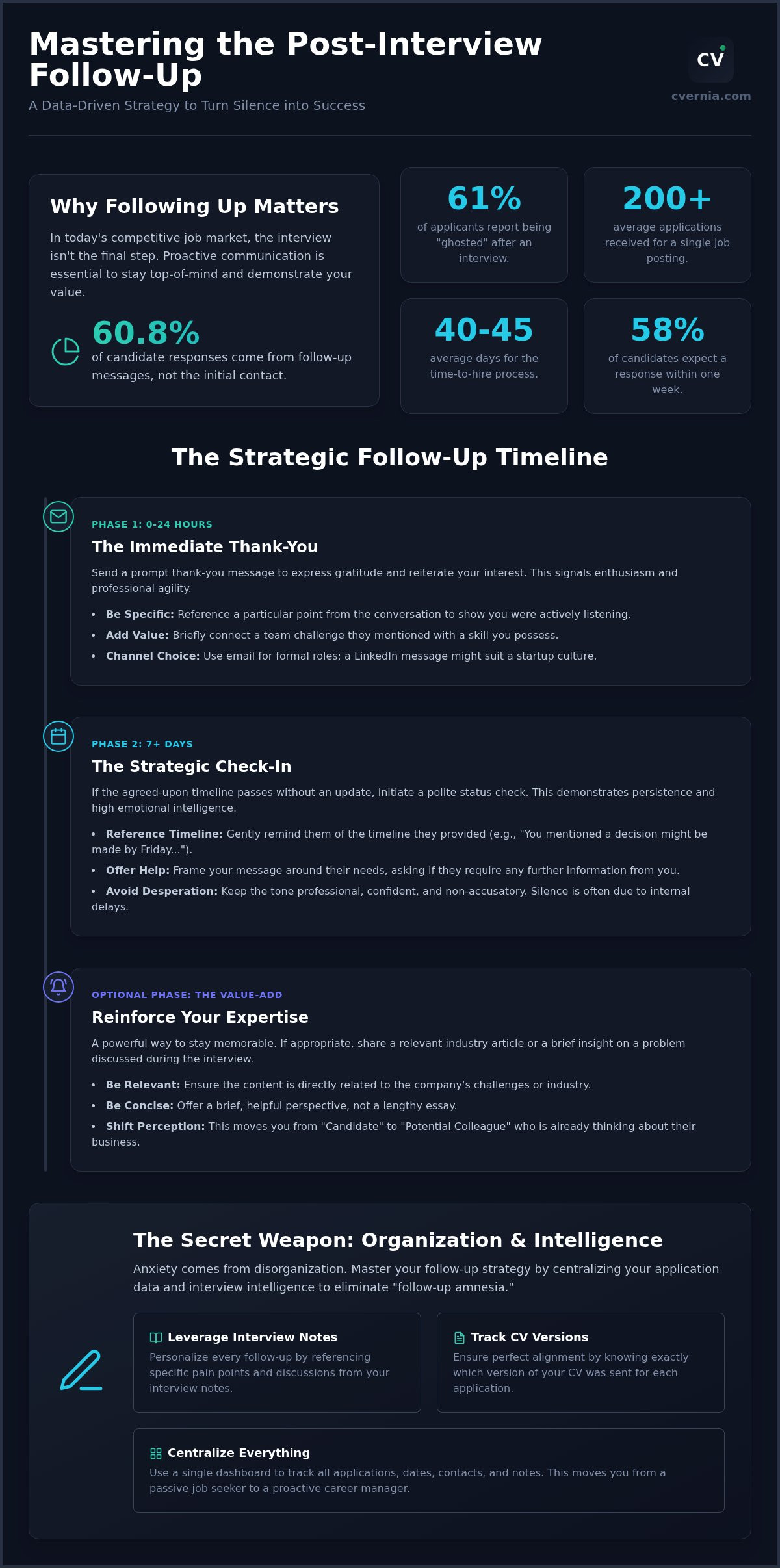
Did you know that 60.8% of candidate responses come from follow-up messages rather than the initial contact? Learning how to follow up after an interview isn't just about politeness; it's about reclaiming your professional narrative in a market where 61% of applicants are ghosted. You've done the hard work of the interview, but now the silence feels deafening. It's natural to worry about sounding desperate or being annoying to a busy recruiter. We understand that pressure, and we're here to help you navigate it with confidence.
This guide transforms that post-interview anxiety into a data-driven strategy. You'll master a system that turns basic thank-you notes into strategic career wins by leveraging your own interview intelligence. We're going to provide a clear engagement timeline, authentic templates, and a centralized method to track every application status without losing a single detail. From managing your interview notes to timing your outreach perfectly, you'll gain the tools to stay organized and prepared until the final offer arrives.
Key Takeaways
- Maintain professional momentum by following a precise communication cadence that balances immediate gratitude with a strategic one-week status check.
- Create deeper connections by using your interview notes to address specific team pain points mentioned during your conversation.
- Gain a competitive edge when you master how to follow up after an interview by treating every message as a strategic value-reinforcement stage.
- Eliminate follow-up amnesia by centralizing your application tracking and interview intelligence in a single, organized dashboard.
- Ensure perfect alignment by tracking exactly which CV version you used for every application in your pipeline to avoid communication errors.
The Strategic Importance of the Post-Interview Follow-Up
Think of the hiring process as a marketing funnel. The initial application is your lead generation; the interview is the product demo. However, many job seekers stop there, treating the post-interview phase as a waiting game. In reality, mastering how to follow up after an interview is the critical "value-reinforcement" stage of your journey. It's your final opportunity to solidify your professional brand before a decision is finalized. Research indicates that 60.8% of candidate responses come from follow-up messages, proving that proactivity is a necessity, not an option.
Recruiters in 2026 face unprecedented volume. With the average job posting receiving over 200 applications, the "Recruiter Memory Gap" is a very real hurdle. You might have had a stellar conversation on Tuesday, but by Friday, that recruiter has likely interviewed a dozen other people. Staying top-of-mind isn't annoying; it's helpful. It bridges the gap between being a name on a screen and becoming a memorable solution to their specific business problems.
Your goal is to facilitate a psychological transition in the mind of the hiring manager. You want them to stop seeing you as a "Candidate" and start seeing you as a "Potential Colleague." This shift happens when your communication moves from asking for a job to offering professional insights. You can achieve this through three distinct types of outreach:
- The Thank You: A prompt post-interview thank-you letter sent within 24 hours to express gratitude and highlight a specific connection point.
- The Check-In: A professional status inquiry sent once the agreed-upon timeline has passed.
- The Value-Add: A strategic message sharing a relevant industry article or a brief solution to a pain point discussed during the meeting.
Why Silence is Rarely a Final Answer
Don't assume silence equals rejection. Internal hiring delays are common, often caused by shifting stakeholder alignment or unexpected budget reviews. The average time-to-hire currently sits around 40-45 days. A well-timed follow-up can actually reverse a "maybe" decision by demonstrating persistence and high emotional intelligence. It helps you distinguish a "No" from a "Not Yet," keeping your application active while the company resolves its internal logistics.
Organization: The Secret to Stress-Free Follow-Ups
Follow-up anxiety usually stems from a lack of organized data. When you manage multiple applications, it's easy to lose track of dates and specific conversation details. Manual spreadsheets often become data graveyards that increase your stress rather than reducing it. You need to see your entire application history in one place to remain effective. CVernia’s Application Tracking Dashboard allows you to transition from a passive seeker to a proactive career manager. By centralizing your notes and tracking every interaction, you eliminate the fear of being annoying and replace it with professional precision.
The 2026 Follow-Up Timeline: When to Reach Out
Timing is the difference between professional persistence and unwanted pressure. In 2026, hiring cycles move fast, yet 61% of candidates report being ghosted after an interview. You need a structure that keeps you visible without overstepping. If you're unsure how to follow up after an interview, rely on a data-driven follow-up timeline to guide your actions. Since 58% of candidates expect a response within one week, your goal is to stay top-of-mind during that critical decision window.
The Immediate Thank-You (0-24 Hours)
Send your first message within the first day. High-volume roles in tech or marketing often attract over 500 applications, making early engagement vital. Speed signals your enthusiasm and professional agility. Choose your channel wisely. Email remains the standard for corporate settings, while a LinkedIn message might fit a startup's culture better. Your message should include a specific reference to a challenge the team is facing. This proves you were listening and can provide immediate value to the potential team.
The Strategic Check-In (Day 7+)
If seven days pass in silence, initiate a polite status check. Avoid sounding desperate. Instead, ask if they require any further information to help their decision process. Reference the specific timeline the recruiter mentioned at the end of your call. If they promised an update by Friday, wait until the following Monday to reach out. To stay on top of these shifting dates across multiple roles, integrate the best job interview tracker for 2026 into your daily routine. This prevents "follow-up amnesia" and keeps your search organized.
By day fourteen, if silence persists, pivot your energy. Move the application to a "long-term" status in your pipeline. This shift prevents you from stalling your career search while waiting for one specific answer. Always prioritize the hiring manager's explicit instructions. If they requested two weeks to align stakeholders, respect that boundary. You can manage these varied timelines and custom notes easily with an application tracking dashboard. This ensures you remain a proactive manager of your own career path rather than a passive observer.
Leveraging Interview Intelligence for Perfect Personalization
Most candidates send a generic "thank you for your time" and hope for the best. In a market where 62% of employers use AI to screen initial communications, your only path to standing out is deep personalization. Success depends on your "Note-to-Follow-up" pipeline. This process involves transforming raw data from your conversation into a strategic message that addresses the hiring manager’s specific concerns. When you master how to follow up after an interview with this level of precision, you move from being a candidate to becoming a documented solution to their problems.
Personalization isn't just about using the recruiter's name. It's about reinforcing your fit based on the actual dialogue that occurred. If the manager asked specific questions about your experience with a certain software or methodology, your follow-up is the place to provide a concise, high-impact example you didn't have time to detail during the call. Always maintain absolute truthfulness. Align your real-world accomplishments with the job's needs without ever inflating your experience. Honesty builds the trust necessary for a long-term offer.
Capturing the Right Data During the Call
Effective follow-ups begin before the meeting ends. You must track names, specific departmental challenges, and subtle cultural nuances. Utilize our interview preparation and guidance to structure your note-taking process. Record your "Immediate Post-Interview Impressions" within ten minutes of finishing the call. These details fade fast. Capturing them immediately ensures you have the exact "hooks" needed to prove you were listening and are already thinking like a member of the team.
The 'Value-Add' Follow-up Strategy
A "Value-Add" message positions you as an active contributor rather than a passive seeker. This strategy involves sending a relevant resource or insight that directly relates to an interview topic. Consider these practical approaches:
- Forward a recent industry report that addresses a challenge the manager mentioned.
- Briefly expand on a question where you felt your initial answer could have been stronger.
- Share a specific tool or template you've used to solve a problem similar to theirs.
Ensure this outreach feels helpful, not like a homework assignment for the recruiter. Keep your commentary brief. By providing value before you're even on the payroll, you demonstrate the proactive mindset companies crave. This approach bridges the gap between being a name on a list and being a colleague they can't wait to hire.
Managing the Follow-Up Loop: Avoiding Spreadsheet Fatigue
Managing a job search in 2026 is a logistical challenge. If you're juggling five or ten active leads, remembering exactly how to follow up after an interview becomes a high-stakes memory game. Most candidates rely on manual spreadsheets, but these quickly turn into "data graveyards." They're static, hard to update, and lack the dynamic reminders needed to keep a lead warm. Professional organization requires a system that tracks not just the date of the meeting, but the specific version of your CV you used; this includes unique contact details for both the recruiter and the hiring manager.
Precision is your greatest asset. You've likely tailored your resume for each specific role to pass ATS filters, so following up with talking points that don't align with that document creates a professional disconnect. You must know exactly which experience you highlighted during the application phase. Setting up automated reminders ensures you never miss a 24-hour thank-you or a 7-day check-in. This prevents your application from sinking to the bottom of an overflowing inbox while you wait for a response.
The Danger of Duplicate Follow-ups
Disorganized tracking leads to embarrassing administrative errors. Sending the same follow-up email twice or reaching out to the wrong person within a large firm signals a lack of attention to detail. This is particularly risky when managing multiple interview threads within a single organization. Utilize smart reapplication detection to understand your full history with a company. Knowing your past touchpoints prevents redundant communication and ensures your outreach always feels fresh, intentional, and well-timed.
Organizing Your Outreach Workflow
Adopt a 60/30/10 routine to maintain your momentum. Spend 60% of your time on active follow-ups and interview prep, 30% on new applications, and 10% on networking. This ratio ensures you're nurturing existing leads rather than just chasing new ones. Centralizing your attachments and notes is the only way to achieve quick recall. When a recruiter calls unexpectedly, you shouldn't be scrambling through folders. You need your "Interview Intelligence" at your fingertips to speak confidently about the role.
Take control of your career pipeline today. Access our application tracking dashboard to eliminate spreadsheet fatigue and manage your follow-ups with professional precision.
Centralizing Your Follow-Up Strategy with CVernia
Stop letting your hard-earned interviews fade into silence. "Follow-up amnesia" occurs when the sheer volume of your search exceeds your manual capacity to track it. When you are managing multiple leads, the specific details that make a message stand out often get lost in the shuffle. CVernia solves this by centralizing your entire strategy, turning a chaotic inbox into a streamlined professional pipeline. By moving your process into a dedicated environment, you shift from being a reactive candidate to a professional manager of your own career trajectory.
A clean organizational system provides a significant psychological advantage. It alleviates the inherent stress of the job search by replacing uncertainty with readiness. Instead of wondering if you missed a deadline, you can focus on refining your message. Knowing exactly how to follow up after an interview with the right data at the right time builds the self-assurance needed to navigate high-pressure hiring cycles. This transition from disorganized effort to strategic management is what separates top-tier professionals from the rest of the applicant pool.
Features for the High-Efficiency Job Seeker
Our platform is designed to handle the complexities of the 2026 hiring landscape. The Application Tracking Dashboard provides a visual map of your progress, ensuring no lead goes cold. You can manage your follow-up status for every role with a single glance. Precision is maintained through several key features:
- Interview Notes Management: Keep your "Intelligence" directly adjacent to the job record for instant recall during outreach.
- Application Tracking Dashboard: Monitor every stage of the funnel to ensure timely engagement.
- Version Management: Ensure your follow-up talking points align perfectly with the specific ats compliant resume you submitted for that role.
From Interview to Offer: Closing the Loop
Efficiency leads to faster hiring cycles. When you respond with precision and speed, you demonstrate the exact qualities recruiters look for in a colleague. Centralized management ensures you never send a generic message when a personalized one is required. This level of organization is reinforced by our Career Academy, which provides the learning resources needed to master how to follow up after an interview effectively. By integrating your notes, versions, and timelines into one dashboard, you eliminate the friction that often delays a job offer.
Empower your professional journey with a system built for success. Take control of your follow-up process with CVernia today and transform your interview performance into a career win.
Take Command of Your Career Narrative
Mastering how to follow up after an interview is the final, decisive step in your hiring journey. You've learned that silence isn't necessarily a rejection; it's often a call for professional persistence. By leveraging specific interview intelligence and respecting the strategic timeline, you transform from a mere applicant into a future colleague. Success in a crowded market requires more than just good manners. It demands a high-efficiency system that keeps your details sharp and your outreach perfectly timed.
Stop struggling with disorganized spreadsheets that lead to missed opportunities. You deserve a clear, stress-free view of your professional pipeline. Streamline your post-interview strategy with CVernia's Application Tracking Dashboard to gain immediate access to centralized Interview Notes management and integrated application status tracking. Our smart reapplication detection ensures your communication remains precise across every firm you target. You've got the talent and the tools to succeed. Step into your next role with the confidence of a candidate who is always prepared and organized.
Frequently Asked Questions
What is the best way to follow up after an interview in 2026?
The best way is to combine prompt gratitude with a specific value-reinforcement strategy. Send a personalized email within 24 hours that references a challenge discussed during the meeting. In 2026, recruiters expect high-speed, high-precision communication. Use your interview notes to address departmental pain points directly. This approach proves you're already thinking like a team member rather than just another candidate in the pool.
How long should I wait to send a thank you email after an interview?
Send your thank-you email within 24 hours of the meeting concluding. Promptness signals your professional agility and enthusiasm for the role. If the interview happened on a Friday afternoon, aim to have the message in their inbox by Monday morning. Since 58% of candidates expect a response within one week, your early engagement ensures you remain top-of-mind as the hiring manager begins their evaluation process.
What should I do if I don't hear back after my follow-up email?
Wait seven business days before sending a polite status check if you haven't received a response. Silence often stems from internal stakeholder delays rather than a rejection. If another week passes without contact, move the application to long-term status in your tracker and focus on new leads. Maintaining a proactive search prevents you from stalling while waiting for a single answer in a high-volume market.
Is it okay to follow up with a recruiter on LinkedIn?
LinkedIn is an excellent channel for follow-ups, especially in tech or creative industries. Use the platform to send a brief, professional message if the recruiter has been active there or if you've already connected. However, keep the tone formal and avoid being intrusive. If you're unsure how to follow up after an interview on social media, stick to email as your primary channel to maintain professional boundaries.
How do I organize my interview notes for effective follow-up?
Organize your notes by capturing specific names, departmental challenges, and cultural nuances immediately after the call. Don't rely on memory; use a centralized dashboard to store these details adjacent to the job record. Recording immediate post-interview impressions allows you to extract specific hooks for your follow-up messages. This high-efficiency organization prevents follow-up amnesia and ensures every message you send is deeply personalized and relevant to the team's needs.
Can I follow up more than once if I haven't received a response?
You can follow up twice before pausing your outreach. Send the initial thank-you, followed by a status check after seven days. If you still hear nothing, one final value-add message after another week is acceptable. Beyond three touches, further communication may appear desperate or intrusive. Focus your energy on other opportunities while keeping the door open for a delayed response from the hiring manager.
What should I include in a post-interview check-in email?
Include a brief reference to the interview date, the specific role, and the timeline discussed during the meeting. Ask if the team requires any additional information to assist with their decision-making process. Keep the tone helpful and professional rather than demanding an update. Referencing a specific pain point from your conversation reinforces your value while you seek a status update on your application.
How can I track which version of my resume I sent to a specific company?
Use a dedicated version management tool to link specific CV files to individual job applications. Manual folders often lead to confusion, especially when you tailor documents for ATS compatibility. By centralizing your application history, you can see exactly which experience you highlighted for every role. This ensures your follow-up communication remains perfectly aligned with the professional narrative you presented during the initial application and interview stages.


