

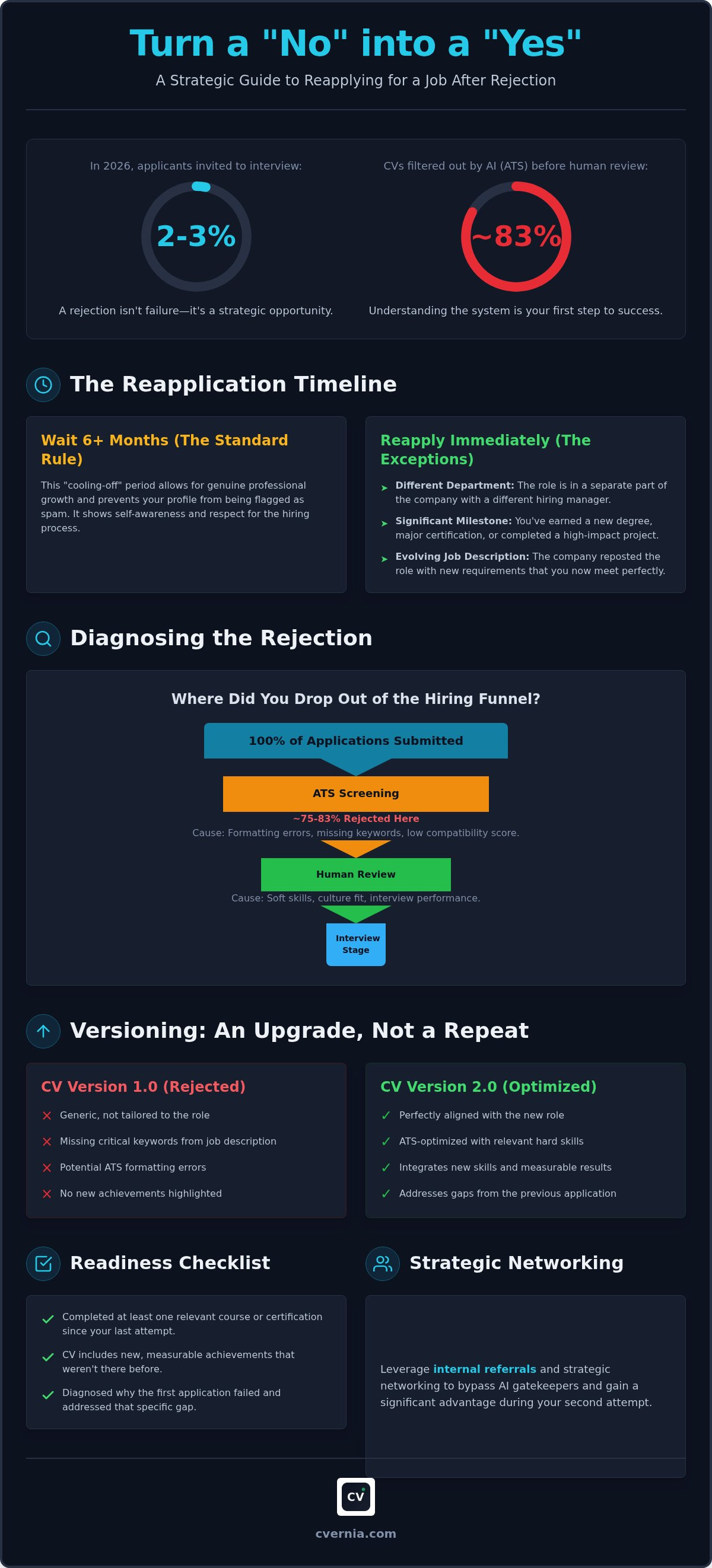
Did you know that in 2026, only 2-3% of applicants are invited to interview? If you've recently faced a "no" from your dream company, it's easy to feel like you've been permanently blacklisted. However, reapplying for a job after rejection isn't a sign of desperation. It's a strategic move. It's your chance to present a version of yourself that's perfectly aligned with the employer's evolving needs.
We know the confusion that comes from seeing a role reopen while your previous application sits in a digital drawer. You've likely felt the stress of tracking different CV versions or wondering if your skills were even seen by a human. This guide transforms that "no" into a future "yes" by mastering the timing and technical upgrades required for success. You'll gain the confidence to approach the same company with a fresh, optimized perspective.
We'll explore the ideal reapplication timeline and how to use ATS analysis to beat the 83% of AI filters that block qualified candidates. You'll also learn to use version management tools to ensure your next attempt is a significant upgrade, not a repeat performance.
Key Takeaways
- Identify the standard six-month cooling-off period and the specific exceptions that allow you to submit a new application immediately.
- Diagnose previous failures by analyzing your ATS compatibility to ensure your technical formatting isn't blocking your CV from human review.
- Master the strategy for reapplying for a job after rejection by treating your next submission as a version upgrade rather than a simple repeat.
- Leverage internal referrals and strategic networking to bypass AI gatekeepers and gain a significant advantage during your second attempt.
- Utilize smart version management tools to track exactly what you sent previously and integrate past interview feedback into your new application.
The Reapplication Timeline: When is it Too Soon?
Receiving a rejection letter feels like a closed door, but it's often just a temporary "not now." Most professional recruiters suggest a standard six-month cooling-off period before you attempt to join the same company again. This timeframe isn't arbitrary; it's a built-in buffer within the job application process that allows candidates to actually grow. Reapplying for a job after rejection too quickly can signal a lack of self-awareness. It may even flag your profile as "spam" in an Applicant Tracking System (ATS), making it harder for future versions of your CV to get noticed.
Company size plays a massive role in how strictly you should follow this timeline. In a boutique agency, the recruiter who rejected you last month will certainly remember your name this month. Global corporations operate differently. They often have separate hiring teams for different regions or departments, which can offer more flexibility. However, even in large firms, your previous data remains in the system. You must be strategic about when you re-enter their radar to ensure you're seen as a fresh, improved candidate.
The 6-Month Rule vs. The New Role Exception
Respecting the six-month window prevents recruiter fatigue and gives you time to address the gaps that led to the initial rejection. Despite this general rule, three specific scenarios allow you to bypass the wait and reapply immediately:
- A Different Department: If you applied for a Project Manager role in Finance but see a similar opening in Operations, the requirements and hiring managers are likely different.
- Significant Professional Milestones: Earning a major industry certification, finishing a degree, or completing a high-impact project fundamentally changes your value proposition.
- Evolving Job Descriptions: Sometimes a company re-posts a role with updated requirements. If your skills now align with those new "must-haves," you have a valid reason to try again.
Assessing Your Readiness to Re-Enter the Funnel
Before you hit submit, evaluate if your profile has truly evolved. Ask yourself if you've acquired the specific technical tools or leadership experiences that were missing last time. Look closely at the new job description. If the company's needs have shifted toward a specific software or methodology you've recently mastered, your readiness is high. A strategic pause is a period of active skill acquisition rather than a passive wait for the calendar to turn.
Use this checklist to confirm you're ready for the second round:
- You've completed at least one relevant course or certification since your last attempt.
- Your CV includes new, measurable achievements that weren't there before.
- You've diagnosed why the first application failed and addressed that specific technical or experience gap.
Diagnosing the Rejection: Why Did Not You Make the Cut?
Most job seekers wait for a feedback email that never arrives. This "Feedback Vacuum" is the standard in 2026, where high application volumes prevent recruiters from offering personalized advice. Instead of waiting for a response, you must take charge of your own diagnosis. Understanding how applicant tracking systems work is the first step in this process. These digital gatekeepers screen out approximately 75% of resumes before a human ever sees them. If your CV lacked specific markers or technical compatibility, it likely didn't fail because of your talent, but because of your data presentation.
Analyze exactly where you dropped out of the hiring funnel to find the root cause. If you received an automated rejection within 48 hours, your ATS score was likely the culprit. This often happens due to formatting errors or a lack of hard skill alignment. However, if you reached the final interview stage, the rejection was probably based on soft skills or cultural fit. Reapplying for a job after rejection is only effective if you can distinguish between a technical "fail" and a person-to-person "miss." Conduct a thorough skill gap analysis by comparing your previous CV version against the original job description to see which "must-have" requirements you didn't emphasize enough.
Using ATS Analysis for Self-Diagnosis
Use an ats compliant resume checker to identify missing industry keywords and formatting traps. These tools simulate how a recruiter's software parses your data. Look for issues like complex tables, non-standard fonts, or headers that the bot can't read. Focus on truthful alignment rather than "keyword stuffing." Modern AI recruitment tools can easily detect and penalize artificial keyword density. Instead, weave your relevant certifications and achievements into your bullet points naturally to ensure both the bot and the human recruiter see your value.
Reviewing Interview Performance Notes
If you reached the interview stage, your previous performance is your most valuable data source. Review your structured notes from that first attempt. Identify the specific behavioral questions that caused you to hesitate or the technical tasks where you felt less confident. Prepare new, data-backed answers that highlight your growth since that meeting. Use any feedback you managed to secure to pivot your professional narrative. If a recruiter mentioned a lack of specific software experience, make your new proficiency in that tool the centerpiece of your updated application. Managing your progress with a centralized application tracking dashboard ensures you never lose these critical insights between attempts.
Versioning Your Application: The Upgrade Strategy
When reapplying for a job after rejection, resubmitting the exact same CV is the most common mistake candidates make. If that version didn't work six months ago, it won't work today. Recruiters can see your entire application history within their ATS. When they compare your old file to the new one and see zero changes, it suggests you haven't grown or didn't bother to improve. Successful version management requires a side-by-side comparison of what you sent "Then" versus what you're sending "Now." You want the hiring manager to see a clear trajectory of professional development.
The CV "Upgrade" Framework
Focus on adding quantifiable achievements that occurred during your waiting period. Did you lead a new project? Did you increase efficiency by a specific percentage? These new data points prove you've been active and productive. Restructure your professional summary to highlight the specific skills the company values most, based on the diagnosis you performed in the previous section. This isn't about inventing skills; it's about shifting the narrative to align with current company goals. Ensure your CV remains a truthful representation while strategically improving its compatibility score for the latest ATS algorithms.
Crafting a Reapplication Cover Letter
Your cover letter is the perfect place to address your evolution. Use a tailored cover letter generator to ensure you're hitting the new role requirements precisely. You don't need to apologize for the previous rejection. Instead, adopt the "Growth" approach. Briefly mention your previous interest and explain how the intervening months have made you an even stronger fit for the team. This demonstrates dedication and a genuine desire to work for that specific organization.
Dedication is a high-value trait in the 2026 job market. When reapplying for a job after rejection, showing that you've stayed interested in the brand despite a setback speaks volumes about your culture fit. It proves you aren't just looking for any job, but specifically their job. This persistence, combined with a technically upgraded application, often turns a previous "no" into a conversation. Modern hiring is about alignment, and versioning your documents ensures that alignment is undeniable.
Strategic Networking: Finding the Internal Path
Hiring is often as much about who knows your growth as it is about what's on your CV. When reapplying for a job after rejection, a referral becomes your most potent tool. Research indicates that candidates sourced through networking or referrals are eight times more likely to be hired than those who apply through a cold portal submission. You aren't just a name in a database; you're a "Silver Medalist." This status means you were a top contender previously, and you should use that momentum to bypass the initial AI gatekeepers. Reach out to former interviewers to remind them of your fit while highlighting the specific technical upgrades you've made since your last meeting.
Your public persona must mirror your new application. Update your LinkedIn profile to reflect the quantifiable achievements and new certifications you've added to your CV. If a recruiter checks your digital footprint after seeing your reapplication, they should see a consistent story of professional advancement. This alignment builds trust and reinforces the idea that you are a "new and improved" version of the candidate they met months ago. A cohesive online presence proves that your growth is genuine and not just a set of keywords added to a document.
Re-engaging the Recruiter
Drafting a professional check-in is an art. It needs to be concise and value-driven. Ask for a brief informational chat to understand how the role's requirements have changed since the last posting. This shows you're proactive and genuinely interested in the team's specific success. Use this three-sentence script to open the door:
"Hi [Recruiter Name], I've recently earned my [Specific Certification] and was excited to see the [Job Title] role reopen. Since our last interview, I've focused on mastering [Skill], which we discussed as a key priority for the team. Could we schedule a five-minute chat to discuss how my updated experience aligns with your current goals?"
Building Internal Advocacy
Social proof is a powerful motivator for hiring managers. Find mutual connections within the company who can vouch for your skills or provide insight into the department's current challenges. Attend company-hosted webinars or virtual events to stay visible and informed. When you submit your new application, mention these internal conversations to demonstrate your active engagement with the company culture. This strategy turns you from a cold applicant into a warm, recommended professional. Organize these connections and outreach efforts using a Career Application Management Platform to ensure no follow-up falls through the cracks.
Managing the Reapplication Journey with CVernia
Success in reapplying for a job after rejection depends on your ability to learn from the past. CVernia serves as the digital memory of your career journey, ensuring you never repeat previous mistakes. Our Smart Reapplication Detection feature alerts you when you're targeting a company you've applied to before. It immediately surfaces your previous CV, cover letter, and recruiter interactions. This transparency allows you to build a "Version 2.0" that is a genuine upgrade rather than a duplicate effort.
Centralized attachment management keeps your files organized by date and specific role. You won't have to dig through old folders to find what you sent six months ago. Instead, you can focus on leveraging our Career Academy to bridge the skill gaps identified in your first attempt. These learning resources provide the specific guidance needed to master new certifications or technical tools that make your second application undeniable.
Data-Driven Version Management
Use the CVernia dashboard to compare your current ATS score against your previous submission. This side-by-side analysis highlights exactly where your formatting or keyword alignment has improved. High-performing candidates use this data to ensure their compatibility score is optimized for 2026 recruitment standards. Organizing your professional documents in one place ensures maximum clarity. You'll always have the right version of your CV ready for quick retrieval during a recruiter's follow-up call.
Preparing for the "Second Chance" Interview
Earning an interview for a second time is a major win that requires precise preparation. Use our job interview tracker to review the notes and feedback stored from your first round. These insights allow you to review exactly which questions were asked and how you responded previously. Rehearsing with your actual history in mind builds a level of confidence that generic preparation cannot match.
Manage your follow-up tasks and thank-you notes through the same centralized interface. This ensures your communication remains consistent and professional throughout the entire reapplication journey. Persistence is a powerful signal to employers when it's backed by organized, data-driven growth. Start your reapplication strategy with CVernia today and transform your previous rejection into your next career milestone.
Transform Your Rejection Into a Career Milestone
A rejection today isn't a permanent "no." It's an invitation to refine your strategy and return with a profile that's impossible to ignore. By mastering the six-month cooling-off period and diagnosing technical gaps, you position yourself as a proactive professional who values growth. Remember that reapplying for a job after rejection is most effective when you treat your second attempt as a version upgrade. You've already learned the "rules" of the company's hiring process; now it's time to use that data to your advantage.
CVernia provides the technological edge you need to stay organized and competitive. Our Smart Reapplication Detection technology ensures you never lose track of past interactions, while our ATS Compatibility Analysis helps you beat the AI filters that block qualified candidates. With Centralized Interview Note Management, your previous feedback becomes the foundation for your future success. You don't have to navigate this journey alone.
Master your next reapplication with CVernia’s tracking tools. Your dream role is still within reach, and your next "yes" is just a strategic update away. Stay persistent and stay prepared.
Frequently Asked Questions
Is it bad to reapply for a job after being rejected?
Reapplying for a job after rejection isn't bad; it's a strategic demonstration of your commitment to the brand. Recruiters often value candidates who show persistence and have used the intervening time to improve their technical profile. If you've acquired new skills or certifications, your second attempt proves you're a proactive professional. This persistence often separates top-tier talent from passive applicants who give up after a single setback.
How long should I wait to reapply to the same company?
Respect the standard six-month waiting period for the same role to avoid being flagged as spam by recruitment software. This buffer gives you sufficient time to gain measurable experience or certifications that fundamentally change your candidacy. You can bypass this timeline only if the company posts a different role in another department or if you've reached a significant professional milestone that resets your qualifications.
Do recruiters see that I applied before?
Most modern Applicant Tracking Systems (ATS) maintain a complete history of your interactions with the company. Recruiters can see exactly when you applied, which version of your CV you submitted, and any interview notes from previous rounds. Using a platform like CVernia allows you to see what they see, ensuring your next submission is a clear "Version 2.0" that shows professional advancement rather than a repeat.
Should I change my resume when reapplying?
You must absolutely update your resume because sending the same document is the fastest way to get a second rejection. Focus on adding quantifiable achievements and restructuring your summary to align with the company's current goals. Use ATS compatibility tools to ensure your formatting is readable by the latest 2026 software. Reapplying for a job after rejection requires a technical upgrade that reflects your growth since the first attempt.
What if I was rejected after the final interview?
Being a final-round candidate means you're already a "silver medalist" who is highly qualified for the organization. Use your stored interview notes to identify specific technical or behavioral questions that were challenging during the first round. Focus your new application on bridging those final gaps. Reach out to the hiring manager directly to express your continued interest and highlight the specific progress you've made since your last meeting.
Can I apply for a different position at the same company immediately?
You can apply for a different position immediately if your skills genuinely match the new role's requirements. This is common in large corporations where different departments have separate hiring budgets and managers. Ensure your CV is tailored specifically for the new role rather than using a generic template. This shows you're targeting a specific need within the company rather than just applying to every open vacancy.
How do I mention my previous application in a new cover letter?
Adopt a "Growth" approach in your cover letter by briefly acknowledging your previous interest. Explain that your passion for the company has led you to spend the last few months mastering specific skills they value. Highlight your new certifications or project successes as proof of your dedication. This narrative turns your previous rejection into a story of resilience and proactive development, which are high-value traits in any hiring process.
Does reapplying make me look desperate?
Strategic reapplication doesn't look desperate; it looks dedicated. Desperation is characterized by sending the same flawed CV multiple times in a week. Dedication is shown by waiting the appropriate amount of time and returning with a technically superior application. When you present a data-driven "Version 2.0" of your professional profile, you signal that you're a high-value candidate who is specifically invested in their team's success.


