

67% of staffing agencies now rely on AI-powered tools to format and filter every application they receive. If you feel like your career history is disappearing into a digital black box, you aren't alone. You've likely spent hours tailoring every bullet point, only to be met with silence. The most common question we hear is: how do I know if my resume is ats friendly before I hit submit? It's a valid concern. Even the best experience can't help you if a parser cannot read your data correctly.
We understand how frustrating it is to follow conflicting formatting advice while your dream roles pass you by. This guide changes that. You will discover exactly how to test, verify, and fix your resume compatibility so you never have to wonder why you aren't getting callbacks. We provide a definitive 2026 verification checklist. This includes a clear pass or fail test for your current document, actionable steps to fix layout issues, and a streamlined way to manage your tailored versions without the usual stress. By the end of this article, you'll have the confidence to apply knowing your credentials are visible to both machines and humans.
Key Takeaways
- Shift your perspective from "beating a bot" to ensuring data accessibility. Modern systems like Greenhouse and Workday act as database managers that require clean data to parse your professional history accurately.
- Perform immediate self-checks using the "Select-All" highlight and "Plain Text" conversion methods. These simple tests are the fastest way to answer how do I know if my resume is ats friendly before you hit the submit button.
- Eliminate technical roadblocks by removing images, charts, and complex columns. 2026 recruitment standards prioritize minimalist, single-column layouts that AI parsers can read without processing errors.
- Transition from basic keyword stuffing to strategic contextual alignment. Focus on identifying high-value terms that demonstrate measurable impact rather than simply repeating phrases from the job description.
- Centralize your application strategy with CVernia’s management platform. Use truthful ATS analysis and version control to track your progress and maintain consistency across every submission.
Understanding the "Black Box": Why ATS Compatibility Matters in 2026
To grasp the modern recruitment process, you must first understand what an applicant tracking system is in the current market. It is no longer just a simple "filter" designed to toss out resumes. Instead, it's a sophisticated database management tool. Recruiters use these systems to organize, search, and rank thousands of candidates. If you're constantly asking, "how do I know if my resume is ats friendly," you're really questioning whether your professional history is actually making it into that database.
The "Invisible Resume" problem occurs when a highly qualified candidate gets lost in the digital stack. This happens because the system's AI cannot extract the information correctly. In 2026, platforms like Greenhouse and Workday have moved beyond simple keyword counting. They now focus on semantic intent. They try to understand the context of your experience rather than just matching isolated words. If your document isn't structured for this type of AI "parsing," your best achievements might stay hidden from human eyes.
How Applicant Tracking Systems Work: The Parser’s Perspective
The technology behind recruitment has shifted from basic Optical Character Recognition (OCR) to advanced Natural Language Processing (NLP). Modern parsers read your resume to understand the relationship between your skills and your job titles. Your contact information and previous roles are the most critical data points for these systems. If they're buried in headers or complex tables, the parser may fail to create a profile for you. When you ask, how do I know if my resume is ats friendly, you're checking if these vital details are easily accessible. For a detailed breakdown of this technology, explore our 2026 guide on how applicant tracking systems work.
Common Myths: What the ATS Actually Sees
One of the biggest myths is that a "bot" is making the final hiring decision. In reality, a human recruiter still sets the search parameters and reviews the results. The ATS simply helps them find the most relevant people faster. Another dangerous misconception is the "white font" trick. Some candidates try to hide keywords in white text to rank higher. Modern AI parsers see this immediately and often flag the document for manipulation. Truthful representation is essential in 2026. Your goal shouldn't be to trick a machine, but to ensure your genuine experience is presented in a format that the machine can process and the recruiter can appreciate.
The 3 Essential Tests to Verify Your Resume’s ATS Friendliness
Manual testing is your first line of defense. Before you rely on sophisticated software, you can perform quick, effective checks to answer the question: how do I know if my resume is ats friendly? These methods reveal the technical health of your document and ensure your professional data isn't trapped in a digital void. By simulating how a parser views your file, you can identify hidden roadblocks before you hit the submit button.
Test 1: The Highlight & Copy Method
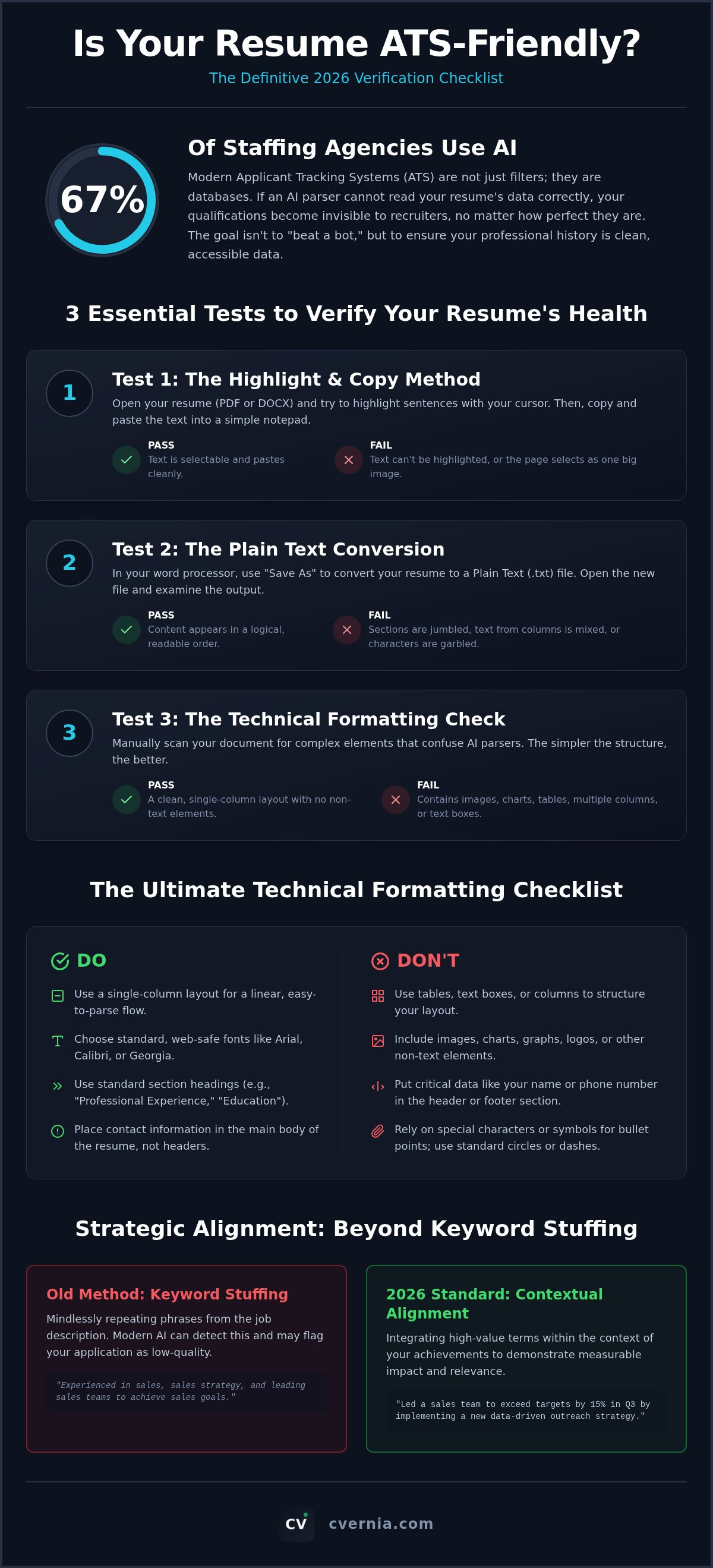
Open your resume PDF and attempt to highlight the text with your cursor. If you can't select specific words or if the entire page highlights as one large block, your text is likely "locked" inside an image or a complex vector. Recruiters often receive documents that look perfect to the human eye but appear completely blank to an automated system. Parseable text is the foundation of digital applications. If you can't copy and paste your work history into a standard notepad, the ATS cannot extract your skills or contact information. This simple test ensures your content is actually readable by the machine.
Test 2: The Plain Text Conversion
This test reveals how an ATS interprets your document's structure and flow. Open your resume in your word processor, select "Save As," and choose the ".txt" (Plain Text) format. Open the resulting file to see what remains. You might find jumbled contact details or overlapping experience sections that didn't exist in your original design. Columns are notorious for failing this test. They often cause the parser to read horizontally across the page, mixing your current job responsibilities with unrelated education history. If the plain text version looks like a chaotic puzzle, it's a clear sign you need to simplify your layout to a single-column format.
While manual checks catch glaring technical errors, they don't measure semantic relevance or ranking potential. In 2026, 67% of staffing agencies use AI-powered tools that look for more than just isolated keywords. They analyze the context and impact of your achievements to determine fit. A professional CV Compatibility & ATS Analysis provides the competitive data you need to rank higher. It moves beyond basic formatting to show you exactly how your experience aligns with specific job requirements. Combining these manual tests with truthful software analysis gives you a complete, actionable picture of your application's readiness. It's the most reliable way to confirm how do I know if my resume is ats friendly while managing multiple tailored versions of your career story.
The Ultimate Technical Formatting Checklist for 2026
After performing the manual tests mentioned earlier, you must verify your technical settings. If you're still wondering, "how do I know if my resume is ats friendly," the answer often lies in the hidden structure of your file. Modern parsers are efficient, but they still struggle with complex formatting that deviates from established standards. Following a strict technical checklist ensures your data remains intact throughout the extraction process.
File Formats and Document Structure
In 2026, PDF has become the gold standard for layout retention. It ensures your document looks exactly the same on a recruiter's screen as it does on yours. However, some older systems still parse .docx files more reliably. If you're applying to a legacy corporation, consider the Word format to be safe. Avoid using columns to organize your content. As we discussed in the plain text test, columns often lead to jumbled data extraction. Similarly, eliminate all non-parseable elements such as images, charts, and skill progress bars. These graphics look modern but appear as empty space or garbled code to a parser. Use standard section headings like "Work Experience" or "Professional Summary." Creative titles like "My Professional Journey" might confuse the AI and prevent it from categorizing your history correctly.
Typography and Visual Hierarchy
Font selection is about more than aesthetics; it's about data integrity. Sans-serif fonts like Inter, Source Sans Pro, and Calibri are the top choices for 2026. These clean lines are easy for Natural Language Processing tools to recognize. While bolding and italics help highlight your achievements for human eyes, avoid underlining text. Underlining can cut through the descenders of letters, making it harder for certain parsers to identify the character correctly. Follow these typography rules to maintain a professional look that machines can read:
- Use a 10-12 point font size for body text to ensure readability.
- Stick to a single-column layout to prevent parsing errors.
- Avoid icons or emojis, which can trigger system errors.
Keep your most critical information out of headers and footers. Many Applicant Tracking Systems simply ignore these areas during the parsing phase. If your phone number or email is stuck in a header, you might become unreachable. Place these details in the main body of the document instead. Remember the 6-second rule. Once the machine passes your resume, a human recruiter will spend only a few seconds reviewing it. Your design must be clean, punchy, and highly scannable. Striking this balance is the ultimate way to answer the question: how do I know if my resume is ats friendly? For more help choosing a layout that satisfies both bots and bosses, check out our guide on selecting an ats compliant resume template.
Strategic Alignment: Moving Beyond Keyword Stuffing to Real Relevance
If you're still asking, how do I know if my resume is ats friendly, you've already mastered the technical basics. Now, you must focus on strategic alignment. In 2026, AI parsers look for contextual relevance rather than just a long list of nouns. This means distinguishing between hard skills like "SQL" and contextual keywords like "data-driven decision making." One tells the system what you know. The other proves how you apply it. Modern systems prioritize candidates who demonstrate impact within a specific environment.
The question how do I know if my resume is ats friendly now becomes a question of strategic fit. Truthful tailoring is your most powerful tool. Align your genuine experience with the specific needs of the job description without inventing qualifications. This is critical because many modern systems use smart reapplication detection. If you submit three different versions of your resume to the same company with conflicting skills, the system flags the inconsistency. Honesty ensures your professional reputation remains intact while you target roles that truly match your expertise.
Identifying the Right Keywords
Scan the job posting for recurring nouns and industry-specific tools. These are the high-value terms the recruiter has prioritized. Use strong action verbs like "orchestrated" or "streamlined" to demonstrate the impact of your work rather than just listing your daily duties. Avoid the fake skills trap. While it's tempting to add a trending software you've never used, modern interviewers will uncover the truth quickly. Focus on the skills you actually possess that solve the employer's specific problems. This approach ensures you pass the initial AI scan and impress the human recruiter who reviews your file next.
Version Management for Multiple Applications
Managing ten different versions of a resume on your desktop is a recipe for confusion. You risk sending the wrong file to a top-tier employer, which can damage your credibility instantly. Use a centralized dashboard to track every version, interview note, and attachment. This level of organization allows you to maintain consistency across your LinkedIn profile and your submitted CV. When a recruiter cross-references your digital presence, they should see a unified professional brand that reinforces your expertise. Consistency is a key signal of professional maturity in the 2026 hiring landscape.
Take control of your job search by using a Career Application Management Platform to track your progress and manage your tailored versions with ease.
Beyond the Score: Managing Your Optimized Career Journey with CVernia
Passing a technical scan is only your first victory in the modern hiring landscape. Once you've answered the core question, how do I know if my resume is ats friendly, you need a strategy to handle the momentum that follows. CVernia’s ATS Analysis doesn't just provide a generic compatibility score. It delivers a comprehensive roadmap that highlights exactly where a parser might struggle with your specific data. This clarity allows you to fix issues with precision. You'll ensure your professional story reaches the recruiter’s desk exactly as you intended, without the fear of being lost in a digital stack.
Successful job seekers in 2026 treat their search like a high-stakes project. You'll likely manage several versions of your CV, each tailored for different roles and industries. Integrating these compatibility checks into a centralized Career Application Management Platform is essential for maintaining your sanity. It prevents the common pitfall of sending an outdated or incorrect version to a top-tier employer. By centralizing your workflow, you move from a state of reactive searching to proactive career management. You gain total visibility over your progress, turning the stress of the "black box" into a transparent, manageable process.
Centralized Application Control
Tracking your version history is as important as the resume itself. You need to know which specific keywords and formatting choices led to an interview invitation so you can replicate that success. Our platform allows you to manage attachments and interview prep notes in one secure location. This ensures you're always prepared when a recruiter calls. You won't have to scramble through old emails to find the exact document you submitted three weeks ago. Everything is organized and accessible. Optimize your resume and manage your journey with CVernia to take full control of your professional narrative and stay ahead of the competition.
Continuous Career Growth
Long-term success requires more than a one-time fix. It requires a commitment to professional development and strategic persistence. Use our smart reapplication detection to improve your odds on the second try. This technology helps you refine your skills and experience for a specific company without creating conflicting data points in their database. Beyond the initial application, leverage the Career Academy to master the nuances of the 2026 hiring market. We act as your trusted companion, providing the tools and guidance you need to navigate every transition with confidence. Your journey doesn't end with a simple pass or fail test. It evolves into a lifelong path of readiness and achievement.
Take Control of Your Professional Visibility
Mastering the technical foundations of your resume is the first step toward landing your next role. By utilizing the manual tests and formatting standards we've discussed, you ensure your data is accessible to modern AI parsers. You no longer need to wonder, how do I know if my resume is ats friendly, because you now have the tools to verify its health. Success in 2026 requires a balance between technical precision and authentic storytelling. Focus on contextual relevance and truthful representation to stand out to human recruiters who review your file after the machine passes it.
Ready to move beyond basic checklists? Access our all-in-one application tracking dashboard to organize every tailored version and interview note in one secure place. Benefit from our smart reapplication detection and a strict no fake skills guarantee that protects your professional reputation. We act as your trusted companion, providing the clarity you need to ensure your experience gets noticed. Start Your ATS Analysis and Manage Your Applications with CVernia today. You've done the hard work of building your career; let us help you showcase it with confidence. Your next breakthrough is within reach.
Frequently Asked Questions
Can I use a two-column resume for ATS in 2026?
No, you should generally avoid two-column layouts. While some advanced systems claim to handle them, most parsers still read text from left to right across the entire page. This often results in a jumbled mess where your job titles and dates blend together. Stick to a clean, single-column structure to ensure your data is extracted accurately. It's the most reliable way to maintain your professional narrative during the automated scan.
Does the ATS read headers and footers?
Many modern Applicant Tracking Systems ignore information placed in headers and footers. If you put your contact details or LinkedIn URL in these sections, the system might fail to create a complete profile for you. Always place your name, phone number, and email address in the main body of the document. This simple adjustment ensures that recruiters can actually reach you once the initial digital filtering process is complete.
Should I use a PDF or a Word document for my application?
PDF is the preferred standard for 2026 because it preserves your layout perfectly across all devices. However, if a job posting specifically asks for a .docx file, you should follow those instructions. Some older legacy systems still parse Word documents more effectively than PDFs. If you're wondering how do I know if my resume is ats friendly, starting with a clean PDF that passes the "Select-All" test is usually your safest bet.
How many keywords do I need to be considered "ATS friendly"?
There isn't a specific magic number of keywords required for success. In 2026, systems prioritize semantic relevance and context over simple keyword density. Focus on including high-value terms that appear naturally within your bullet points. Mentioning a tool or skill once or twice with a measurable achievement is far more effective than listing it repeatedly. Quality and truthful representation will always outperform robotic keyword stuffing in the eyes of both machines and humans.
Will images or headshots break the ATS parsing?
Yes, images, headshots, and complex graphics can significantly disrupt the parsing process. Most systems cannot see the content within an image, and these elements often cause technical errors that lead to a blank profile. Avoid using charts or skill bars that rely on visual representation. Focus on plain, parseable text to ensure the system captures every detail of your professional journey without any technical friction or data loss.
Is there a way to test my resume for free before applying?
You can perform immediate manual tests by using the "Select-All" highlight method or saving your file as a plain text document. These checks reveal if your text is readable and if the formatting remains logical. For a more comprehensive evaluation, utilize CVernia's ATS analysis tools. They provide a clear roadmap of your document's health, allowing you to fix issues before you officially submit your application to a potential employer.
Does the ATS score actually determine if I get an interview?
A high compatibility score does not guarantee an interview, but it does ensure your resume is visible to the recruiter. The ATS is a tool used to rank and organize candidates based on specific criteria. If your document doesn't parse correctly, you might never appear in the recruiter's search results. Once you pass the automated scan, a human will typically spend six to eight seconds reviewing your resume before deciding whether to move forward.
What happens if my resume is not ATS friendly?
If your resume isn't compatible, you essentially become invisible in the hiring process. The system may fail to extract your skills, job titles, or contact information, leaving you with an empty or jumbled candidate profile. This is often why qualified applicants never receive callbacks despite having the right experience. Understanding how do I know if my resume is ats friendly is the only way to ensure your hard-earned credentials actually reach a human decision-maker.


