
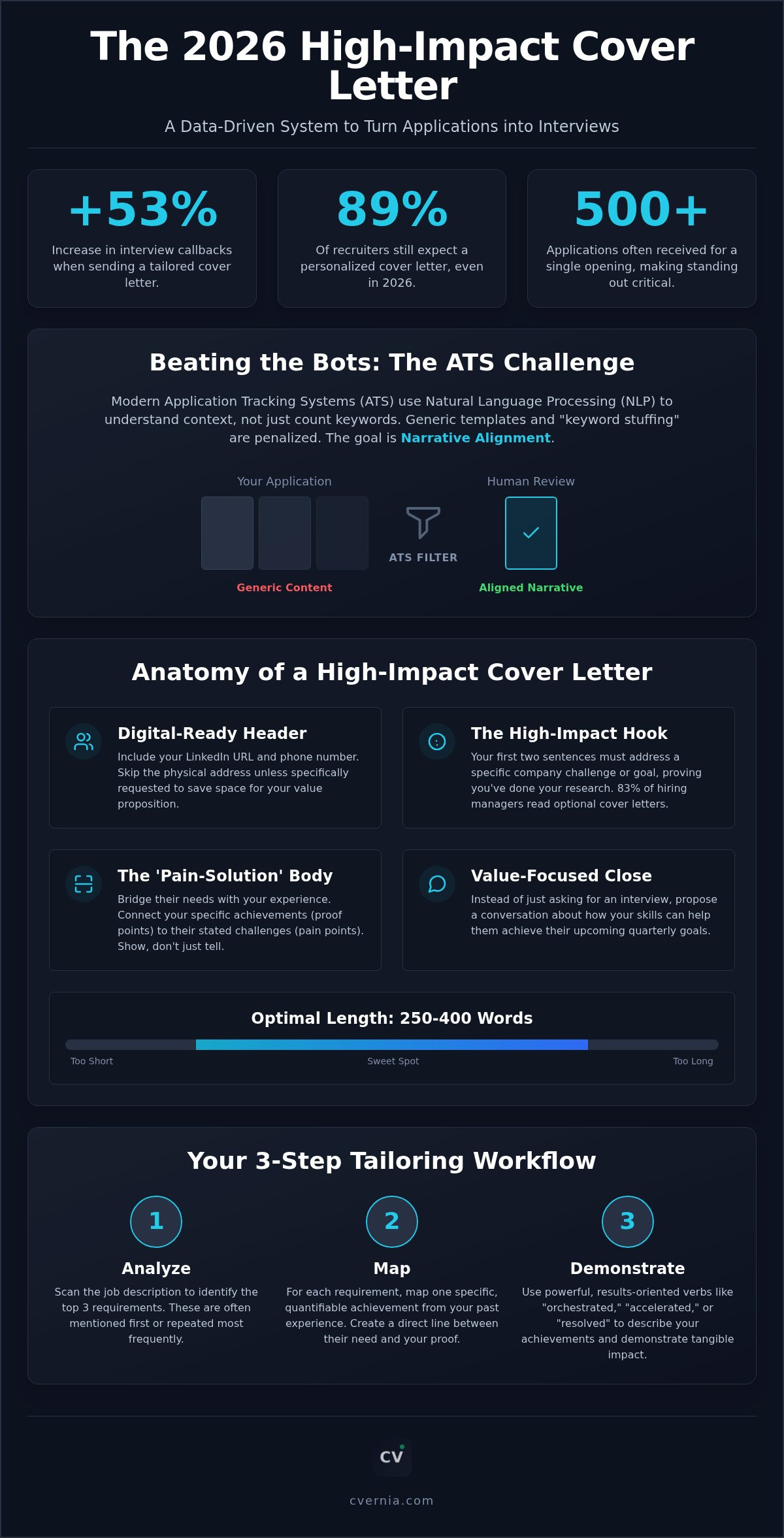
Did you know that sending a tailored cover letter can increase your interview callback rate by 53% compared to skipping it entirely? Even in 2026, 89% of recruiters still expect this personalized touch, yet most candidates feel completely overwhelmed by the thought of rewriting their pitch for every single application. You're likely tired of staring at a blank screen, wondering if your effort will just end up in an ATS black hole. Learning how to write a tailored cover letter shouldn't feel like a full-time job. It's about strategic alignment, not just busywork.
We've designed this guide to replace your uncertainty with a repeatable, data-driven system. You'll discover how to pass modern ATS filters while proving to hiring managers that you're the perfect cultural and technical fit. We'll walk through the exact 2026 standards for brevity, including the ideal 250 to 400 word count. By the end of this article, you'll have the tools to build a high-impact narrative that balances human authenticity with the technical precision recruiters demand. It's time to stop guessing and start getting invited to the interview room with confidence.
Key Takeaways
- Master how to write a tailored cover letter using a repeatable system that balances human narrative with technical ATS compatibility.
- Discover the 2026 standards for high-impact hooks that reference company-specific challenges within your first two sentences.
- Learn why manual tailoring often misses the mark and how to use data-driven analysis to align your experience with recruiter filters.
- Identify a streamlined workflow for extracting critical hard and soft skill keywords from any job description.
- Protect your productivity by implementing a version management system to handle multiple applications without losing quality or focus.
The Strategic Shift: Why Tailored Cover Letters Win in 2026
Tailoring is the intentional alignment of your professional journey with the specific problems a company needs to solve. While the basic concept of what a cover letter is hasn't changed, the technology reading it has evolved significantly. In the current hiring market, recruiters often face over 500 applications for a single opening. They rely on sophisticated bots to do the heavy lifting before a human ever sees your name. This is why mastering how to write a tailored cover letter is no longer a "nice to have" skill; it's the absolute barrier for entry. You aren't just changing a company name in a template. You're building a truthful competitive advantage by showing exact precision in every paragraph.
Avoid the common temptation of keyword stuffing. Modern screening tools are designed to detect unnatural phrasing and will penalize applications that feel like a list of buzzwords. Instead, focus on narrative alignment. This means weaving those critical skills into a story that proves you've done the work. You want to show, not just list. At CVernia, we act as your digital mentor to help you manage this technical side of tailoring. Our platform, available via subscription for full access, ensures your version management stays organized as you customize your pitch for different roles. We believe in truthful representation, so your competitive edge comes from clarity, not exaggeration.
The Death of the Generic Template
Sending a one-size-fits-all letter is now a major red flag for hiring managers. Many modern recruitment platforms use AI-driven sentiment analysis to spot standard templates in seconds. These generic documents signal a lack of genuine interest and suggest you're just playing a numbers game. In a crowded market, your letter needs to prove you've researched the company's specific goals. If your pitch could apply to three different competitors, it isn't tailored enough. Authentic, personalized content is what catches a recruiter's eye when they're tired of seeing the same recycled phrases.
How ATS Bots Read Your Cover Letter
Modern Application Tracking Systems use Natural Language Processing (NLP) to understand context, not just count words. Your letter must complement your resume by providing the "why" behind your achievements. Don't simply repeat your bullet points. Use this space to expand on the impact of your actions. Bots are smarter now; they analyze the relationship between your skills and the company's stated mission. They look for specific examples that mirror the job description's requirements. ATS compatibility in the context of cover letters is the measure of how effectively your narrative matches the specific intent and requirements of the job description. By focusing on this alignment, you ensure the technology works for you rather than against you.
Anatomy of a High-Impact Tailored Cover Letter
Mastering the structure of your pitch is just as important as the content itself. While you might follow a National Careers Service step-by-step guide for the basics, a high-impact 2026 application requires a more surgical approach. Your header must be digital-ready. Include your LinkedIn URL and a professional phone number, but skip the physical address unless the job posting explicitly asks for it. This saves valuable space for your hook. Research shows that 83% of hiring managers will read your cover letter even if it's optional, so your first two sentences must address a specific company challenge. Don't just say you're applying; show you've been paying attention to their recent market moves or project launches.
The body of your letter serves as the bridge between your past and their future. This is where you connect your proof points to their pain points. Instead of a generic list of duties, focus on how your specific skills solved a problem similar to what the employer is currently facing. If you're unsure where to start, our tools at CVernia can help you identify these critical alignment areas. Finish with a call to action that centers on the value you bring. Suggest a conversation about how your expertise can contribute to their upcoming quarterly goals rather than simply asking for an interview.
The 'Pain-Solution' Framework
Analyze the job description to find the top three requirements. These are usually the skills mentioned first or repeated most often. Map one specific achievement to each of these three requirements. Use active, results-oriented verbs like "orchestrated," "accelerated," or "resolved" to demonstrate impact. This method ensures you are learning how to write a tailored cover letter that speaks directly to the recruiter's needs. It transforms your letter from a passive summary into a proactive solution for the hiring team.
Addressing the Hiring Manager
Personalization starts with the salutation. Avoid "To Whom It May Concern" at all costs; it's the fastest way to look like you're using a template. Try to find the name of the department head or the internal recruiter through LinkedIn or the company's "About Us" page. If the name is truly unavailable, use a specific title like "Dear [Department] Hiring Manager." For more tips on getting this right, check out our Addressing Your Cover Letter FAQ. A personalized greeting creates an immediate psychological connection and proves you've done your homework.
Data-Driven Tailoring: Using ATS Analysis to Align Your Narrative
Manual review is excellent for style, but it can't see what the algorithm sees. In 2026, understanding how to write a tailored cover letter requires a shift from pure storytelling to precise data alignment. You're aiming to meet a specific technical threshold set by the hiring company's software. Research shows that applications with no cover letter have a 10.7% callback rate, while those with a tailored letter jump to 16.4%. This difference often comes down to how well your keywords align with the recruiter's specific search parameters. You need to ensure your most relevant skills are visible to the bots before a human ever reads your first sentence.
Using ATS resume checkers allows you to scan for keyword density before you hit submit. This isn't about gaming the system. It's about ensuring your narrative uses the same vocabulary as the job description. If the recruiter's tool is looking for "strategic project management" and you wrote "leading high-level initiatives," the bot might mark you as a partial match. CVernia’s CV Compatibility & ATS Analysis tool bridges this gap by highlighting these invisible disconnects. It helps you maintain a balance between being bot-friendly and human-readable, ensuring your pitch resonates with both the software and the hiring manager.
Manual Tailoring vs. Platform-Assisted Tailoring
Manual tailoring is incredibly time-consuming. You might spend hours on one letter only to realize you forgot to mention a core skill you actually possess. Platform-assisted tailoring increases efficiency, moving you from uncertainty to readiness in minutes. This speed doesn't sacrifice quality; it enhances accuracy by detecting missing skills you forgot to mention. By using a centralized application tracking dashboard, you ensure your cover letter consistently supports your CV without contradicting it. This version management is essential when applying to multiple roles, preventing the "version fatigue" that often leads to avoidable errors.
Maintaining Truthfulness in the Age of AI
The rise of generic AI tools has created a new risk: skill hallucination. Some generators invent qualifications to fit a job description, which is a fast track to a blacklisted application. CVernia takes a different approach. Our platform acts as a digital mentor, using truth-focused content generation. We only use the real experience you've provided to build your narrative. Honesty remains your best long-term career strategy because trust is the foundation of any professional relationship. While full access to these advanced features requires a subscription, the investment ensures your applications remain both competitive and authentic. We help you present your true self with a strategic advantage.
A Step-by-Step Workflow for Customizing Your Application
Dissecting the job description is your first move. You need to identify the core problems the company is trying to solve. Look for hard skills like technical proficiencies and soft skills like cross-functional leadership to build your foundation. Research the company's 2026 mission statement or recent press releases. This provides the context for your narrative hook. Select exactly two or three achievements from your career that mirror their current hurdles. When you draft the content, use a "You-centric" approach. Focus on how your expertise serves their goals rather than just listing what you want from the role. Finish with a final compatibility check to ensure your language aligns with the job's specific requirements.
This workflow turns a daunting task into a manageable process. By focusing on alignment, you move from a generic applicant to a strategic partner. Most candidates fail because they treat their letter as a biography. You should treat it as a proposal. Show them you understand their market position and have the specific tools to help them succeed. This level of precision is exactly what modern recruiters look for in a sea of automated applications. It demonstrates both your professional competence and your genuine interest in their success.
Keyword Extraction for 2026
Mandatory skills are the non-negotiables for the ATS. If the posting lists "Cloud Architecture" as a requirement, that term must appear in your letter. Preferred skills often act as the tie-breaker for human recruiters. Weave these into your professional story naturally. Avoid listing them in a block. For example, instead of saying you have "communication skills," describe a time you resolved a specific project bottleneck. This prevents the robotic feel of over-optimized text. You want the keywords to feel like a natural part of your career journey, not a forced addition.
The 10-Minute Tailoring Challenge
Efficiency is the key to scaling your search. You can master how to write a tailored cover letter without spending hours on every application. Use our tailored cover letter generator to create a high-quality base draft in seconds. Once the draft is ready, spend five minutes adding personal flair. Mention a specific detail from your research to prove human oversight. Finish with a formatting check to ensure your layout is clean and ATS-friendly. This balanced approach allows you to maintain high quality while applying to multiple roles. Ready to streamline your process? Start your application management journey today with our suite of optimization tools.
Scaling Your Strategy: Managing Multiple Tailored Versions
Applying to dozens of roles can quickly lead to "Version Fatigue," a state where the quality of your customizations begins to slip. When you're managing thirty different versions of the same pitch, it's easy to lose track of which specific narrative worked for which employer. Learning how to write a tailored cover letter is only half the battle; the other half is maintaining that precision across every single submission without burning out. Disorganization is the primary cause of application errors, such as referencing the wrong company or missing a critical keyword you used in a previous successful draft.
A job search management system is essential for modern job seekers who want to maintain a high standard of quality at scale. Centralized dashboards allow you to track exactly which version of a letter was sent to which company, providing a clear history of your outreach. You can also utilize Smart Reapplication Detection to review and improve upon previous versions of your documents. This technology identifies when you are applying to similar roles and helps you refine your pitch based on what has worked before. It ensures that your strategy evolves with every click, making you more efficient as your search progresses.
Centralized Application Management
Move away from messy spreadsheets and buried desktop folders that often lead to embarrassing mistakes. A centralized platform ensures you link every tailored letter directly to your interview notes and company research. This level of organization keeps your attachments structured so you are always "interview-ready" when a recruiter calls. When you can see every version of your application in one place, you eliminate the risk of sending the wrong file. It builds a foundation of preparedness that allows you to focus on the human side of the interview rather than hunting for lost documents.
Continuous Optimization
Treat your job search like a data-driven project. Analyze which tailored versions of your letters get the most "hits" and use that data to refine your future pitches. You can learn from rejections by reviewing your ATS compatibility scores and identifying exactly where your narrative alignment fell short. This feedback loop transforms every "no" into a strategic adjustment for the next "yes." Continuous improvement is the secret to a shorter, more successful job search. Ready to take control of your professional journey? Start managing your applications with CVernia today and experience the clarity of a professional, organized search. Full access to our advanced tracking and version management tools is available via subscription, providing you with a reliable partner for your entire career journey.
Take Control of Your Professional Narrative
Mastering the application process in 2026 means moving beyond basic templates. You've discovered that successful tailoring requires a strategic balance between human storytelling and technical precision. By focusing on pain-solution frameworks and data-driven alignment, you ensure your message reaches the right eyes. Understanding how to write a tailored cover letter is your ticket to standing out in a crowded market. It's about proving to the recruiter that you aren't just looking for any job, but specifically their job.
Efficiency doesn't have to come at the cost of quality. You can scale your search without losing the personal touch that makes you unique. Optimize your application journey with CVernia's tailoring tools. Our platform provides the technical edge you need with ATS-compatibility analysis and smart reapplication detection. Manage every version with a centralized application dashboard to ensure you're always prepared for the next step. While full access is subscription-based, the strategic advantage you gain is an investment in your future success. You have the skills and the system; now it's time to show the world what you can do with confidence.
Frequently Asked Questions
How much should I change in my cover letter for each application?
You should aim for about 30% to 50% customization for every role. Focus your energy on the opening hook and the specific proof points that align with the top three requirements in the job description. You don't need to rewrite your entire history, but you must ensure the narrative specifically addresses the company's current hurdles. Using a centralized dashboard helps you manage these versions efficiently without losing the core of your professional identity.
Can I use AI to write my cover letter in 2026?
Yes, you can use AI as a digital mentor, but avoid generic generators that often hallucinate skills. In 2026, recruiters use sentiment analysis to spot recycled templates instantly. CVernia focuses on truth-focused content generation, meaning we only use your actual experience to help you learn how to write a tailored cover letter. This ensures your application remains authentic and passes human scrutiny after clearing the technical ATS filters.
Does the ATS really read the cover letter or just the resume?
Modern Applicant Tracking Systems definitely scan cover letters for keyword density and narrative alignment. While your resume provides the data, the letter provides the necessary context. In 2026, bots use Natural Language Processing to see if your professional story matches the job's intent. Skipping the letter or sending a generic one can lower your overall compatibility score, potentially preventing your resume from ever reaching a human recruiter's desk.
How long should a tailored cover letter be?
A tailored cover letter should be exactly one page long, typically ranging between 250 and 400 words. This length allows for three to four punchy paragraphs that deliver high impact without overwhelming the reader. Recruiters in 2026 prefer brevity and clarity over long narratives. Focus on making every sentence count by directly connecting your achievements to the employer's specific pain points and their stated mission or upcoming quarterly goals.
What if I don't have all the skills listed in the job description?
Focus on your transferable skills and your ability to learn quickly. You don't need 100% of the listed qualifications to be a strong candidate. Use your letter to explain the "why" behind your experience, showing how your existing skills solve the company's problems. Truthful representation is vital; never invent qualifications. Instead, emphasize your unique perspective and your proven track record of adapting to new technical challenges or market shifts.
Should I mention the company's name in the first paragraph?
Absolutely. Mentioning the company name and a specific challenge they face in the first two sentences is a 2026 professional standard. This immediately signals to both the ATS and the hiring manager that your application isn't a generic mass-submission. It creates an immediate psychological connection. By referencing their mission or a recent project, you prove you've done your research and are genuinely invested in their specific success.
How do I tailor a cover letter if I'm changing careers?
Use the cover letter to bridge the gap between your past industry and your new target role. Highlight universal skills, such as project management or leadership, that apply directly to the new position. This is the perfect place to provide the context your resume might lack. Explain your motivation for the shift and show how your diverse background provides a fresh, valuable perspective that a traditional candidate might not offer.
Is it worth tailoring a cover letter for entry-level positions?
It's highly worth the effort. Research shows that applications with a tailored letter have a 16.4% callback rate compared to just 10.7% for those with no letter at all. For entry-level roles where many candidates have similar experience, a personalized pitch is your best competitive advantage. It demonstrates your work ethic and professional maturity, proving to the hiring team that you're prepared to contribute to their goals from day one.


