
What if your job search felt less like a chaotic race against the clock and more like a high-performance command center? You've likely felt the sting of a missed follow-up or the sudden panic of realizing you sent the wrong CV version to a dream recruiter. Learning how to organize job applications is the only way to stop feeling like your hard work is disappearing into a digital black hole. You deserve a system that works as hard as you do.
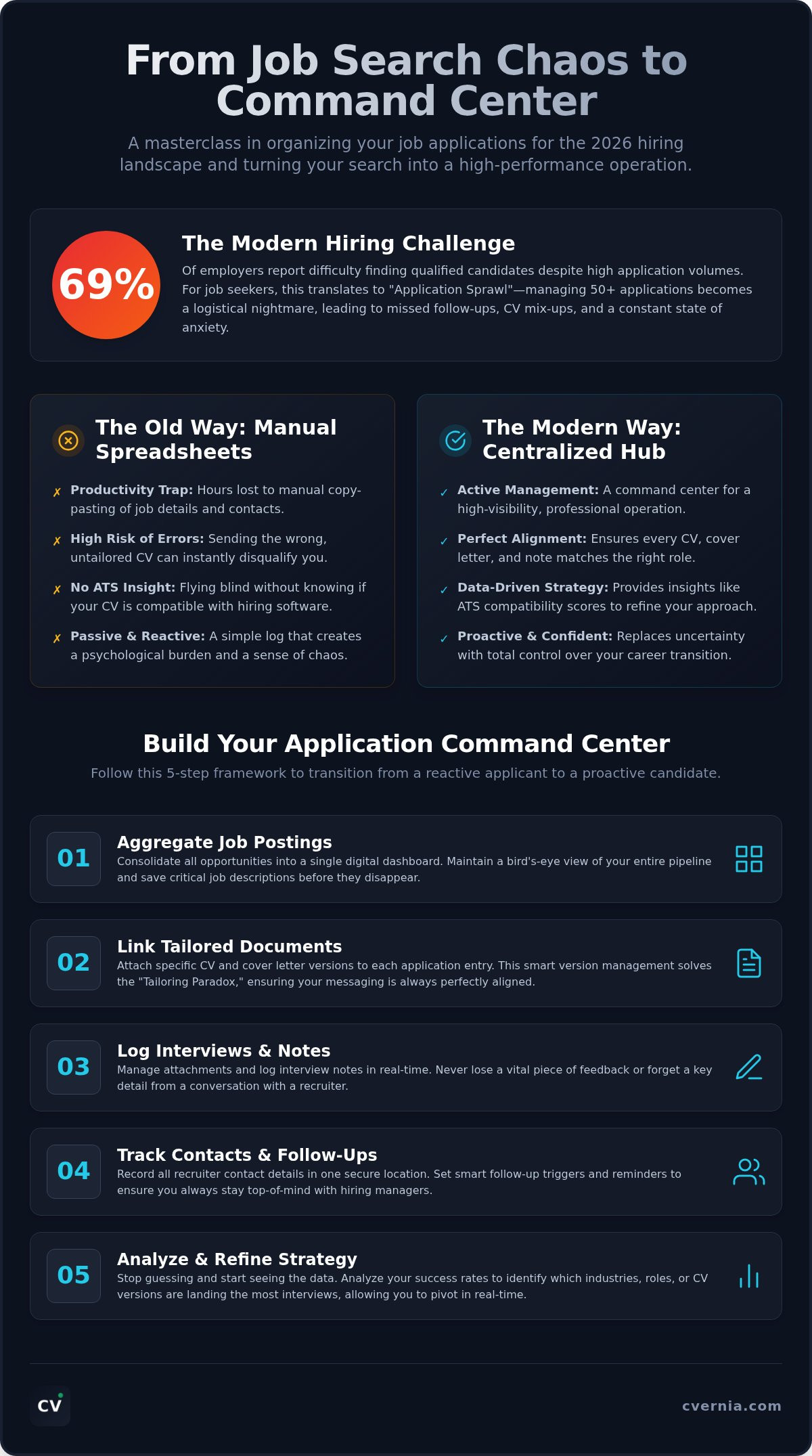
We understand that the 2026 hiring landscape is complex; 69% of employers report difficulty finding qualified candidates despite high application volumes. This masterclass teaches you how to build a centralized system that tracks every CV version, interview note, and ATS score. You'll master the art of high-volume searching without sacrificing the quality of your personal brand or losing track of vital contact names.
Stop guessing which applications are performing and start seeing the data. We'll show you how to build a professional dashboard that speeds up your tailoring process and ensures you never miss a beat. From managing pay transparency details to navigating new AI hiring regulations, you're about to transform your career transition from a source of stress into a streamlined path to success.
Key Takeaways
- Move beyond the limitations of manual spreadsheets and discover why a centralized digital dashboard is essential for high-volume job searching in 2026.
- Learn a tactical 5-step framework on how to organize job applications so every CV version and interview note stays perfectly aligned with the right role.
- Navigate the "Tailoring Paradox" by implementing smart version management that allows for deep customization without compromising your core data.
- Utilize advanced features like smart reapplication detection and ATS compatibility scoring to refine your strategy and learn from every submission.
- Build a reliable "command center" for your career that tracks interview dates, contact names, and attachments in one secure, accessible location.
The Chaos of Modern Hiring: Why Spreadsheets Fail in 2026
The modern job market moves at a pace that renders traditional spreadsheets obsolete. When you're managing "Application Sprawl," applying to 50 or more roles across various industries, a simple table isn't enough to sustain your momentum. You need a system that tracks the nuances of every interaction. Manual logging often results in lost time and missed follow-up windows; these are the hidden costs of an unorganized search. If you're wondering how to organize job applications effectively, you must first acknowledge that your current manual process might be holding you back.
Version control is the primary hurdle for today's job seekers. Tailoring your CV is non-negotiable, yet managing dozens of slightly different documents becomes a logistical nightmare without the right tools. This chaos creates a significant psychological burden. It shifts your mindset from professional confidence to a state of constant anxiety. Transitioning to a centralized command center replaces that uncertainty with a sense of total control.
The Limitations of Manual Data Entry
Relying on Excel or Google Sheets for your career moves is a productivity trap. Copy-pasting job descriptions and contact names into individual cells consumes hours that you should spend on networking or interview prep. There's also the very real risk of a CV Mix-up. Sending the wrong tailored version to a recruiter doesn't just look unprofessional; it actively disqualifies you. You can't afford to lose a dream role because of a simple filing error.
Manual systems also fail to account for the technical side of hiring. They can't tell you how applicant tracking systems work or if your document is compatible with a specific employer's software. An Applicant Tracking System (ATS) is designed to filter candidates based on specific algorithms. If your manual tracking doesn't include compatibility scores, you're essentially flying blind in a data-driven world.
From Passive Logging to Active Management
Modern hiring requires a shift from passive logging to active Career Application Management. This holistic strategy ensures that every move you make is backed by specific insights. In a competitive 2026 market, visibility is your greatest asset. You need to know which CV versions are getting hits and which ones are being ignored. Knowing how to organize job applications through a dedicated platform ensures you remain prepared, aligned, and ready for every opportunity.
Application management is a strategic advantage that transforms the job search from a series of disjointed tasks into a high-visibility professional operation. By treating your search like a managed project, you gain the clarity needed to pivot your strategy in real-time. This proactive approach allows you to focus on the human side of the interview while your system handles the logistics.
Building a Centralized Application Hub: The 5-Step Framework
Mastering how to organize job applications requires more than just a list of names and dates. It demands a structured hub that serves as your professional command center. This 5-step framework transitions you from a reactive applicant to a proactive candidate who stays ahead of the hiring curve.
- Step 1: Aggregate job postings into one digital dashboard to maintain a bird's-eye view of your entire pipeline.
- Step 2: Link specific CV and cover letter versions to each entry to ensure your messaging is always perfectly aligned.
- Step 3: Log interview notes and manage attachments in real-time so you never lose a vital piece of feedback.
- Step 4: Record recruiter contact details and set follow-up triggers to stay top-of-mind.
- Step 5: Analyze your success rates to identify which industries or CV versions are landing the most interviews.
Aggregating Your Opportunities
Start by pulling every interesting lead into a dedicated job interview tracker. In the 2026 market, job descriptions often vanish from boards once the application window closes; saving them immediately is critical for your eventual interview preparation. Don't just track by "Application Status." Add a field for "Excitement Level" to help you prioritize high-value roles when your schedule gets tight. With 45% of job seekers currently looking for at least three months, maintaining a clear visual pipeline prevents burnout and keeps your focus on the best opportunities.
Post-Application Logistics
Most tracking systems stop at the "Applied" stage, but the real work begins after you hit submit. Learning how to organize job applications through a centralized hub ensures you never scramble for a name during a surprise phone screen. Centralize recruiter names, email threads, and LinkedIn profiles within your hub so you can reference them instantly. You should also store role-specific portfolios, references, and certifications as attachments. Having these ready allows for faster responses when a hiring manager asks for proof of your skills.
Managing these logistics manually is often a recipe for "ghosting" yourself. Set automated reminders for follow-ups, especially in states with new pay transparency laws where salary discussions happen earlier in the process. Utilizing an all-in-one application tracking dashboard helps you stay ahead of these deadlines. By organizing your preparation alongside your tracking, you ensure that every interaction with a potential employer is informed, professional, and perfectly timed.
Manual Spreadsheets vs. Application Management Platforms
Evaluating the time-to-value ratio is the first step in deciding how to organize job applications. While setting up a basic spreadsheet feels fast, the application speed it offers is severely limited. A dedicated platform provides a pre-built infrastructure that allows you to scale from 10 to 100 applications without the system breaking down. Tabbed sheets inevitably become cluttered and unmanageable. A centralized dashboard maintains clarity regardless of your application volume. It's about moving from a simple list to a professional operations hub.
Platforms also ensure truthful representation. They help you align your real skills with job descriptions without the temptation to over-embellish. You stay honest, optimized, and ready for scrutiny. This balance is difficult to maintain in a manual list. You might easily lose track of which version of your professional story you've presented to a specific recruiter. Using a system that links documents to roles ensures your narrative remains consistent across the entire hiring journey.
The Intelligence Gap
Spreadsheets are fundamentally static containers. They cannot perform ats compliant resume analysis or provide real-time feedback on your document's health. While you're manually updating a status from "Applied" to "Interview," a platform automates these triggers through smarter workflows. Smart reapplication detection is another critical advantage. It prevents you from wasting effort on roles you've already targeted, ensuring your energy is spent on fresh, high-probability opportunities. This level of technical insight is what separates a modern job search from an outdated one.
The Cost of "Free" Tools
Many job seekers choose free tools to save money. They rarely calculate their personal hourly rate. If you spend five hours a week manually organizing your data, you're losing time that could be spent on high-impact networking. Professional management tools are a career investment that pays dividends in faster placement and higher salary offers. You're not just buying software; you're buying back your time. Free tools often cost more in lost opportunities because they lack the analytical depth needed to win in 2026.
Tactical Version Management: Organizing Your CVs and Cover Letters
Effective document management is the backbone of a successful search. When you master how to organize job applications, you solve the "Tailoring Paradox," which is the need to customize your materials for every role without losing your core professional data. You shouldn't have to start from scratch every time you find a new lead. Instead, map your CV versions to specific job categories or industries. This allows you to pivot quickly when a recruiter calls. It also ensures your ATS compatibility scores remain high because you're using the right keywords for the right sector. Your organization system should act as a library of your professional achievements, ready to be deployed at a moment's notice.
Managing CV Iterations
Relying on file names like "Resume_Final_v2" or "CV_Marketing_2026" is a dangerous strategy that leads to confusion. These names provide zero context when you're managing dozens of active applications. Use a system that links each document directly to the job posting. This ensures your messaging remains consistent throughout the hiring process. You should also use a tailored cover letter generator to align your narrative with specific job descriptions. Tracking which keywords triggered specific interview invites helps you refine your master document over time. By knowing exactly which version of your CV a recruiter is looking at, you can prepare for interviews with total confidence.
Smart Reapplication Strategies
Most job seekers treat every application as a fresh start, but this approach ignores valuable historical data. You need to identify when you are reapplying to a previous company or a similar role type within the same conglomerate. Smart reapplication detection allows you to review old versions and learn from past rejections. Did a specific portfolio piece get a positive reaction last time? Use it again. Did a certain phrasing lead to a quick rejection? Change it. Updating your attachments based on previous feedback turns every "no" into a data point for a future "yes." This historical view is a critical part of how to organize job applications for long-term career growth. It transforms your search from a numbers game into a strategic evolution of your personal brand.
Take control of your professional narrative and stop losing track of your best work. Start managing your CV versions and reapplication history with CVernia's intelligent platform today.
CVernia: The Intelligent Companion for Your Job Search
CVernia isn't just a tool; it's a partner that understands the hidden mechanics of the modern hiring market. While earlier sections explored the theory of how to organize job applications, this platform provides the practical infrastructure to execute that strategy flawlessly. It bridges the gap between simply tracking a status and actively managing your professional growth. By centralizing your entire journey, you move from a state of reactive stress to one of proactive readiness. You're no longer just a name in a database. You're a prepared professional with a system that supports every move you make.
The CVernia Workflow
The journey begins with job discovery and flows seamlessly into interview preparation. Our Application Tracking Dashboard gives you real-time visibility into every move. You'll never have to worry about the "CV Mix-up" because every version is locked to its specific role. Smart detection features save you from embarrassing reapplication errors by alerting you to previous attempts at the same firm. This allows you to leverage your history rather than being haunted by it. You can see exactly what worked in the past and refine your approach for the future.
Leveraging ATS analysis ensures that your professional truth is heard by the bots. You don't need to guess if your CV is compatible; the platform provides the data you need to align your skills with the hiring manager's expectations. This structured preparedness allows you to focus on the human connection during the interview. Your logistics are handled by a trusted companion, leaving you free to demonstrate your value with total confidence.
Your Strategic Advantage
Organized candidates perform better because they aren't distracted by missing details. When you have a "digital mentor" in your pocket, you carry the confidence of a professional who is fully in control of their narrative. You're not just applying for jobs; you're building a library of success. Our Career Academy further bridges the gap between tracking and learning, offering resources that help you refine your approach based on real-world hiring trends and modern recruitment technology.
Empowerment comes from knowing exactly where you stand. With 45% of job seekers looking for at least three months, having a system that maintains your momentum is vital. You've learned the framework for how to organize job applications, now it's time to use the technology designed to support it. Stop feeling like you're shouting into a void and start managing your career with the precision it deserves. Your next role is waiting, and you have the tools to claim it.
Start organizing your job search with CVernia today
Take Control of Your Career Journey
The transition from a chaotic job search to a streamlined professional operation begins with a single decision. You've learned that manual spreadsheets are no longer enough to manage "Application Sprawl" in the competitive 2026 market. By implementing a centralized hub, you ensure that every tailored CV and interview note is exactly where it needs to be. Mastering how to organize job applications isn't just about tracking dates; it's about building a library of your professional success that evolves with every submission.
Empower yourself with tools that bridge the gap between simple logging and strategic management. High-performing candidates use data to their advantage, leveraging technology to stay aligned with hiring manager expectations. It's time to stop feeling like your applications are disappearing and start seeing the visibility you deserve. Your career deserves a command center that works as hard as you do.
Master your job search with the CVernia Application Tracking Dashboard. Benefit from Smart Reapplication Detection, ATS Compatibility Scoring, and Integrated Interview Notes to stay ahead of the competition. You're ready to turn uncertainty into readiness and claim the role you've worked for. Your next chapter starts with total preparedness.
Frequently Asked Questions
How do I keep track of 50+ job applications effectively?
Use a centralized application tracking dashboard instead of manual spreadsheets to learn how to organize job applications effectively. High-volume searches require a system that links every CV version, cover letter, and interview note to the specific role. This prevents "Application Sprawl" and ensures you never miss a follow-up window. A dedicated platform provides the real-time visibility needed to manage dozens of active leads without losing your professional edge.
Is a spreadsheet enough for a modern job search in 2026?
No, a static spreadsheet lacks the analytical depth required for the 2026 hiring environment. While sheets can log dates, they can't perform ATS compatibility analysis or track complex version history. Modern platforms offer smart reapplication detection and automated reminders that a manual table simply cannot match. You need a dynamic system that handles the logistics while you focus on the human side of the interview process.
How do I manage different versions of my CV for various roles?
Implement a version management system that maps each CV iteration to a specific job category or industry. Avoid generic file names like "Final_v2" and instead use a platform that links documents directly to the application entry. This ensures you always know exactly which professional story you've shared with a recruiter. It's the most effective way to learn how to organize job applications without risking a document mix-up.
What is the best way to organize interview notes?
Centralize your notes within your application hub alongside the job description and recruiter contact info. Use a dedicated interview notes dashboard to record feedback, questions asked, and follow-up details immediately after the call. Keeping these attachments and insights in one secure location prevents vital information from being lost in email threads. This structured preparedness allows you to build on previous conversations during subsequent interview rounds with total confidence.
Can I track applications across multiple job boards in one place?
Yes, a career application management platform allows you to aggregate postings from various sources into a single digital command center. This prevents you from jumping between LinkedIn, Indeed, and company portals to check your status. Consolidating your pipeline into one dashboard provides a bird's-eye view of your progress. It ensures you maintain a consistent follow-up strategy regardless of where you originally found the opportunity or the recruiter involved.
How does an application tracker help with ATS compatibility?
Advanced trackers include integrated ATS compatibility scoring to measure how well your CV aligns with a specific job description. This analysis helps you identify missing keywords or formatting errors before you hit submit. By organizing your applications through a system that "thinks" like a recruiter's software, you increase your odds of passing initial filters. It transforms your tracking from passive logging into an active optimization strategy that actually lands interviews.
Should I save the job description for every role I apply to?
Absolutely, as job postings are often taken down once the application window closes or the role is filled. Having a saved copy within your tracking system is essential for accurate interview preparation and follow-up. You'll need to reference the specific requirements and responsibilities to tailor your answers during the screening process. A centralized hub makes it easy to store these descriptions as permanent attachments for every entry you create.
How do I handle reapplying to a company I was previously rejected from?
Use smart reapplication detection to review your previous version and identify areas for improvement. Analyze old interview notes and feedback to understand why the earlier attempt didn't result in an offer. This historical data is a goldmine for refining your strategy. By comparing your new CV iteration against the previous one, you can ensure your professional growth is clearly visible to the hiring team this time around.


