

Did you know that 34% of recruiters consider a lack of result statements on a resume an absolute dealbreaker? In a job market where nearly 99% of Fortune 500 companies rely on AI-driven systems to filter talent, simply listing your past duties is no longer enough. Learning how to quantify financial achievements on resume documents is the definitive way to ensure you move past automated filters and into the interview room.
It's frustrating to feel like your career impact is being reduced to a series of technical numbers. You might worry that a data-heavy page looks cluttered or that you're choosing the wrong metrics to highlight. We understand these pressures, and we're here to help you turn that uncertainty into professional confidence. This guide will teach you to master the art of translating your fiscal impact into clear, data-driven bullet points that satisfy modern ATS platforms like Greenhouse and prove your ROI to hiring managers.
You'll gain a step-by-step framework for identifying your most valuable fiscal contributions and optimizing them for 2026 recruitment technology. Prepare to build a resume that doesn't just list your history, but proves your value and sets the stage for successful salary negotiations.
Key Takeaways
- Identify the "business owner mindset" recruiters crave by distinguishing between your technical financial tools and strategic analytical impact.
- Optimize your application for 2026 hiring software by learning how to quantify financial achievements on resume templates using specific nomenclature and currency-related keywords.
- Apply the "Action + Metric + Outcome" formula to translate complex fiscal data into punchy, readable bullet points that prove your value.
- Maintain professional integrity by learning how to truthfully estimate financial impact even when exact company data is proprietary or restricted.
- Leverage CVernia’s real-time ATS compatibility scoring to ensure your financial metrics are correctly weighted and visible to hiring managers.
Why Financial Achievements are Critical for 2026 Resumes
Financial achievements represent any measurable impact you've had on a company's bottom line. While many candidates believe these metrics belong solely in the accounting department, 2026 hiring trends prove otherwise. Today, every role is a financial role. Whether you work in marketing, HR, or operations, your value is tied to fiscal outcomes. The purpose of a resume has evolved from a simple work history to a high-stakes business case. Learning how to quantify financial achievements on resume documents allows you to present yourself as a strategic asset rather than just an expense.
Hiring managers now prioritize a "business owner mindset." They want professionals who understand how their specific tasks influence the broader corporate ecosystem. In a landscape where 75% of resumes are filtered out by AI before a human sees them, your data acts as a universal proof of seniority. It replaces vague qualitative descriptions with hard evidence that even the most advanced ATS algorithms can't ignore. High-growth firms specifically look for candidates who can demonstrate revenue growth or cost savings with precision.
The Universal Language of Fiscal Responsibility
Modern department heads require P&L (Profit and Loss) literacy across their entire teams. When you describe your work, you must connect daily operations to corporate financial health. If you optimized a workflow, you didn't just "save time"; you reduced operational costs by a specific percentage. This shift in perspective is vital. Quantifying your impact reduces recruiter skepticism during the initial 7 to 9-second scan. It provides immediate, verifiable context for your skills and shows you understand the mechanics of profitability.
Meeting 2026 Corporate Expectations
The demand for managers who can justify project costs through ROI (Return on Investment) has never been higher. Proving you can manage a budget or drive revenue signals your readiness for executive-level responsibilities. You must bridge the gap between technical execution and fiscal outcomes. By focusing on how to quantify financial achievements on resume drafts, you demonstrate that you aren't just doing the work; you're driving the business forward. This level of transparency builds trust and positions you for higher salary tiers during negotiations because your value is already documented in dollars and cents.
Categorizing Your Expertise: Hard vs. Soft Financial Skills
Recruiters in 2026 aren't just looking for a list of responsibilities; they're searching for a specific balance of technical mastery and strategic vision. Learning how to quantify financial achievements on resume sections begins with categorizing your expertise into hard and soft skills. This distinction allows you to align your experience with the specific needs of a Job Description (JD) while ensuring your bullet points remain readable for both human eyes and AI filters. Always prioritize the skills explicitly mentioned in the job post to maximize your compatibility score.
Hard Financial Skills: Tools and Technical Proficiencies
Hard skills are the quantifiable technical abilities you use to perform your job. In 2026, proficiency with modern financial systems is a non-negotiable requirement for many corporate roles. You should highlight your experience with ERP systems such as SAP, Oracle, NetSuite, or Workday. These tools are the backbone of modern business operations, and mentioning them specifically helps you bypass keyword filters. Beyond software, focus on core technical competencies like financial modeling, internal auditing, and tax compliance. If you're applying for international roles, demonstrate your familiarity with reporting standards like GAAP or IFRS. Being specific about these standards proves your technical depth and immediate readiness for the role.
Soft Financial Skills: Strategic and Analytical Thinking
While hard skills show what you can do, soft financial skills demonstrate how you think. These are the strategic mindsets that turn raw data into business growth. Focus on risk assessment by describing how you identified fiscal vulnerabilities during project lifecycles. Vendor management is another high-value area; don't just say you "worked with vendors," but explain how you drove value through strategic procurement and negotiation. Data interpretation is equally critical. Show how you converted complex financial reports into actionable plans that led to measurable results. Using CVernia to tailor your CV ensures that these strategic nuances aren't lost in translation when you apply for competitive management positions.
For those in non-finance roles, use this checklist of high-value keywords to signal fiscal responsibility:
- Budget Management: Oversight of departmental or project-based spending.
- Cost-Benefit Analysis: Evaluating the financial viability of new initiatives.
- Resource Allocation: Optimizing the distribution of capital or assets.
- Revenue Growth: Direct or indirect contributions to the top line.
Always maintain absolute truthfulness when listing these technical categories. Fabricating expertise in a specific ERP or reporting standard is a major risk that can lead to immediate disqualification during the interview phase. Instead, focus on the tools you've actually mastered and the strategic thinking you've genuinely applied.
Optimizing Financial Data for Applicant Tracking Systems (ATS)
Modern hiring relies on algorithms that scan for specific financial nomenclature and abbreviations to rank your candidacy. These systems prioritize currency-related keywords, especially for leadership roles where fiscal oversight is a core requirement. Learning how to quantify financial achievements on resume documents requires an understanding of how bots interpret symbols and numbers. You can verify your numerical formatting and compatibility by using an ATS resume checker. Placing critical financial metrics within the first few bullet points of your most recent roles increases the weight the algorithm assigns to those specific keywords by signaling their primary importance to your professional identity.
Keyword Integration Without the Fluff
Start by identifying the "must-have" financial keywords found in the job description. If a company emphasizes "OpEx" or "Capex," you must include those exact terms to satisfy the algorithm's search queries. Use variations to cover all bases; for example, write "Financial Planning & Analysis" followed by the "FP&A" acronym in parentheses. This strategy ensures you're visible regardless of how the recruiter sets up their search parameters. While technical jargon signals competence to the software, you must balance it with clear, punchy language. A human recruiter will eventually read your resume, and they shouldn't need a finance degree to understand that you saved the company money.
Formatting Pitfalls to Avoid with Financial Data
Avoid using tables, charts, or complex symbols to display your budget successes. These visual elements often break the parsing logic of an ATS, causing your hard-earned data to disappear or turn into garbled text. Standardize your currency formats for global applications by using universal codes like USD, EUR, or GBP instead of relying solely on symbols. Many modern 2026 systems like Greenhouse or Workday are highly efficient, but they still function best with clean, predictable layouts. Stick to plain text and standard bullet points to guarantee your financial achievements remain visible and impactful throughout the digital screening process. This simple formatting discipline ensures that the numbers you worked so hard to achieve actually reach the person making the hiring decision.
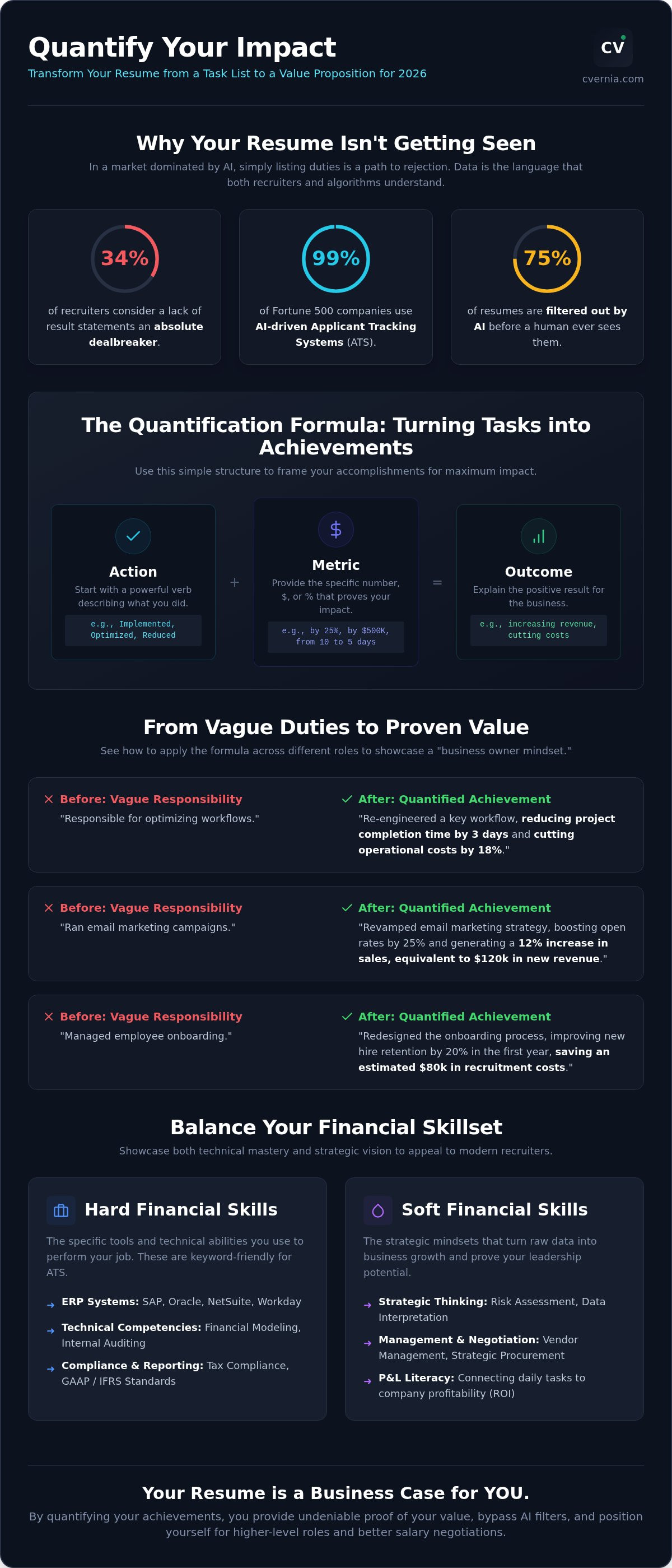
The Quantification Formula: Turning Tasks into Achievements
Structuring your success requires more than just listing daily duties. You need a repeatable method to highlight your fiscal impact. The "Action + Metric + Outcome" formula is the gold standard for financial storytelling. It forces you to move beyond what you did and focus on what you achieved for the business. Learning how to quantify financial achievements on resume drafts ensures your contributions are seen as strategic wins rather than routine tasks.
The Formula in Action: Step-by-Step Examples
Start by identifying the fiscal lever you influenced. This could be cost reduction, revenue growth, or the total budget you managed. Next, assign a percentage or currency value to that change. Precision builds immediate credibility with recruiters. Finally, connect the result to a specific business goal. For example, instead of saying you "managed the department budget," write: "Managed a $1.2M departmental budget, reducing discretionary spending by 15% to support market share expansion." This structure provides context and proves you understand how your work drives the company forward.
Don't let proprietary data stop you from being specific. If exact figures are confidential, use honest, verifiable ranges or percentages. Stating you "improved profit margins by 10-12%" is more effective than leaving the metric out entirely. Tailor your detail level based on seniority. Junior roles should focus on accuracy and process improvements. Executive roles must emphasize P&L oversight, long-term ROI, and strategic capital allocation.
Quantifying for Non-Finance Professionals
You don't need a background in accounting to show fiscal responsibility. Project managers should focus on "on-time and under-budget" delivery, stating the exact percentage of capital saved through efficient resource management. Sales and marketing professionals can link campaign spend directly to Customer Acquisition Cost (CAC) or total revenue generated. If you work in operations, highlight efficiency gains that translated into specific labor cost savings. These metrics show you have a business owner mindset regardless of your job title.
Integrating these results into a career change resume proves your transferable value to a new industry by speaking the universal language of profit. It shows a new employer that you are focused on the bottom line from day one. You can optimize your bullet points with CVernia to ensure every achievement is formatted for maximum impact and correctly weighted for modern screening tools. This methodical approach transforms a standard work history into a compelling business case for your next promotion.
How CVernia Helps You Tailor Financial Success Truthfully
Implementing the strategies discussed in this guide requires a platform that understands the complexities of the modern job market. CVernia provides the technological edge needed to manage your career history with professional confidence. Use the centralized dashboard to organize your professional journey into a secure skills bank. This feature allows for rapid, truthful document tailoring without the stress of starting from scratch for every application. It acts as an intelligent digital mentor, ensuring your fiscal impact is never lost in translation.
Managing a complex career history requires more than a static document. By leveraging a centralized repository of your successes, you can maintain a high degree of individualization for every role you pursue. This organized approach builds trust with potential employers. It suggests that you are a candidate who is prepared, efficient, and highly dependable. Your financial data becomes a strategic asset rather than a formatting hurdle.
Data-Driven Tailoring with ATS Analysis
Scan your resume against specific job descriptions to verify your financial keyword alignment in seconds. Real-time ATS analysis ensures your numerical data and currency symbols are parsed correctly by 2026 hiring software. It's critical to remember that while bots scan for density, they also evaluate context. CVernia helps you phrase your achievements to meet these evolving expectations while adhering to the rule of truthful representation. In high-stakes financial reporting, accuracy is your greatest asset. The platform is specifically designed to help you understand how to quantify financial achievements on resume drafts with absolute precision, ensuring you bypass filters while maintaining professional integrity.
Mastering Version Management
Create specialized versions of your CV based on the target role's priorities. You might need a "Budget-Heavy" version for operational roles or a "Strategy-Heavy" version for executive positions. Tracking these versions through the application tracking dashboard allows you to see which quantified achievements lead to the highest engagement. Smart reapplication detection helps you refine your fiscal bullet points over time, ensuring your most impactful data always takes center stage. This iterative process is essential for mastering how to quantify financial achievements on resume documents in a competitive market. Start quantifying your career impact with CVernia today and turn your financial history into a proven record of professional ROI.
Secure Your Professional Future with Data-Driven Proof
You now possess the strategic framework to transform a standard work history into a powerful record of fiscal success. By consistently applying the Action + Metric + Outcome formula, you prove your strategic value to any organization. Mastering how to quantify financial achievements on resume drafts is a critical skill for the 2026 job market. You've learned to balance technical ERP proficiency with soft analytical mindsets while keeping your formatting optimized for modern screening systems.
Take the guesswork out of your job search and let technology validate your hard work. You can optimize your resume’s financial impact with CVernia’s ATS analysis tools to ensure every metric is correctly weighted for the roles you want. Leverage real-time ATS compatibility scoring and truth-focused CV tailoring technology to present your most impressive self. Combined with smart reapplication tracking, these tools empower you to navigate your career journey with absolute clarity. You're ready to step into your next interview with the confidence that your value is proven and your ROI is undeniable.
Frequently Asked Questions
Should I include a financial skills section if I am not applying for a finance role?
Yes, you should include these skills because every modern role impacts a company's bottom line. Highlighting fiscal responsibility signals a "business owner mindset" that recruiters in 2026 highly value. You can weave these skills into your professional summary or work experience rather than a dedicated section. This approach proves you understand the financial implications of your daily tasks, regardless of your specific job title or department.
How do I quantify my financial achievements if I did not have direct budget access?
You can still quantify your impact by focusing on cost savings, efficiency gains, or revenue support. If you optimized a workflow that saved the team five hours a week, calculate the labor cost savings based on average hourly rates. You might also mention the total value of projects you supported. Learning how to quantify financial achievements on resume drafts often involves looking at your operational successes through a fiscal lens.
What are the most in-demand financial keywords for resumes in 2026?
In 2026, recruiters look for keywords like "ESG reporting," "digital transformation," and "predictive forecasting." Proficiency with ERP systems like SAP, NetSuite, or Workday remains a top priority. You should also include "ROI," "capital allocation," and "cost-benefit analysis." These terms signal that you are prepared for the high-tech, data-driven nature of modern business. Always align these keywords with the specific requirements listed in the job description to maximize your compatibility score.
Can I use abbreviations like P&L, ROI, or EBITDA on my resume?
Yes, you can use these abbreviations, but it's smarter to include the full term at least once. Write "Return on Investment (ROI)" or "Profit and Loss (P&L)" to ensure modern ATS algorithms recognize your expertise. This dual-entry method satisfies both the software's keyword requirements and the human recruiter's need for quick readability. It prevents your technical achievements from being overlooked during the initial automated screening process.
Is it better to list financial skills in a sidebar or the main body of the CV?
It is generally better to list these skills in the main body of your CV. While sidebars are visually appealing, some older ATS platforms still struggle to parse them correctly. Integrating your financial achievements directly into your work experience provides necessary context for your numbers. This placement allows you to use the "Action + Metric + Outcome" formula effectively, showing exactly how you applied your skills to achieve results.
How do I list financial software if I am self-taught or used it in a previous role?
List the software in your "Technical Skills" section and mention your proficiency level. You don't need formal certification to claim expertise if you can demonstrate your ability during an interview. If you used the software in a previous role, include it in the relevant work experience bullet points. Be honest about your skill level to maintain professional integrity. CVernia’s centralized skills bank can help you track these proficiencies for rapid tailoring.
What happens if an ATS fails to recognize my financial certifications?
If an ATS fails to recognize your certifications, your application might be unfairly deprioritized. To prevent this, use standard naming conventions and avoid placing certifications inside headers or footers. You can use a tool like CVernia’s real-time ATS compatibility scoring to verify that your credentials are being read correctly. Ensuring your certifications are in a plain-text format helps the software parse your qualifications accurately and increases your overall compatibility score.
How many quantified financial bullet points should I include per job entry?
Aim for one or two quantified financial bullet points per job entry. Overloading your resume with numbers can make it look cluttered and difficult to read. Focus on your most significant achievements that directly align with the target role's needs. This selective approach ensures your most impressive data stands out to recruiters. Learning how to quantify financial achievements on resume sections requires a balance between data and clear storytelling.


