
Did you know that 47% of workers in 2026 have a significant gap in their career history? While nearly half of your peers share this experience, it's natural to feel a spike of anxiety when staring at a blank space on your professional timeline. You might fear that recruiters will misinterpret your time away or that an automated filter will reject your application before you ever get a chance to speak. Learning how to explain career gap on resume isn't about hiding your history; it's about owning your story with professional confidence. We understand the stress of the modern job search, and we're here to ensure your transition is seamless and successful.
You can transform these periods of caregiving, travel, or personal growth into strategic transitions that actually highlight your resilience and adaptability. This guide provides a clear, actionable strategy to help you pass through ATS filters and articulate your non-traditional experience with ease. We'll explore modern formatting techniques, truthful narrative shifts, and specific scripts for your next interview. By the end of this article, you'll have a resume that stands out for the right reasons and the self-assurance to explain your journey to any hiring manager.
Key Takeaways
- Understand how the 2026 hiring landscape views employment gaps and why transparency is now considered a mark of professional maturity.
- Discover how to explain career gap on resume by reframing periods of unemployment as intentional growth phases rich with transferable skills.
- Implement hybrid resume layouts that ensure ATS compatibility while keeping your most relevant professional achievements front and center.
- Master the "Brief and Bold" rule to address gaps proactively in cover letters and interviews without losing momentum.
- Maintain narrative consistency across every application version by using a centralized management system to track your specific explanations and interview notes.
Understanding the Career Gap in the 2026 Hiring Landscape
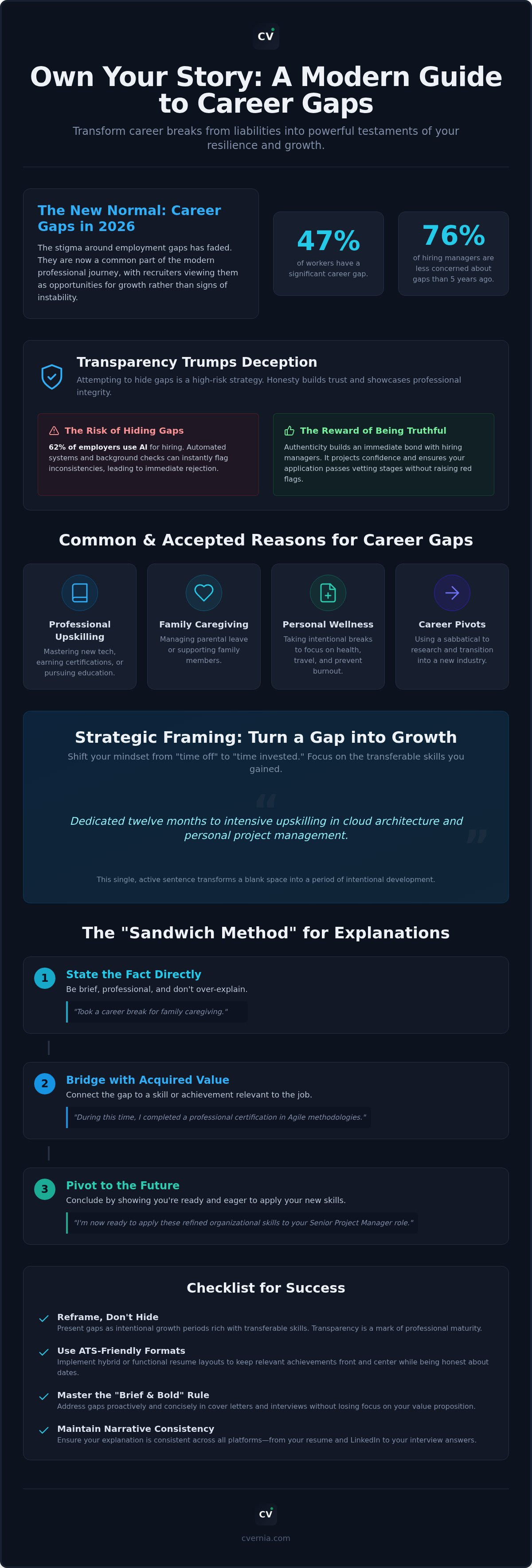
A career gap is any significant period, usually three months or more, where you weren't officially employed. In 2026, the stigma once attached to these breaks has largely evaporated. Data from 2025 shows that 47% of U.S. workers have a gap in their history, making it a common professional experience. Recruiters have evolved their perspective following the remote-work revolution and the "Great Reshuffle." They now view career breaks as opportunities for growth rather than signs of instability. A 2026 survey revealed that 76% of hiring managers consider employment gaps less concerning than they did five years ago.
Attempting to hide these periods is a risky strategy. With 62% of employers using AI for hiring stages in 2026, automated systems and background checks identify inconsistencies in seconds. The most effective approach is to build a "Strategic Narrative." This foundation allows you to own your timeline. It shifts the focus from "time off" to "time invested," ensuring you remain the architect of your professional story. Learning how to explain career gap on resume starts with accepting that your value isn't tied solely to continuous employment.
The Most Common Reasons for Career Gaps
Professional paths in 2026 are rarely linear. Recruiters expect to see transitions that reflect a well-rounded life. Common reasons for these pauses include:
- Professional Upskilling: Stepping back to master new technologies or complete advanced certifications.
- Family Caregiving: Managing parental leave or supporting family members through health transitions.
- Personal Wellness: Taking intentional breaks to focus on health and prevent burnout.
- Career Pivots: Using a sabbatical to travel or research a shift into a new industry.
Why Truthful Representation is Your Best Asset
Authenticity builds an immediate bond of trust with a hiring manager. Avoid the temptation to invent "freelance consultancy" work to fill a void. Modern verification tools are sophisticated; they catch inflated titles or fake experience immediately. When you master how to explain career gap on resume with honesty, you project confidence and integrity. You can utilize functional and hybrid resumes to emphasize your capabilities while remaining entirely truthful about your dates of employment. This transparency ensures your application passes through every stage of the vetting process without raising red flags.
Strategic Framing: Turning a Gap into Growth
View your time away as a "Growth Period" rather than a professional void. This mindset shift is essential for building confidence. Instead of seeing a blank space, identify the specific competencies you sharpened while you weren't officially on a payroll. For instance, managing a full-scale home renovation requires advanced project management and vendor negotiation. Coordinating international travel involves complex logistics and budgeting. When you determine how to explain career gap on resume, focus on these high-level transferable skills. Define your gap in one active sentence: "Dedicated twelve months to intensive upskilling in cloud architecture and personal project management."
Alignment is your secret weapon. Review the job description and find where your gap-year activities overlap with their requirements. If the role demands leadership, highlight the volunteer coordination you performed. If it requires technical proficiency, showcase the certifications you earned. You can use tailored CV creation tools to ensure your framing remains consistent across every application you submit. This consistency builds trust with recruiters who may see multiple versions of your profile.
The "Sandwich Method" for Resume Explanations
This technique provides a professional structure for your narrative. Start with a direct statement of fact: "Took a career break for family caregiving." Immediately follow this with the value you gained: "During this time, I completed a professional certification in Agile methodologies." Finally, pivot to the future: "I'm now ready to apply these refined organizational skills to your Senior Project Manager role." This approach ensures the focus remains on your readiness and value rather than the time away. It's a benefit-first logic that speaks directly to the employer's needs.
Handling Redundancy and Involuntary Gaps
Involuntary gaps are common in the modern economy. In 2025 alone, employers announced 1,206,374 job cuts; this was a 58% increase from the previous year. Recruiters understand this market context. When addressing redundancy, keep the explanation brief and focused on the scale of the event. State clearly: "Role eliminated due to a company-wide restructuring affecting 15% of the workforce." Emphasize your "Ready-to-Work" status by highlighting recent professional development. This shows you've remained engaged with industry trends despite the layoff. It transforms a potentially negative point into a demonstration of workforce stability and resilience.
Formatting for Success: ATS-Friendly Layouts for Gaps
Traditional career advice often suggests using functional resumes to hide gaps. In 2026, this approach is a mistake. Functional formats often confuse bots because they lack the chronological context required to calculate total years of experience. Instead, the hybrid resume has emerged as the gold standard for candidates with employment breaks. This layout combines a robust skills section with a traditional work history, allowing you to highlight your value immediately without appearing to hide your timeline. It's the most reliable way to build an ats compliant resume while maintaining recruiter trust.
Start with a strong Professional Summary to control the first impression. Use this space to own your narrative. A single phrase like "Strategic Operations Manager returning to the workforce following a dedicated period of professional upskilling" addresses the gap head-on. It frames your time away as an intentional, value-added choice. When it comes to dates, consistency is vital. Use the "Year-Only" format if your gap spans several months within a single calendar year, but don't switch between formats. If you list months for one role and only years for another, it looks suspicious to human eyes and can trigger errors in automated parsing. Learning how to explain career gap on resume formatting is about providing clarity, not creating confusion.
The Hybrid Resume Structure
Place a "Professional Competencies" or "Technical Skills" section directly beneath your summary. This ensures your most relevant qualifications are the first things a reader sees. Don't leave your gap as empty space. List "Community Leadership" or "Advanced Education" as formal experience blocks. If you managed a volunteer project or completed a full-time certification, treat it as a job. Understanding how applicant tracking systems work is essential here. Bots need these experience blocks to parse your timeline correctly and credit you for your active time during your transition.
Optimising Your Skills Section
Use an ATS checker to identify keywords that might be missing from your profile due to your time away. Focus on hard skills that remain industry standards. While soft skills are important, bots prioritize technical proficiencies and specific software names. Balance these keywords with quantifiable achievements from your previous roles. Even if you've been away for 18 months, your past impact remains a powerful indicator of your future performance. This strategy ensures you remain competitive against candidates with continuous work histories by focusing on current readiness rather than past pauses.
Beyond the Resume: Cover Letters and Interviews
Your resume gets you through the door, but your conversation secures the offer. While you've already mastered how to explain career gap on resume layouts, your cover letter and interview responses must reinforce that same narrative. Follow the "Brief and Bold" rule: dedicate one concise paragraph to your break, then pivot immediately back to your qualifications. This prevents you from sounding defensive and keeps the focus on your current readiness. Your time away is a professional transition, not a personal apology.
Using a tailored cover letter generator helps you frame this period proactively. You can map your "gap skills" directly to the employer's specific pain points. If you spent your time away mastering a new software or methodology, mention how that proficiency solves a current challenge the company faces. Demonstrate your "currentness" by referencing recent industry trends or news. This shows that while you weren't in a traditional office, you never stopped being a professional. Close with a strong statement about your "Day One" contribution to prove you're ready to hit the ground running.
The Cover Letter Narrative
Connect your time away to the company’s future needs. If you took a sabbatical for travel, highlight the cross-cultural communication skills you developed. If you were caregiving, emphasize your refined multitasking and crisis management abilities. When you determine how to explain career gap on resume success in a letter, focus on the result of that time. Mention a specific industry certification or a personal project that kept your skills sharp. This proactive approach shows you're a self-starter who values continuous improvement.
Mastering the Interview Conversation
Mastering the interview requires a shift in body language and vocal tone. Project confidence through steady eye contact and a composed posture. When the recruiter asks, "Tell me about this gap," have your elevator pitch ready. It should be a 30-second version of the "Sandwich Method" discussed earlier. State the reason, highlight the value gained, and return to the role. For example: "I took a structured break to focus on professional upskilling in AI integration. I'm now eager to bring those technical insights to your development team." Turn the question back to the role by asking, "How does my experience with these new tools fit your current team structure?"
Consistency is your best ally in building trust. Use Interview Preparation & Guidance tools to organize your thoughts and keep your story aligned across all applications. Recording interview notes allows you to track exactly which version of your story you shared with each hiring manager. This prevents contradictions and ensures you enter every meeting feeling prepared. Your career break is a chapter of your story, not a plot hole. Own it with authority and let your preparation speak for itself.
Managing Your Narrative with CVernia
Organizing your application history is the final step in mastering your professional image. Once you've decided how to explain career gap on resume layouts, you must ensure that explanation remains consistent across every touchpoint. A job search management system allows you to track exactly which narrative you shared with each recruiter. This level of organization prevents the common pitfall of contradictory stories during multi-stage interview processes. It transforms a scattered search into a precise, professional operation. You can focus on your next career move while the platform handles the complexity of your historical data.
Consistency builds trust, especially when your timeline includes a break. If you re-apply to a firm where you previously submitted a CV, our Smart Reapplication Detection ensures your updated gap explanation aligns with your past records. This feature allows your story to evolve naturally without raising red flags about your integrity. You can also utilize the Career Academy & Learning Resources to bridge any skill gaps in real-time. Staying "Industry-Ready" during a transition is easier when you have a structured roadmap for your professional development.
Version Control for Your Career Story
Don't use the same "Gap CV" for every role you target. Different positions require different levels of detail regarding your time away. For a technical role, your gap might be a major strength if you spent that time mastering AI or cloud architecture. For a leadership position, your caregiving or sabbatical experience might be a neutral fact that demonstrates workforce stability. Create specific versions of your CV that highlight the most relevant aspects of your journey for each unique job description. Track the feedback you receive for each version to refine your explanation. This iterative approach ensures your narrative becomes more persuasive with every application you send.
The Power of Centralized Management
Reduce application anxiety by moving your search into an organized Tracking Dashboard. Instead of hunting through sent folders, you can view every CV version, cover letter, and interview note in one place. This centralized view helps you spot patterns in recruiter responses. If one specific framing of your career gap consistently leads to interviews, you can apply that successful logic to all future submissions. Managing attachments and interview notes for every stage ensures you never walk into a meeting unprepared. Organize your career narrative with CVernia today to turn your employment gap into a strategic advantage. You deserve a partner that tracks the details so you can focus on the big picture.
Step Into Your Professional Future with Confidence
Your professional journey is unique, and your time away is a valid chapter of that story. In the 2026 job market, success belongs to those who frame their experiences with honesty and strategic intent. Remember that nearly half of your peers have navigated similar gaps; the difference lies in your ability to articulate your value. By using hybrid formatting to satisfy ATS requirements and employing the "Sandwich Method" during interviews, you transform a pause into a powerful launching pad.
Consistency is the final piece of the puzzle. Mastering how to explain career gap on resume requires a tool that keeps your narrative aligned across every version of your application. You don't have to manage this transition alone. Master your career narrative with CVernia’s Application Management Platform to access precision ATS compatibility analysis and smart reapplication version management. Our centralized interview note tracking ensures you stay prepared for every conversation. You've done the work to grow; now it's time to show the world your readiness. Your next great opportunity is waiting.
Frequently Asked Questions
Is a 6-month career gap a red flag for recruiters?
A six-month career gap is rarely a red flag in 2026. Most hiring managers understand that professional paths aren't always linear. In fact, gaps of less than six months often go unremarked during initial screenings. You should focus your energy on demonstrating your current industry knowledge rather than worrying about a short pause. If asked, provide a brief, one-sentence explanation and immediately pivot to your excitement for the specific role.
Should I put a career gap on my LinkedIn profile?
Utilize the "Career Break" feature on your LinkedIn profile to provide immediate context. Leaving a blank space allows recruiters to make their own assumptions, which are often less favorable than the truth. By adding a formal break, you normalize your time away for caregiving, travel, or upskilling. This transparency builds trust and ensures your profile remains complete and professional in the eyes of potential employers and industry peers.
How do I explain a career gap due to mental health?
Frame a mental health break as a "personal health sabbatical" or "intentional wellness leave." You aren't required to share private medical details with a recruiter. Focus your narrative on the fact that the period is successfully concluded and you are fully prepared for a new professional challenge. Highlighting any light upskilling or industry reading you did during this time can also demonstrate your continued commitment to your career path.
Can I use a functional resume to hide a long employment gap?
Avoid using a functional resume to hide your history. Modern recruiters find them frustrating, and many automated systems struggle to parse them correctly. Instead, implement a hybrid layout to master how to explain career gap on resume formatting. This approach places your skills at the top while keeping your chronological work history clear. It provides the transparency recruiters value while ensuring you pass through automated filters without technical errors.
What is the best way to list a sabbatical on a resume?
Treat a sabbatical as a legitimate entry in your professional experience section. Use a clear title like "Professional Development Sabbatical" and include the specific dates. Use bullet points to highlight any certifications, volunteer work, or technical skills you acquired during this time. This transforms a gap into a proactive period of growth. It shows recruiters that you value continuous improvement even when you aren't working in a traditional office setting.
Do I have to explain a career gap in my cover letter?
You don't need to address every gap in your cover letter. Reserve this space for breaks longer than 18 months that might require more context than a resume allows. Keep your explanation to a single, bold paragraph. State the reason for your time away, mention a key takeaway or skill gained, and then move directly to how you'll solve the company's current problems. Your goal is to provide clarity without losing momentum.
How do I handle a career gap if I was a stay-at-home parent?
List your time as a stay-at-home parent as a formal entry on your professional timeline. Use a title like "Full-time Parent" or "Family Management." Focus on high-level transferable skills such as complex scheduling, budgeting, or community leadership roles. Recruiters in 2026 value the resilience and organizational mastery required for family care. This honest representation prevents gaps in your timeline and shows that you remained active and engaged during your time away.
Does the ATS automatically reject resumes with gaps?
No, Applicant Tracking Systems do not automatically reject resumes because of employment gaps. These systems are designed to parse dates and calculate your total years of relevant experience. Rejections usually happen because of formatting errors that make dates impossible to read. To ensure success, use a clean, standard layout that allows the bot to identify your work history and skills correctly. Clear formatting is more important than a continuous timeline.


