
What if the secret to interview confidence wasn't about memorizing scripts, but about mastering your own data? Most candidates walk into the room fearing they'll freeze up or struggle to decide which skills to highlight for a specific role. It's a natural reaction to the high-pressure environment of 2026, where skills-based hiring is the new gold standard and resume trust is at an all-time low. You aren't just competing against other applicants; you're proving your adaptability in a landscape shaped by new AI regulations and transparency laws.
We understand that organizing notes for multiple companies is overwhelming. This guide empowers you to master the most common interview questions and answers using strategic, truthful frameworks that showcase your unique value. You'll learn to align your experience with job requirements while maintaining a centralized system for your preparation notes. We'll provide a comprehensive list of frequent questions, a proven method for building high-impact responses, and a workflow to keep you organized from the first screening to the final offer. Let's transform your interview anxiety into a structured plan for success.
Key Takeaways
- Learn to categorize questions into introductory, behavioral, and situational types to better understand exactly what a recruiter is looking for.
- Master the "Big Five" common interview questions and answers with strategic frameworks that help you remain truthful while highlighting your greatest strengths.
- Utilize the STAR method as your gold standard for behavioral questions to deliver high-impact stories that focus on your specific actions and results.
- Identify high-priority keywords through ATS analysis to align your talking points with the specific requirements of every role you pursue.
- Stay organized throughout your hiring journey by using a centralized tracking system to manage interview notes, dates, and different application versions.
The Landscape of Common Interview Questions in 2026
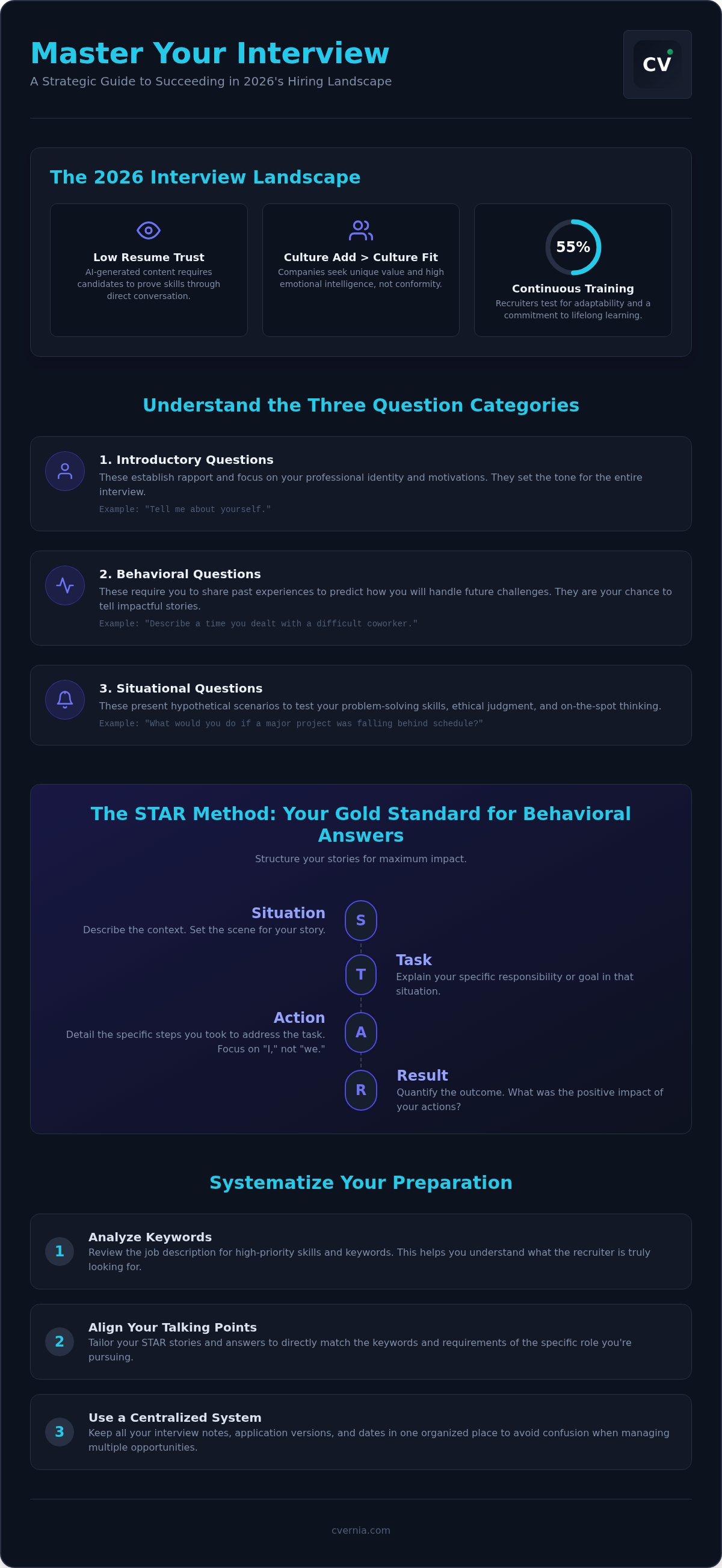
Recruiters use a set of standardized queries to level the playing field among candidates. By asking common interview questions and answers, hiring managers establish a baseline for comparison, allowing them to measure your logic and communication style against other applicants. In 2026, this process has become more vital as resume trust declines due to AI-generated content. Employers are no longer looking for a "culture fit" who blends in; they want a "culture add" who brings unique value and high emotional intelligence to the team.
Preparation begins by understanding the three main categories of questions you will face:
- Introductory: These set the tone and establish rapport, focusing on your professional identity and motivations.
- Behavioral: These require you to recount past experiences, serving as a predictor of how you will handle future challenges.
- Situational: These present hypothetical scenarios to test your immediate problem-solving skills and ethical judgment.
The 2026 hiring market places a premium on adaptability. Data from Indeed in November 2025 shows that 55% of employees require continuous training to remain successful. Consequently, recruiters use these standard questions to see if you can evolve alongside shifting technology. Truthful representation is your core career value here; your goal is to be strategic without sacrificing the authenticity that builds trust.
The Psychology of the Recruiter
When an interviewer asks "Tell me about yourself," they are scanning for alignment with the hidden requirements of the job description. They want to know if you possess the soft skills necessary to thrive in a modern, tech-integrated environment. Recruiters look for cues of self-awareness and resilience that a standard CV cannot convey. They use these interactions to determine if you can manage the social dynamics of their specific workplace while staying focused on high-level goals.
Introductory vs. Technical Questions
Introductory questions focus on your "why," while technical questions drill into your "how." The first five minutes of any conversation often set the tone for the entire meeting, making your initial delivery critical. If you can confidently articulate your background, you build the momentum needed for complex technical evaluations. Interview Readiness is a blend of preparation and authenticity. By mastering the basics, you clear the path to showcase your specialized expertise without the distraction of nervous stumbles.
Mastering the "Big Five" Core Interview Questions
Every conversation with a recruiter follows a predictable rhythm. While technical assessments vary, most hiring managers rely on a core set of queries to evaluate your personality and professional trajectory. Mastering common interview questions and answers isn't about memorization; it's about building a narrative that proves you are the right fit for the role. Start by addressing why you want the job by linking the company's stated mission to your personal career goals. If a company values sustainability or rapid innovation, show how your previous work aligns with those specific pillars.
Handle the question of why you are leaving your current role with professional grace. Focus on your desire for growth or a shift in technical direction rather than airing grievances about past employers. Similarly, when asked where you see yourself in five years, demonstrate realistic ambition. Connect your future milestones to the value you can provide the company, showing that you intend to grow alongside the organization. This approach builds trust and positions you as a long term asset.
The "Tell Me About Yourself" Pitch
Deliver a concise introduction using the Present-Past-Future framework to keep your response under two minutes. Start with your current role and a high level achievement to establish immediate credibility. Briefly mention a past experience that provided you with the foundational skills necessary for this new position. Finally, pivot to the future by explaining why this specific role is the logical next step in your career. This structure ensures you stay focused on relevant highlights rather than reciting a chronological biography that might lose the interviewer's attention.
Strengths and Weaknesses: A Strategy of Growth
Select strengths that are proof-backed with specific examples from your portfolio. Instead of saying you are a "hard worker," describe a time you managed a complex project under a tight deadline. When addressing weaknesses, avoid clichéd answers like "perfectionism" or "working too hard." Choose a real, fixable weakness, such as public speaking or a specific software tool, and explain the steps you are currently taking to improve. This demonstrates the self-awareness and learning mindset that 2026 employers value highly. To stay organized while refining these stories, you can use specialized Interview Preparation & Guidance tools to track your best responses for different application versions. This methodical approach ensures your talking points remain consistent and high-impact throughout the hiring journey.
The STAR Method: Structuring Behavioral Answers
Behavioral questions are designed to predict your future performance based on your past actions. Recruiters use them to move beyond the polished surface of your CV and see how you actually operate under pressure. The STAR method provides a clear, logical structure for your responses, ensuring you don't lose the interviewer in unnecessary detail. This framework is the gold standard for navigating common interview questions and answers that begin with "Tell me about a time when." It forces you to focus on your specific contributions and their tangible impact.
Mastering this technique requires you to break down your experiences into four distinct components. Start with the Situation by providing brief context. Move to the Task to explain the specific challenge or goal you faced. The Action is the most critical part; describe the exact steps you took to address the situation. Finally, deliver the Result by sharing the positive outcome of your efforts. This structured approach builds credibility and shows that your successes are repeatable and grounded in logic.
Building Your Library of Stories
Identify five to seven key professional wins that you can adapt to various questions. Don't wait for the interview to recall these moments; prepare them in advance to ensure accuracy and confidence. Map your stories to recurring themes like conflict resolution, leadership, failure, and innovation. For example, a story about a missed deadline can demonstrate resilience if you focus on how you communicated the delay and salvaged the project. Ensure your stories remain truthful while highlighting your individual contribution rather than just the team's overall effort. This preparation prevents you from "freezing up" when faced with unexpected queries.
Quantifying the Result
Turn vague statements into concrete proof by using hard data. A result that includes numbers carries significantly more weight than a general claim of improvement. Transform a phrase like "I improved the process" into "I reduced processing time by 20% over six months." Use percentages, currency, and specific timeframes to add authority to your answers. If you don't have access to hard numbers, rely on qualitative feedback. Mentioning that a manager praised your "exceptional attention to detail" or that a client renewed their contract because of your service provides the validation recruiters seek. This focus on impact proves you understand the business value of your work.
Tailoring Your Answers: Aligning Experience with Job Requirements
Success in a modern interview depends on your ability to bridge the gap between your historical achievements and the company's future objectives. While you've mastered the delivery of common interview questions and answers, you must now customize those responses to the specific role. Recruiters in 2026 prioritize skills-based hiring over pedigree; they want to hear the exact terminology found in their job descriptions. Mirroring the recruiter’s language validates your expertise and signals that you've already integrated into their professional culture. If the job posting emphasizes "cross-functional synchronization," ensure your stories use that specific phrasing rather than generic terms like "teamwork."
Consistency is equally vital. You must align your interview talking points with the specific version of the CV you submitted for that application. In a high-volume job search, it's easy to lose track of which skills you highlighted for which company. Use your preparation phase to review the technical requirements and soft skills you prioritized during the application stage. This ensures your narrative remains cohesive and reinforces the data already processed by the hiring team's screening tools.
Keyword Alignment Strategies
Analyze the job description to identify recurring verbs and technical competencies. Use a high-quality ATS resume checker to pinpoint the high-priority keywords that the employer values most. Once you've identified these terms, infuse them into your STAR stories naturally. This isn't about keyword stuffing; it's about strategic alignment. You can also perform a CV compatibility analysis to find gaps in your interview prep. If the analysis shows you're light on "agile project management," prioritize a story that proves your experience in that area. This technical preparation allows you to speak with the precision that modern hiring managers expect.
Positioning Yourself as the Solution
Go beyond the job description by researching the company's recent challenges or industry news. Frame your experience as a direct answer to their current needs. If a company is expanding into a new market, highlight your experience with international scaling. This proactive approach transforms you from a candidate into a consultant. Demonstrate this high-level understanding by crafting insightful questions for the interviewer. Ask about how they plan to navigate specific industry shifts or how your role will contribute to their upcoming quarterly goals. To ensure your talking points are perfectly synced with your application, optimize your interview preparation with tools that link your notes directly to your submitted CV version.
Systematizing Your Prep: Managing Interview Notes and Attachments
Preparation doesn't end when you've memorized your STAR stories. In a competitive hiring market, you're likely managing several active applications at once. Treat your interview journey as a data-driven process rather than a series of isolated events. Use a centralized job interview tracker to maintain a clear overview of every role. This organization allows you to focus on delivering high-impact common interview questions and answers without the stress of mixing up company details or interviewer names.
Organize your records by company, date, and specific interview round. This structure is vital for managing attachments like the exact version of the CV or portfolio you submitted for that specific job. When you walk into a second-round interview, you should have your notes from the first round ready to ensure your narrative remains consistent. Record your post-interview reflections immediately to capture what went well and identify areas for improvement. This habit turns every interaction into a learning opportunity that sharpens your performance for the next call.
The Power of Interview Notes
Write down key details the moment the call ends. Capture the names of your interviewers, specific cultural cues they mentioned, and any unique challenges the team is currently facing. These details are gold for crafting a personalized thank-you email that proves you were listening. Your notes also serve as a foundation for Smart reapplication detection. If you don't land the role now, your records help you refine answers over time for future opportunities at the same firm. You aren't just taking notes; you're building a professional knowledge base.
Centralized Application Management
Move beyond messy spreadsheets and scattered sticky notes. A dedicated Application Tracking Dashboard provides a visual map of your progress, keeping your interview notes and CV versions in one secure location. CVernia’s platform acts as your digital mentor, ensuring you never walk into a meeting feeling underprepared. Before your next interview, follow this final 10-minute checklist to center yourself:
- Review the specific CV version you submitted for this role to ensure consistency.
- Re-read your STAR stories tailored to the job's key requirements.
- Verify your tech setup and lighting to ensure a professional digital presence.
- Note the interviewers' names to use them naturally during the conversation.
- Take three deep breaths to transition from "prep mode" to "engagement mode."
Step Into Your Next Interview With Confidence
Mastering common interview questions and answers is the foundation of a successful career transition in 2026. By utilizing the STAR method and aligning your stories with specific job requirements, you transform from a nervous applicant into a strategic solution provider. Success isn't just about the words you say; it's about the systems you use to stay organized throughout your journey. Your preparation notes and past successes are valuable assets that deserve a professional management system.
Managing multiple rounds of interviews requires precision and clarity. You can organize your interview notes and track every application with CVernia to ensure you never lose a critical detail. Our platform offers ATS compatibility analysis for every job description and smart reapplication detection to help you refine your strategy over time. Manage all your interview notes and attachments in one centralized dashboard, allowing you to focus entirely on your performance. You have the skills and the experience to succeed. Now, you have the framework to prove it. Take control of your preparation today and turn your next interview into a definitive job offer.
Frequently Asked Questions
How do I answer "What is your salary expectation?" without losing leverage?
State a salary range based on verified market data and the specific requirements of the role. Since laws in states like Virginia now mandate pay transparency as of July 1, 2026, you often have a good-faith range to work with from the start. If the recruiter asks early, politely deflect by focusing on the value you bring. Ask for the company's budgeted range first to maintain your negotiating power and ensure alignment.
What should I do if I don’t know the answer to a technical interview question?
Be honest about what you don't know while demonstrating your logical thought process. Explain how you'd approach finding the solution, such as consulting documentation or collaborating with a specialist. Recruiters in 2026 value adaptability and a growth mindset over static knowledge. By walking the interviewer through your problem-solving steps, you prove that you can handle unfamiliar challenges even when the immediate answer isn't available.
Is it okay to bring notes or a "cheat sheet" into the interview?
Bring an organized set of notes to demonstrate your high level of preparedness. It's completely professional to refer to a list of your STAR stories or specific questions you've prepared for the team. This practice prevents you from forgetting key data points under pressure. Using a digital dashboard to manage your interview notes ensures you have the right version of your talking points ready for every specific company and round.
How many questions should I ask the interviewer at the end?
Prepare three to five high-impact questions that focus on the company's future goals and team dynamics. Ask about the specific challenges the department is facing or how they measure success for this role. This demonstrates that you're thinking like a consultant rather than just an applicant. Quality matters more than quantity; well-researched questions show that you've done your homework and are genuinely invested in the organization's long-term success.
How do I explain a gap in my employment history truthfully?
Address employment gaps with brief, truthful explanations that focus on your transition back to work. Mention any upskilling or personal projects you completed during that time to show you remained productive. Since 55% of employees report needing continuous training to stay successful, highlighting your recent learning is a strategic move. Keep your answer positive and quickly pivot back to why you are the ideal solution for their current needs.
What is the best way to handle a "Tell me about a time you failed" question?
Structure your response to common interview questions and answers about failure using the STAR method. Briefly describe the situation but spend the majority of your time on the actions you took to rectify the mistake and the lessons you learned. Showcasing self-awareness and a commitment to growth is essential. Recruiters want to see that you can take ownership of a situation and implement changes to prevent similar issues in the future.
How soon should I send a thank-you note after the interview?
Send a personalized thank-you email within 24 hours of your interview. Use this opportunity to reference a specific topic you discussed or a culture cue you noticed during the call. This reinforces your interest and keeps you top-of-mind for the hiring team. A prompt, professional follow-up demonstrates your efficiency and attention to detail, which are key traits that modern employers look for when making their final hiring decisions.


