
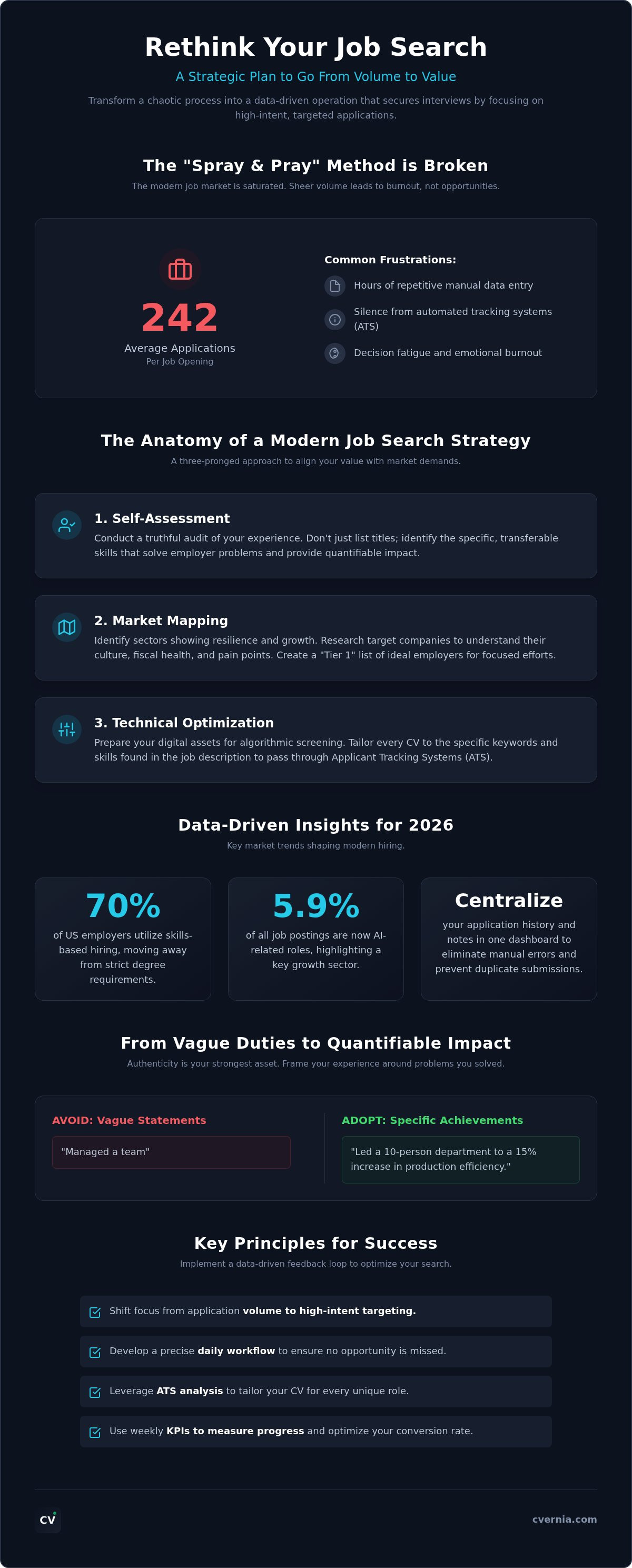
With the average job opening now attracting 242 applications, the "spray and pray" method isn't just exhausting; it's statistically broken. You've likely spent hours manually entering data into repetitive forms only to be met with total silence from an automated system. It's frustrating to feel like your career is being judged by an algorithm that doesn't see your true potential. You deserve a strategic job search plan that treats your time as a premium resource rather than a disposable commodity.
We're here to help you transform that chaotic pile of open tabs into a precise, data-driven operation that actually secures interviews. You'll learn how to build a centralized system for your application data, automate the tedious parts of tracking, and master the skills-based hiring trends that 70% of employers now prioritize. This guide outlines a clear daily workflow to increase your conversion rates and turn the hiring process back in your favor. Stop guessing where your applications went and start managing your career transition with the authority of a seasoned professional. Let's move from uncertainty to readiness by building a system that works as hard as you do.
Key Takeaways
- Shift your focus from application volume to high-intent targeting by aligning your transferable skills with specific market demands.
- Develop a strategic job search plan that replaces fragmented tools with a precise daily workflow, ensuring no opportunity falls through the cracks.
- Navigate the complexities of 2026 hiring technology by leveraging ATS analysis to tailor your CV for every unique role you pursue.
- Implement a data-driven feedback loop using weekly KPIs to measure your progress and optimize your application-to-interview conversion rate.
- Centralize your application history and interview notes in one dashboard to eliminate manual errors and prevent duplicate submissions.
Defining the Strategic Job Search Plan: Why Intent Beats Volume
A strategic job search plan is not a simple to-do list; it's a precision-engineered framework designed to align your professional value with current market realities. While the "spray and pray" method relies on the hope that sheer volume will eventually yield a result, a strategic approach relies on intent. This shift is vital because the modern market is saturated. Sending hundreds of generic resumes into the void only leads to decision fatigue and emotional burnout. By focusing on high-intent applications, you preserve your mental energy for the roles that actually matter. You're no longer a passive participant in the hiring cycle; you're a data-driven professional who understands how to navigate the system.
For a comprehensive overview of the job search process, one must look beyond the act of clicking "apply" and consider the foundational research required to stand out. In 2026, success is defined by how well you close the gap between what you offer and what the market demands. Using a data-driven feedback loop allows you to see which versions of your CV are gaining traction and which ones are falling flat. This clarity transforms your search from a stressful guessing game into a manageable, professional operation.
The Anatomy of a Modern Job Search Strategy
Success in 2026 requires a three-pronged approach to your career transition. Start with a Self-Assessment by conducting a truthful audit of your experience. Don't just list job titles; identify the specific transferable skills that solve employer problems. Next, move to Market Mapping. Identify sectors showing resilience, such as AI-related roles which now comprise 5.9% of all postings. Finally, focus on Technical Optimization. Prepare your digital assets for algorithmic screening by ensuring every CV is tailored to the specific keywords found in the job description.
Why Traditional Tracking Methods Fail
Many professionals still rely on fragmented tools like manual spreadsheets or messy email folders. These methods inevitably fail as your search scales. Disorganized tracking leads to missed follow-up opportunities and the embarrassing mistake of duplicate applications to the same firm. A centralized system provides the clarity you need to adjust your tactics in real time. Strategic intent is the deliberate alignment of your daily actions with high-value opportunities that match your specific career goals.
The Foundation: Aligning Career Goals with Market Demand
A successful strategic job search plan begins with a clear-eyed assessment of your current professional standing. You can't navigate a market you don't understand, especially when the US unemployment rate sits at 4.3% and wage growth has stabilized at 2.5%. Start by conducting a truthful audit of your experience. This process isn't just about listing previous duties; it's about identifying the specific problems you've solved for past employers. Map these skills against current job descriptions to see where you align or where you might need to bridge a gap. By researching target companies early, you can identify their unique pain points and hiring patterns before you ever hit "submit."
Self-Audit: Identifying Your Unique Value Proposition
Extracting quantifiable data is the key to building a compelling case for your candidacy. Instead of stating you "managed a team," specify that you "led a 10-person department to a 15% increase in production efficiency." Avoid inflating data; authenticity is your strongest asset. Categorize your skills into core competencies that define your career and "nice-to-have" additions that offer a strategic advantage. If you're struggling to articulate your impact, explore the Career Academy for resources that help refine your professional narrative and align it with modern expectations.
Market Research for 2026 Roles
Researching target companies allows you to understand their internal culture and fiscal health. In 2026, nearly 70% of US employers utilize skills-based hiring practices, moving away from strict degree requirements. Use this data to create a "Tier 1" list of ideal employers where you will focus your deepest tailoring efforts. These companies should represent the roles where your skills provide the highest ROI.
Utilizing a strategic job search framework helps you treat your career transition like a business case rather than a series of random events. Track industry-specific salary trends on major job search engines and look for "hidden" opportunities on company-specific career pages. This preparation ensures you're ready for the shift toward specialized, tech-augmented roles that define the current labor landscape. You can organize your target company research within a centralized dashboard to keep your strategy focused and your data accessible.
- Identify transferable skills: Focus on abilities that apply across different industries.
- Analyze hiring patterns: Look for companies that are actively expanding their AI or tech-integrated departments.
- Map skill gaps: Use job descriptions to find which certifications or tools you should learn next.
Mastering the Technical Strategy: ATS and Document Tailoring
Understanding Applicant Tracking Systems (ATS) is a non-negotiable part of your strategic job search plan. In 2026, these systems act as the primary gatekeepers for nearly every corporate role. They don't just search for simple keywords; they rank your experience based on how well your CV aligns with the specific requirements of the job description. If you use a "one-size-fits-all" resume, you're likely the victim of automatic rejection before a human ever sees your name. Successful applicants treat the ATS as a strategic data point rather than a hurdle. It's a tool that tells you exactly what an employer values most.
High-intent tailoring is the only way to ensure your documents pass these digital filters. This involves a precise alignment of your truthful experience with the language of the job posting. Compatibility analysis helps you identify missing keywords that you possess but haven't clearly articulated. This isn't about padding your CV with buzzwords. It's about ensuring your actual achievements are visible to the algorithms used by Greenhouse and Workday. When you bridge this communication gap, your interview conversion rate naturally climbs.
The Science of CV Compatibility
To optimize your chances, you must scan your resume for ATS compatibility before every submission. Standard formatting is essential; complex layouts, images, or unusual fonts can cause parsing errors that render your data unreadable. Balance algorithmic optimization with human readability. While the machine ranks you, a hiring manager eventually makes the final decision. Use clean headers and bulleted lists to satisfy both. This dual approach ensures your value proposition is clear to both the software and the recruiter.
Generating Tailored Cover Letters
Templates are a useful starting point, but they shouldn't be the end of your process. Use a tailored cover letter generator to create a foundation that you then customize for specific roles. A great cover letter addresses the hiring manager's specific needs and demonstrates high role-alignment. It shows you've done the market research mentioned earlier and understand the company's current challenges. Maintain a professional, solution-oriented tone that positions you as a ready-to-work partner. By integrating these technical steps into your strategic job search plan, you move from being a face in the crowd to a top-tier candidate.
Executing the Plan: A Step-by-Step 2026 Workflow
Transitioning from a theoretical strategic job search plan to daily execution requires a shift in mindset. You must stop viewing the job search as a series of chores and start treating it as a managed professional project. With the US hiring rate at 3.4% as of June 2026, competition for high-quality roles remains steady; yet, most candidates still sabotage their own efforts through disorganization. You can overcome this by establishing a routine that prioritizes high-value actions over busywork. A structured workflow ensures that your energy is spent where it generates the highest return, moving you closer to a signed offer every single day.
Daily and Weekly Job Search Habits
Secure more interviews by focusing your morning "Power Hour" on high-intensity tailoring rather than passive scrolling. During this time, you should only interact with your "Tier 1" list of employers, ensuring every document is perfectly aligned with their specific needs. Balance this effort by scheduling dedicated blocks for skill development through a Career Academy. This keeps your profile competitive as 70% of employers continue to lean into skills-based hiring. Application quality should always outweigh application volume in your weekly KPIs because a single high-intent submission is worth more than fifty generic entries. Set realistic targets, such as three deep-tailored applications and five new networking connections per week, to maintain momentum without hitting burnout.
Managing the Interview Pipeline
Organization becomes your greatest competitive advantage once the interview invites begin to arrive. Use a job interview tracker to manage the chaos of multiple stages and deadlines. This system allows you to record specific interview notes and manage attachments, such as portfolio pieces or presentation decks, for quick reference during follow-ups. Preparation should focus on behavioral questions that reflect the 2026 market, specifically how you use tech tools to augment your professional output. After every session, implement a strict follow-up schedule to stay top-of-mind with recruiters. A brief, value-added note sent within 24 hours reinforces your professionalism and keeps your candidacy active.
Consistency is the engine that drives your career transition forward. By automating the administrative burden of tracking, you free up mental space for the high-level strategy that actually wins roles. You can centralize your entire application workflow to ensure you never miss a follow-up or lose a vital piece of interview feedback again.
Centralizing Your Strategy: Scaling with CVernia
Scaling a job search manually is a recipe for error. You've already mapped the market and tailored your assets; now, you need a way to manage that volume without losing precision. A strategic job search plan requires a centralized hub to replace the fragmented chaos of spreadsheets and lost email threads. This centralization isn't just about storage; it's about visibility. When you see your entire pipeline in one dashboard, you can make better decisions about where to invest your time next. It transforms a scattered series of tasks into a streamlined, professional operation.
Smart Reapplication and Version Control
Tracking which version of your CV was sent to which company is critical for maintaining professional credibility. If you apply for a different role at the same firm six months later, you must ensure your narrative remains consistent. Smart reapplication detection identifies these overlaps, allowing you to refine your strategy rather than repeating past mistakes. This system ensures you always lead with your most compatible version while maintaining a truthful, consistent professional history across every submission. It removes the guesswork from version management, especially when you're pursuing multiple career paths simultaneously. For instance, if you're targeting both project management and operations roles, you can track the specific performance of each CV version. This data-driven approach allows you to double down on the strategy that is generating the most interviews.
The CVernia Advantage: Your Strategic Command Center
The Career Application Management Platform acts as the "central nervous system" of your career transition. It integrates ATS analysis, version control, and interview tracking into a single, high-performance interface. Users report that centralized tracking saves an average of 5-10 hours per week by eliminating manual data entry and disorganized file searching. Having all application attachments and interview notes in one place reduces the mental load significantly. It allows you to focus on performance rather than administration. The dashboard provides a clear overview of your progress, showing you exactly where each application stands in the hiring cycle. This transparency alleviates the inherent stress of the search by replacing uncertainty with organized data. You'll know exactly which follow-ups are due and which interview notes to review before your next call.
Don't let a disorganized system undermine your hard work. You've built the foundation and mastered the technical requirements. Now, give yourself the tools to scale that effort into a successful hire. Start building your strategic job search plan with CVernia today.
Take Command of Your Career Trajectory
The 2026 job market requires more than persistence; it demands a high-performance system. You've learned how to align your unique skills with market needs and master the technical nuances of algorithmic screening. By shifting from a chaotic volume-based approach to a precise daily workflow, you turn the odds of the hiring process in your favor. Consistency and technical preparedness are the true drivers of interview success.
Implementing a strategic job search plan becomes effortless when you have the right technology supporting you. Replace fragmented spreadsheets with a centralized dashboard that tracks every stage of your journey. Use ATS compatibility analysis to ensure your value is never lost in translation. Protect your professional reputation with smart reapplication detection that prevents duplicate errors. You're no longer just applying for jobs; you're managing a data-driven career transition with absolute confidence.
Build your strategic job search plan on CVernia and transform your professional future today. You have the skills and the strategy. Now, it's time to execute with precision.
Frequently Asked Questions
What should be included in a strategic job search plan?
A strategic job search plan must include a truthful audit of your transferable skills, a "Tier 1" list of target employers, and a technical strategy for ATS compatibility. You also need a centralized tracking system to manage follow-ups and interview notes. This structure ensures you align your professional value with market demand rather than relying on luck. It replaces chaotic browsing with a purposeful, data-driven workflow that keeps your career transition organized and efficient.
How long does a typical strategic job search take in 2026?
In the current "low-hire, low-fire" environment of 2026, the timeline varies significantly based on industry and seniority. With the US hiring rate at 3.4% as of June 2026, many professionals find that a thorough search takes between three to six months. Using a strategic job search plan helps you manage this duration by providing clear milestones and KPIs. This methodical approach prevents burnout by focusing on progress within your control rather than just the final offer.
How many job applications should I send per week?
Focus on application quality rather than hitting a high arbitrary number. Sending three to five deep-tailored applications per week is often more effective than submitting dozens of generic resumes. This allows you enough time to perform compatibility analysis and customize your cover letters for every unique role. High-intent targeting increases your interview conversion rate because your documents actually speak to the employer's specific pain points and requirements.
Can I use a strategic plan to change careers?
Transitioning to a new field is highly achievable with a strategic approach. Since nearly 70% of US employers now utilize skills-based hiring practices, your demonstrated abilities often matter more than your specific job titles. Identify your transferable skills and map them against the requirements of your target industry. Use resources like the Career Academy to refine your professional narrative and bridge the gap between your past experience and your future goals.
What is the best way to track job applications?
A centralized digital dashboard is the most effective way to manage your search. Moving beyond simple spreadsheets allows you to store interview notes, manage attachments, and utilize smart reapplication detection in one place. This system ensures you never lose track of which CV version you sent to a specific company. It saves hours of administrative work each week and provides the clarity needed to adjust your strategy based on real-time data.
How do I know if my job search plan is actually working?
Monitor your conversion rates to determine the health of your strategy. If your tailored applications are consistently passing ATS filters but failing to secure interviews, your target roles might not align with your current skill set. Conversely, if you aren't receiving any feedback, you may need to improve your technical optimization. A successful plan provides a feedback loop that allows you to identify these bottlenecks and pivot your tactics before you hit a wall.
Is it better to apply for many jobs or just a few?
Applying for a few high-intent roles is significantly better than a high-volume "spray and pray" approach. An average job opening in 2026 receives approximately 242 applications, meaning generic submissions are almost always filtered out by automated systems. By focusing your energy on a "Tier 1" list of ideal employers, you can provide the level of customization required to stand out. This precision ensures you are seen as a solution to the hiring manager's problems.
How can I stay motivated during a long job search?
Maintain motivation by focusing on daily process goals rather than the final job offer. Establish a routine that balances application tasks with networking and professional learning. Using a "Power Hour" for high-intensity work prevents the search from feeling like an endless, overwhelming chore. Celebrate small wins, such as a high compatibility score or a positive networking interaction, to keep your momentum high during the transition. Setting realistic weekly KPIs provides a sense of accomplishment.


