
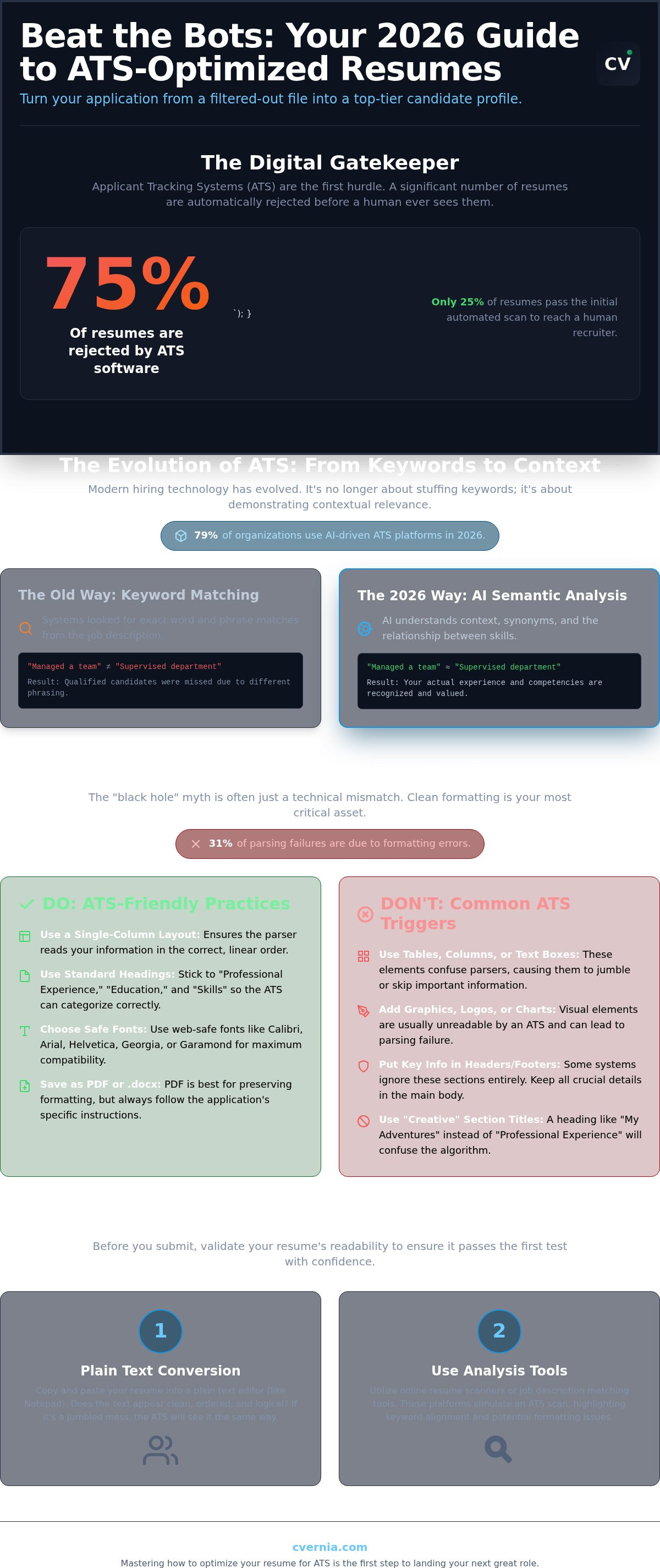
Did you know that up to 75% of resumes are rejected by Applicant Tracking Systems before a human recruiter ever sees them? It's a frustrating reality that often leads to those dreaded automated rejection emails, even when you're perfectly qualified for the role. If you've spent hours manually tailoring every CV only to feel like you're shouting into a digital void, you aren't alone. Learning how to optimize resume for ats isn't about "gaming the system" anymore. In 2026, it's about understanding how modern AI-driven platforms interpret your professional story through semantic analysis and contextual relevance.
We understand the stress of second-guessing your layout or worrying if a complex design will cause a parsing failure. This guide will help you master the art of semantic alignment and structural clarity to ensure your resume passes every digital gatekeeper with confidence. You'll discover how to move beyond simple keyword matching to create a document that ranks high in recruiter searches. We'll explore the latest 2026 trends in skills-based hiring and provide a streamlined process for tailoring your CV without the usual headache. By the end, you'll have a clear roadmap to turn your application from a filtered-out file into a top-tier candidate profile.
Key Takeaways
- Understand the shift from simple keyword matching to AI-driven semantic analysis to ensure your profile resonates with modern hiring algorithms.
- Prioritize clean, single-column layouts and standard headings to eliminate the formatting errors that lead to 31% of parsing failures.
- Learn exactly how to optimize resume for ats by aligning your core competencies with specific job requirements while maintaining total truthfulness.
- Implement a reliable two-step testing phase using plain text conversion and analysis tools to validate your document's readability.
- Centralize your job search using a management platform that tracks every tailored version of your CV and manages your application history automatically.
Understanding the Modern ATS Landscape in 2026
An Applicant Tracking System is essentially a sophisticated digital filing and ranking engine. It's the first gatekeeper your application meets. Recruiters rely on these systems to manage the massive influx of applications that modern job boards generate. Without this technology, a human would have to manually sort through hundreds of files for a single opening. In 2026, 79% of organizations have integrated AI or automation into these platforms to handle this volume with precision. Your goal isn't to "trick" a robot; it's to ensure your document is perfectly readable for the parser so your qualifications can shine.
The tech has shifted dramatically from simple keyword matching to AI-driven semantic understanding. Older systems looked for exact word matches, but modern versions understand context. They recognize that "leading a team" and "departmental supervision" describe similar leadership roles. Learning how to optimize resume for ats now requires focusing on the quality and clarity of your professional story rather than just repeating buzzwords. This evolution actually benefits you because it prioritizes your actual skills over your ability to game a system.
How Applicant Tracking Systems Work Today
The journey begins with parsing. This is where the system breaks your CV into specific data points like job titles, years of experience, and technical proficiencies. Once the data is extracted, the ATS assigns a compatibility score based on how well your profile aligns with the job description. This score determines your visibility. If the parser can't read your file, you won't rank high enough for a recruiter to ever see your name. You can explore the technical side of this process in our guide on How Applicant Tracking Systems Work: A 2026 Guide to CV Compatibility.
The Black Hole Myth vs. Reality
Many candidates believe their resumes disappear into a "black hole" because of a glitch. The reality is often simpler. Research from early 2026 shows that 62% of resumes had significant formatting issues, leading to a 31% parsing failure rate. When a system can't interpret your layout, it simply can't rank you. It's not a mystery; it's a technical mismatch. Even with AI, a human recruiter still makes the final hiring decision, but they only see the candidates that the system successfully identifies as relevant.
A Semantic Match is the core of 2026 recruitment tech, representing the system's ability to understand the contextual relationship between your unique experience and the specific needs of the employer. We want to help you move past the anxiety of the "bot" and focus on clear, strategic alignment. Mastering how to optimize resume for ats starts with respecting these structural rules so your professional value is never lost in translation.
Formatting for Flawless Parsing: The Structural Rules
Prioritize a clean, single-column layout for your document. While multi-column designs might look modern to the human eye, they often disrupt the linear flow of an ATS parser. If the system reads your skills before your job titles, your ranking will suffer. Stick to standard section headings like "Professional Experience" or "Education". Creative titles like "Where I've Been" might confuse the algorithm; it's better to be clear than clever. When you're optimizing your resume for ATS, the structural foundation is your most critical asset.
Avoid using tables, text boxes, or complex charts. As of 2026, major systems like Greenhouse and Workday have improved, but documents built in complex graphic design software still contribute to a 31% parsing failure rate. Use standard document features in Microsoft Word or Google Docs instead. Stick to standard file formats. While .docx was once the gold standard, modern 2026 parsers handle PDFs with high accuracy, provided they aren't saved as flat images. A PDF preserves your formatting across different devices while remaining searchable for the bot. If a job posting specifically requests a Word document, follow that instruction exactly to avoid technical friction.
Safe Fonts and Typography in 2026
Choose professional, web-safe fonts to ensure readability. Sans-serif options like Calibri, Arial, or Helvetica are excellent for digital screens. If you prefer a serif font, Georgia or Garamond remain reliable choices. Keep your body text between 10 and 12 points. This ensures the human recruiter can read it easily once it passes the initial scan. Proper sizing also prevents the parser from misinterpreting text hierarchy. Consult our ATS Resume Checker Guide 2026: Choosing the Right Tool to Beat the Bot to verify your font choices before you apply.
The Danger of Headers, Footers, and Columns
Place your contact information in the main body of the document. Many older parsers still struggle to extract text from headers and footers; this can lead to your phone number or email address being missed entirely. Similarly, sidebars often get read out of sequence, which can scramble your career timeline. To maintain a clean architecture, follow this checklist:
- Use 1-inch margins on all sides to prevent text clipping.
- Avoid images or icons for contact details, as these aren't searchable.
- Ensure your name is the first piece of text on the page.
- Use bullet points for lists rather than paragraph blocks.
You can use CVernia's analysis tools to catch these layout errors before they reach a recruiter's desk. Learning how to optimize resume for ats is much easier when you start with a structure that the technology is designed to understand.
Keyword Optimization Without Sacrificing Truth
AI-powered ATS systems in 2026 achieve up to 95% accuracy in semantic parsing. They don't just count keywords; they evaluate the depth and relevance of your professional story. If you're learning how to optimize resume for ats, you must prioritize hard skills and industry-specific methodologies. These include technical proficiencies like "Cloud Architecture," "Statistical Analysis," or "Agile Scrum" that define your professional capability. Integrate these naturally into your work history rather than hiding them in a cluttered list. This approach ensures the parser understands your expertise while keeping the content engaging for the human recruiter who reads it after the digital scan.
Focus on the specific terminology used in your industry. If a job description asks for "Customer Relationship Management," don't just write "CRM" and assume the system will bridge the gap. While modern AI is smart, using the exact phrasing found in the job post remains a safest bet for high ranking. Emphasize your results by pairing these keywords with quantifiable data. A resume that mentions "Project Management" is good, but one that describes "Project Management to reduce delivery lead times by 20%" is far more persuasive to both the bot and the human eye.
Identifying High-Value Keywords in a Job Post
Analyze the job description to find the employer's "must-haves." Look for nouns and action verbs that repeat throughout the post. These often represent the core competencies required for the role. Focus on "required" qualifications first, as these are the primary filters the system uses to rank candidates. "Preferred" qualifications are secondary but can help you stand out in a competitive pool. Contextual keywords carry more weight than isolated lists because the algorithm evaluates the relationship between your skills and your results. Instead of just listing "Strategic Planning," describe how you used it to increase operational efficiency in a previous role.
The Ethics of Tailoring: CVernia’s Truthful Representation
Don't fall for "hacks" like white-fonting or keyword stuffing. Modern algorithms are designed to detect hidden text and irrelevant word clusters, often flagging these applications as spam or "gaming the system." Lying about your experience is a high-risk, low-reward move that inevitably fails during the interview or background check phase. At CVernia, we advocate for a truthful representation policy. Our platform acts as a digital mentor, helping you align your genuine experience with the employer’s specific terminology. This ensures your resume is both "bot-friendly" and factually accurate. For those moving into new industries, this alignment is crucial to bridge the gap between past roles and future goals. Check out our 2026 Career Change Resume Guide: Professional Pivots for more on translating your existing value into a new context.
The Testing Phase: How to Scan and Validate Your CV
Once you've aligned your professional story with the employer's language, you must verify the technical integrity of your file. Even the most polished resume can fail if the underlying data structure causes "parsing drift" during extraction. Learning how to optimize resume for ats requires this final quality-control stage to confirm that your document is truly ready for submission. Start by performing a "plain text" test. Save your resume as a .txt file and open it in a basic editor. If your dates are merged with job titles or your contact information has vanished, the parser will likely encounter the same issues.
Follow this five-step validation process to secure your application before you hit send:
- Step 1: Save your resume as a plain text (.txt) file to check for character scrambling or layout breaks.
- Step 2: Use a dedicated ATS resume checker to identify critical missing keywords from the job description.
- Step 3: Review the "parsed" view in your analysis tool to see exactly how the system categorizes your professional experience.
- Step 4: Adjust your formatting based on any specific errors, such as misread dates or missing section headers.
- Step 5: Perform a final validation against the specific job description to ensure your compatibility score is competitive.
What a "Good" ATS Score Actually Looks Like
An 80% compatibility score is typically considered the "safe zone" for most modern systems. While it's tempting to chase a perfect 100%, doing so often results in a robotic document that fails the subsequent human review. Remember that the bot is only the first gatekeeper. Once you pass the scan, a recruiter needs to find your narrative compelling and authentic. Focus on achieving a high ranking without sacrificing the natural flow of your career story.
Optimizing for Smart Reapplications
Modern hiring platforms don't just see your current application; they often track every version of your resume you've ever submitted to that company. If you apply for a senior role today with different skills than you listed for a junior role previously, it can raise red flags. How to optimize resume for ats also means managing your application history with precision. CVernia’s smart reapplication detection helps you maintain consistency while showing genuine professional growth over time. This version management ensures that your career trajectory looks logical to internal recruiters who may be reviewing your history.
Take the guesswork out of your application by using CVernia’s ATS analysis tool to validate your resume today.
Beyond the Scan: Managing Your Tailored Applications with CVernia
Most job seekers focus solely on the technical side of how to optimize resume for ats, but the real challenge begins after you hit "submit." Managing dozens of tailored applications across multiple platforms quickly leads to confusion and missed opportunities. CVernia centralizes your entire journey within a single Career Application Management Platform. This approach ensures that you never lose track of which version of your CV you sent to which employer. Our version management tools handle the heavy lifting, allowing you to focus on preparing for the interviews your optimized resume will generate.
Beyond just tracking files, our Application Tracking Dashboard serves as your command center. Store interview notes, portfolio links, and reference letters directly alongside each specific application record. This level of organization prevents the common panic of trying to remember specific details during a surprise recruiter call. You can also access our Career Academy for ongoing professional development, ensuring your skills remain as modern as your resume's layout. By centralizing your resources, you transform a fragmented search into a streamlined path to success.
Centralized Tracking vs. Spreadsheet Chaos
Ditch the manual spreadsheets that become outdated the moment you apply for a new role. Seeing your entire application journey in one place provides a significant psychological benefit by reducing the stress of the unknown. Our The Ultimate Job Search Management System Guide: Scaling Your Career in 2026 explains how to leverage these tools to maintain momentum. CVernia helps you stay organized during high-volume searches, transforming a chaotic process into a methodical progression toward your next role.
Ready to Beat the Bot?
Mastering how to optimize resume for ats is no longer a mystery once you embrace semantic alignment and structural clarity. You've learned to prioritize clean layouts, identify high-value keywords, and validate your data through rigorous testing. This proactive mindset shifts the power back into your hands. Stop worrying about digital gatekeepers and start focusing on the value you bring to your next employer. You're no longer just another file in a database; you're a candidate who understands the rules of the game.
Start optimizing your resume with CVernia today and take the first step toward a more confident, organized, and successful job search. You've got the tools and the knowledge; now it's time to show the world what you can do. We're here to stand by you as your digital mentor throughout every stage of your professional journey.
Take Command of Your Career Future
You now have the blueprint to navigate the modern hiring landscape with precision. By prioritizing structural clarity and semantic alignment, you ensure that every application you submit is both bot-readable and human-ready. Remember that mastering how to optimize resume for ats is not a one-time task; it's a strategic approach to personal branding that values honesty and professional growth. You've moved from uncertainty to readiness by respecting the structural rules that digital parsers require.
Don't let your hard work get lost in a fragmented search. Utilize our Centralized Application Tracking Dashboard to monitor every version of your CV and maintain consistency across your journey. With Smart Reapplication Detection & Version Management, you can confidently demonstrate your evolving expertise to recruiters without fear of contradiction. Plus, our Career Academy provides the ongoing resources you need to stay ahead in a competitive market.
Optimize your resume and track your success with CVernia today. You've done the preparation; now it's time to step into your next role with confidence and clarity. Your professional journey is just beginning, and we're here to stand by you every step of the way.
Frequently Asked Questions
Is it better to submit a resume as a PDF or Word document for ATS?
In 2026, most modern platforms parse PDF files with high accuracy. However, if a job posting specifically requests a .docx file, you should follow that instruction to avoid technical glitches. Word documents remain the most universal format for older systems. If the portal doesn't specify, a PDF is usually best because it preserves your layout for the human recruiter while remaining searchable for the digital parser.
Can I use colors and icons on an ATS-friendly resume?
You can use subtle colors for headings, but avoid icons for critical information like your phone number or email address. Icons are essentially images; the parser can't read a phone symbol as text. If you place your contact details next to an icon, the system might skip them entirely. Stick to standard text for all essential data to ensure your profile is fully indexed by the algorithm.
What happens if my resume isn’t optimized for ATS?
If your resume isn't optimized, it will likely suffer from parsing errors that lead to a low compatibility score. This means your application might never reach a human recruiter's desk. You'll often receive an automated rejection email because the system couldn't identify your relevant skills or experience. Learning how to optimize resume for ats is the best way to prevent your qualifications from being ignored by digital gatekeepers.
Do Applicant Tracking Systems read cover letters too?
Applicant Tracking Systems definitely parse cover letters to gain more context about your candidacy. They look for additional keywords and semantic matches that might not fit in a standard CV. While the resume is the primary data source, a well-aligned cover letter can boost your overall ranking. Use this space to naturally integrate industry terminology that reinforces your fit for the specific role you're targeting.
How many keywords should I include for ATS optimization?
There is no magic number for keywords; focus instead on natural integration and contextual relevance. Modern AI systems penalize for keyword stuffing and look for how you've applied those skills in your work history. Aim to include the core requirements found in the job description at least once. Quality and context matter more than quantity when you're figuring out how to optimize resume for ats effectively.
Does the "white font" trick actually work in 2026?
The white font trick does not work in 2026 and can actually get your application flagged as spam. Modern AI-driven parsers automatically convert all text to a uniform format, making hidden keywords visible to the system. When a recruiter sees a block of irrelevant words at the bottom of your CV, it destroys your professional credibility. Stick to truthful tailoring to build trust with both the bot and the human.
How do I know which ATS a company is using?
You can often identify the specific system by looking at the application page URL or the website footer. URLs containing "ashbyhq," "greenhouse.io," or "myworkdayjobs" are clear indicators of the platform in use. Knowing the system helps you understand its specific parsing capabilities. If the URL is generic, look for "Powered by" text at the bottom of the page to identify the technology managing your application.
Can an ATS read my resume if I use columns?
Most major systems like Greenhouse or Workday can handle columns if they're created using native document features. However, sidebars and text boxes still contribute to a 31% parsing failure rate because they can scramble the reading order. A single-column layout remains the safest option for flawless parsing across all systems. If you use columns, perform a plain text test to ensure your data remains in a logical sequence.


