
Internal mobility was nearly 25% higher in 2023 than in 2019, proving that your next big career leap is likely happening right where you are. Even so, the process of updating resume for same company often feels like a social minefield. You might worry about sounding arrogant to your colleagues or feel frustrated that HR is still looking at a dusty, three-year-old version of your CV. It's a common hurdle, but your internal status should be a strategic advantage, not a source of anxiety.
You deserve a document that reflects your growth and captures the specific value you’ve added to the team. This guide provides a clear roadmap for navigating internal promotions and lateral moves with confidence. We'll show you how to format multiple roles under one employer, pass the latest AI-driven ATS filters, and use version management to keep your professional history organized. By the end, you'll have a polished application that proves you're ready for the next level without the awkwardness of self-promotion.
Key Takeaways
- Understand why updating resume for same company is essential for HR compliance and overcoming the proximity bias that often hinders internal candidates.
- Master the stacking method to format multiple internal roles efficiently while shifting your focus from daily duties to measurable dividends.
- Learn to differentiate your application strategy between leadership-focused promotion versions and skill-centric lateral move versions.
- Optimize your CV for internal Applicant Tracking Systems by aligning your internal titles with market-standard keywords that recruiters actually search for.
- Leverage CVernia’s version management and smart reapplication detection to keep your internal career journey organized, consistent, and professional.
Why Your Current Employer Still Needs a Professional Resume Update
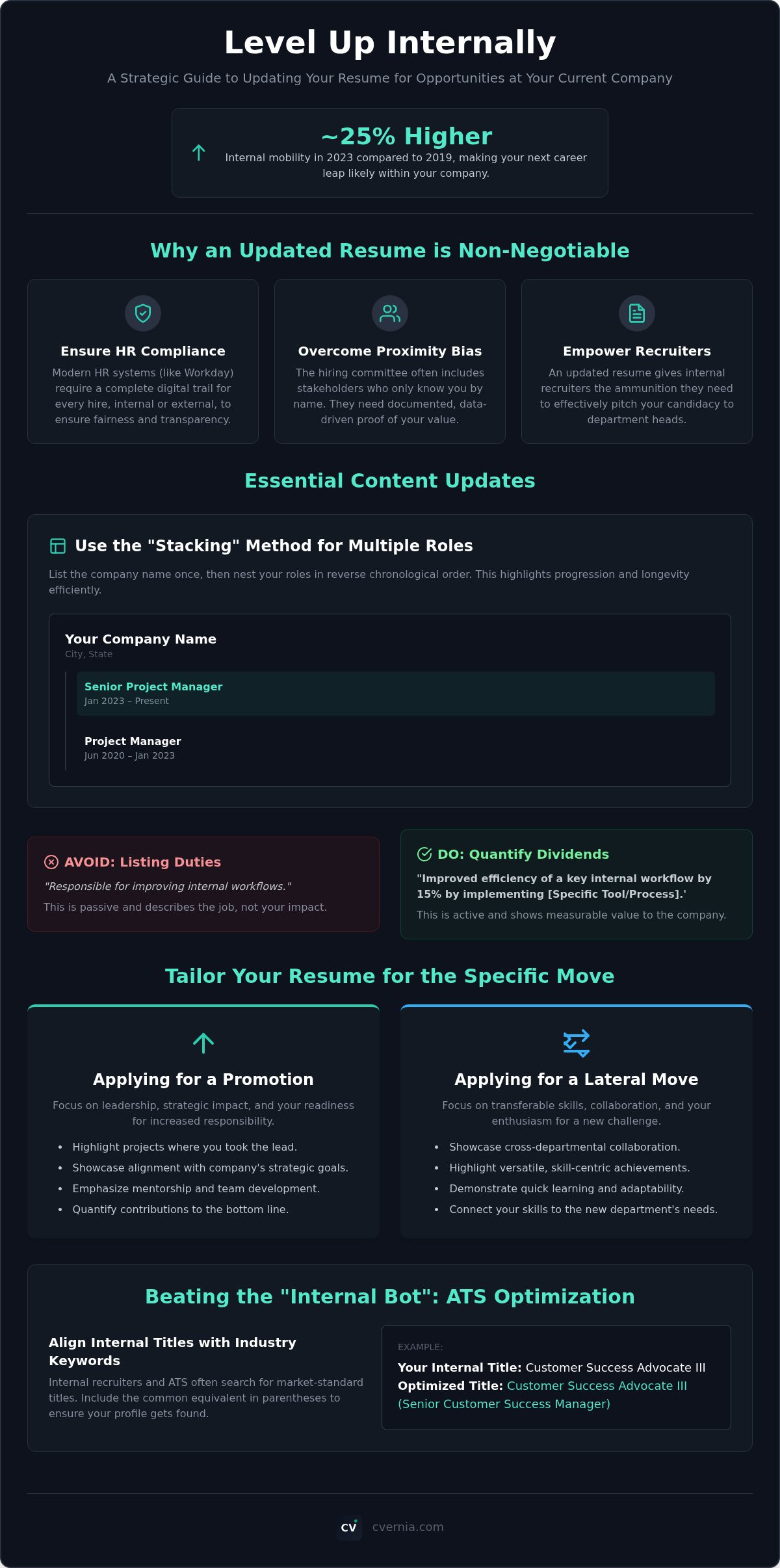
Many employees assume a quick chat by the coffee machine or a positive Slack thread is enough to secure a promotion. In reality, the formal hiring process in 2026 is more rigorous than ever. Even if you've been with the team for years, updating resume for same company applications is a non-negotiable step for HR compliance. Modern organizations use sophisticated systems like Workday or Greenhouse that require a complete digital trail for every internal hire to ensure fair play and transparency during audits. Without a fresh CV, your application might technically "exist," but it won't move through the necessary legal and administrative gates.
Relying on proximity bias is a dangerous game. Your direct supervisor might see your hard work every day, but the hiring committee often includes stakeholders from other departments who only know you as a name on an org chart. They need hard data, not just a friendly reputation. Treating your current employer with the same professional respect as a new prospect ensures you aren't overlooked for an external candidate who arrived with a polished, data-driven document. It's about proving that you haven't just been "present" for the last two years; you've been contributing at a level that justifies a new title or a higher salary bracket.
The Role of the Internal Recruiter
Internal recruiters often manage hundreds of employees across multiple divisions. They act as the primary gatekeepers who must justify your candidacy to department heads you've never met. A clear, updated resume gives them the ammunition they need to pitch you effectively. Don't expect your internal network to bypass the formal screening process. In the modern corporate landscape, "who you know" might get your foot in the door, but "what you've documented" is what closes the deal. A professional update shows the recruiter that you're serious about the transition and ready for the increased responsibility.
Documentation as a Career Growth Tool
The act of updating resume for same company roles serves as a personal skills audit. It forces you to look back at your recent wins and identify exactly where you've grown and where gaps still exist. This preparation is vital for answering the "Why now?" question during internal interviews. It also future-proofs your career by setting the stage for your 2026 performance reviews, providing a ready-made list of achievements for your manager. An internal resume is a strategic bridge between past performance and future potential.
Essential Content Updates: Translating Internal Wins into Value
Don't just tack on a new bullet point to the top of your old CV. When updating resume for same company applications, use the "Stacking" method to show growth. List the company name once at the top. Then, nest your different job titles underneath it in reverse chronological order. This structure highlights your progression and longevity without wasting space on redundant employer descriptions. It tells a story of a rising star rather than a stagnant employee.
Transition your language from "Duties" to "Dividends." Your hiring manager already knows what the job description says; they want to see the results you delivered. Use your insider access to quantify your impact with data external candidates can't touch. Did you improve the efficiency of a specific internal workflow by 15%? Did you help hit a department-specific KPI mentioned in the last quarterly town hall? These specific metrics prove you're already delivering value to the organization's bottom line.
Prune your "Legacy" content to make room for these recent wins. If you've been with the organization for several years, your roles from previous companies should be condensed or removed entirely. Focus on your current tenure. Highlight the projects that align with the company's 2026 strategic goals. This ensures your resume feels fresh and relevant to the specific challenges the department is facing today.
Mastering Company-Specific Terminology
Balance internal jargon with industry standards. If your team uses proprietary names for software or roles, include the industry-standard equivalent in parentheses. This helps the internal recruiter quickly categorize your skills. Aligning your achievements with the company's specific mission statement shows you're a cultural fit. You can use a tailored cover letter generator to perfectly match the tone and terminology of the internal job posting.
Highlighting Cross-Departmental Collaboration
Showcase your ability to see the "Big Picture." Focus on projects where you collaborated with other teams or led initiatives that impacted multiple departments. Mention your proficiency with the company's internal tech stack, such as proprietary databases or specific communication protocols. This insider knowledge makes you a lower-risk hire than an external candidate. Managing these specific details is simpler when you use a centralized application dashboard to track your internal milestones and professional versions.
Managing Resume Versions for Lateral Moves vs. Promotions
Your career trajectory within a single organization isn't always a straight climb. You might be eyeing a leadership role in your current department or considering a strategic shift into a completely different division. When updating resume for same company applications, you must tailor your document to reflect these distinct goals. A promotion version focuses on your upward trajectory, highlighting increased responsibility, strategic decision making, and leadership wins. It's about proving you've outgrown your current title and are ready to manage larger budgets or bigger teams.
In contrast, a lateral move version emphasizes your adaptability and transferable skills. Since about 11% of employees make lateral moves each year, this is a common and effective way to broaden your expertise. For these roles, focus on the "Big Picture" skills that apply across departments, such as project management, data analysis, or mastery of the company’s internal software. You also need a "Safety" version. Keeping a general, updated CV ready for unexpected internal restructures ensures you're never caught off guard if your department's priorities shift suddenly.
Strict version control is your best defense against administrative errors. Never overwrite the original resume that got you hired. HR maintains a digital archive of your initial application, and any discrepancies in dates, titles, or core qualifications between your old and new versions can trigger red flags during a background audit. Maintaining a clean history of your professional evolution shows attention to detail and integrity.
Using CVernia for Version Management
Keeping track of multiple CVs doesn't have to be a manual chore. You can use CVernia’s version management tools to organize your internal applications by department or role type. The platform’s smart detection ensures that your employment dates and official titles remain consistent across every version you create. This centralized system allows you to see exactly which department head received which version of your history, preventing embarrassing overlaps during cross-departmental interviews.
Organizing Internal Application Attachments
Internal applications often require more than just a CV. You should treat your internal performance reviews and "Academy" certifications as vital supplementary attachments that validate your resume's claims. Use a centralized dashboard to store these documents alongside your interview notes for different internal panels. Having your specific wins and feedback loops organized in one place makes updating resume for same company positions a streamlined, stress-free process that reflects your true professional value.
Beating the "Internal Bot": ATS Optimization for Existing Employees
Don't assume your tenure grants you a free pass through the hiring software. The "Internal Pass" is a dangerous myth. Since 99% of Fortune 500 companies use Applicant Tracking Systems (ATS) to screen candidates, your application will likely face a digital gatekeeper before reaching a human. In 2026, 68% of enterprise ATS platforms incorporate AI or machine learning based scoring. This means your document must be optimized to survive a contextual scan, even if you’ve worked in the same office for a decade. When updating resume for same company applications, your goal is to speak the language of the bot while maintaining your insider edge.
Alignment is your strongest tool. Often, internal titles are specific to a company's culture but don't match the "market" titles used in job postings. If your official internal title is "Solutions Architect II" but the job post asks for a "Lead Systems Engineer," ensure both terms appear in your resume. This helps the system bridge the gap between your current record and the new requirements. You can verify your alignment by running your document through a CV compatibility checker to see how an automated system scores your internal history against the new role.
Formatting for speed is equally critical. Internal HR systems need to parse your promotion dates correctly to calculate your total experience within the firm. Use a clean, single column layout. Avoid complex graphics or tables that might confuse the parser. When the system can easily read your progression, it's more likely to flag you as a high potential candidate for the internal recruiter's shortlist.
Strategic Keyword Placement
Focus on "bridge keywords" that link your existing expertise to the requirements of the new position. If you're moving from sales to project management, emphasize "client lifecycle management" and "resource allocation." Avoid the jargon trap where proprietary internal project names replace standard industry terms. A parser might not understand what "Project Phoenix" is, but it certainly recognizes "cross-functional stakeholder management." You should check resume compatibility for an internal role by comparing your CV against the specific competency framework used by your HR department.
Internal Talent Marketplace Optimization
Modern platforms like Workday and Greenhouse now function as internal talent marketplaces. These systems create a permanent employee profile that recruiters use to "headhunt" from within. Ensure your skills section matches the company’s internal competency framework exactly. Truthful representation is vital because your actual performance data is only one click away for any internal recruiter. If the bot flags a discrepancy between your resume and your official HR file, it can damage your professional reputation. To ensure your CV is perfectly optimized for these internal systems, analyze your resume with CVernia’s ATS tools today.
Streamlining Your Internal Climb with CVernia’s Management Platform
Navigating a long term career at one organization requires more than just hard work; it demands a precise record of your professional evolution. When updating resume for same company applications, CVernia acts as your digital mentor, ensuring every internal win is documented and ready for the next opportunity. Our platform centralizes your entire journey from your first day to your next promotion. This organized approach reduces application anxiety by providing a ready to go, tailored document system that reflects your true value to the firm. You don't have to start from scratch every time a new internal opening appears.
Empower your transition into management by leveraging the Career Academy resources. These learning tools prepare you for the specific leadership challenges of 2026, such as managing cross functional teams or navigating complex corporate structures. CVernia is designed as a trusted companion for your professional life, supporting your loyalty to your employer while ensuring your personal growth never stagnates. By maintaining a high degree of individualization in your CV, you position yourself as the most logical choice for internal advancement.
Your Internal Application Dashboard
Maintain a clear overview of your progress with a dedicated dashboard. This tool allows you to track internal deadlines and manage follow ups with hiring managers who might be in your own building. Use the job interview tracker to organize multi stage internal panels. Storing your interview notes in one place ensures you don't repeat the same stories to the same people, helping you maintain a fresh and compelling narrative during every conversation. It's the most efficient way to prove you understand the big picture of the business.
Final Checklist Before You Submit Internally
Perform a quick five minute audit to ensure your application is flawless. Accuracy is paramount when your official records are only one click away from the recruiter. Follow these steps for a polished submission:
- Verify that your dates and official titles match your HR file exactly.
- Audit your internal references to ensure they are prepared for a reach out.
- Confirm your "Smart Reapplication" settings are updated to prevent conflicting data in the company's system.
- Check that your skills section aligns with the latest corporate competency framework.
Take the final step toward your next career milestone. Start tailoring your internal resume with CVernia today and approach your next promotion with professional confidence and strategic advantage.
Secure Your Next Internal Move with Confidence
Your journey within your current company is a testament to your loyalty and professional growth. However, transitioning into a new role requires a formal strategy that goes beyond your daily reputation. By updating resume for same company applications, you ensure that HR compliance teams and internal recruiters see the full scope of your recent wins. Focus on translating your daily duties into measurable dividends and aligning your keywords with the organization's 2026 strategic goals.
Don't let administrative friction or outdated documents slow your climb. Optimize your internal resume with CVernia’s version management tools to keep your professional history organized and consistent across every department. Our platform provides Smart Reapplication Detection to prevent system conflicts, ATS Compatibility Scoring to beat the digital bots, and Centralized Interview Note Management to help you ace every panel. You've already proven your value on the job; now it's time to document it with precision. Step into your next promotion with the self-assurance of a high-performer who is fully prepared for the future.
Frequently Asked Questions
Do I really need a resume for an internal promotion?
Yes, you absolutely need a resume for an internal promotion to satisfy HR compliance and administrative audits. Even if your manager supports you, the hiring committee often includes department heads who don't know your daily work. Providing a fresh CV ensures they have hard data to justify your salary increase or title change. It's also a professional signal that you take the new opportunity seriously and aren't relying solely on your existing tenure.
How do I list multiple positions at the same company on my resume?
Use the stacking method to list multiple roles under a single employer heading. List the company name once at the top with your total years of service. Underneath, list each job title in reverse chronological order with its specific dates and bullet points. This format highlights your upward mobility and long term commitment. It also prevents your resume from becoming repetitive or cluttered with the same company information listed multiple times.
Should I include my current boss as a reference on an internal resume?
You should generally include your current boss as a reference only if they are aware of and support your application. If your move is confidential, it's safer to list other senior colleagues or past managers within the firm. Most internal recruiters will eventually contact your current supervisor as part of the formal vetting process. Open communication with your manager about your career goals is usually the best way to handle this professional transition.
How far back should my internal resume go if I have been at the company for 10 years?
Your internal resume should prioritize your achievements from the last three to five years. If you’ve been at the firm for a decade, condense your earliest roles into brief summaries or single line entries to save space. Focus the majority of your document on your most recent wins and leadership growth. When updating resume for same company applications, you want to prove you're ready for the future, not just dwelling on your entry level past.
Do internal resumes go through an ATS?
Yes, internal resumes go through an Applicant Tracking System (ATS) at most large organizations. Statistics show that 99% of Fortune 500 companies use these systems for both external and internal hires. The "internal bot" scans for keyword alignment and specific competencies to ensure you meet the minimum requirements for the new role. Using a compatibility checker helps ensure your document is parsed correctly by the system before it reaches a human recruiter's desk.
Is a cover letter necessary for an internal job application?
A cover letter is highly recommended for internal applications because it allows you to explain your "Why" more deeply than a CV can. Use it to connect your current insider knowledge to the challenges of the new department. It's your chance to show you've done your homework on the team's specific goals. A tailored letter demonstrates a level of initiative that sets you apart from other internal candidates who might submit a bare application.
Can I mention internal projects that are under NDA on my resume?
You can mention projects under NDA by focusing on the skills you used and the quantifiable impact you made without revealing proprietary details. Instead of naming a specific confidential product, describe it as a "high value internal initiative" or "proprietary software launch." Focus on the percentages and metrics you achieved. This approach proves your professional value while demonstrating that you're a trustworthy employee who respects the company's legal and security boundaries.
How do I handle a lateral move resume vs. a promotion resume?
Handle a lateral move by emphasizing transferable skills and your ability to adapt to new challenges across different departments. For a promotion, focus on leadership, strategic decision making, and your history of increased responsibility. Updating resume for same company moves requires you to pivot your narrative based on the specific job description. Use version management tools to keep these different documents organized so you always present the most relevant professional history to the hiring panel.


