
In 2026, your cover letter is no longer a formal courtesy or a simple summary of your resume. It's a high-stakes narrative bridge that connects your specific achievements to a company’s future challenges. You likely feel the pressure of modern hiring, where the fear of being rejected by an ATS bot is just as real as the struggle to write about yourself without sounding generic. It's a difficult balance to strike, especially when you want to remain truthful while standing out in a crowded digital landscape.
We're here to replace that uncertainty with professional confidence. This guide provides a definitive checklist of what to include in a cover letter to ensure your application is both human-centric and technologically optimized. You'll learn how to bridge the gap between your CV and the job description with precision and clarity. We'll walk through the exact components required for a modern layout, the narrative strategies that build trust, and the formatting rules that keep your document at the top of the pile. By the end, you'll have a clear roadmap to build an application that feels both visionary and grounded in reality.
Key Takeaways
- Master the modern structure by shifting from a summary of your past to a solution for the employer's future.
- Discover exactly what to include in a cover letter to satisfy both human recruiters and AI-driven ATS parsing logic.
- Navigate 2026 etiquette by addressing remote work preferences and using AI as a tool for enhancement rather than a total replacement.
- Align your narrative with company goals by connecting your specific career achievements directly to their high-priority KPIs.
- Streamline your process with a centralized dashboard that tracks application versions and identifies opportunities for smart reapplication.
The Essential Anatomy of a 2026 Cover Letter
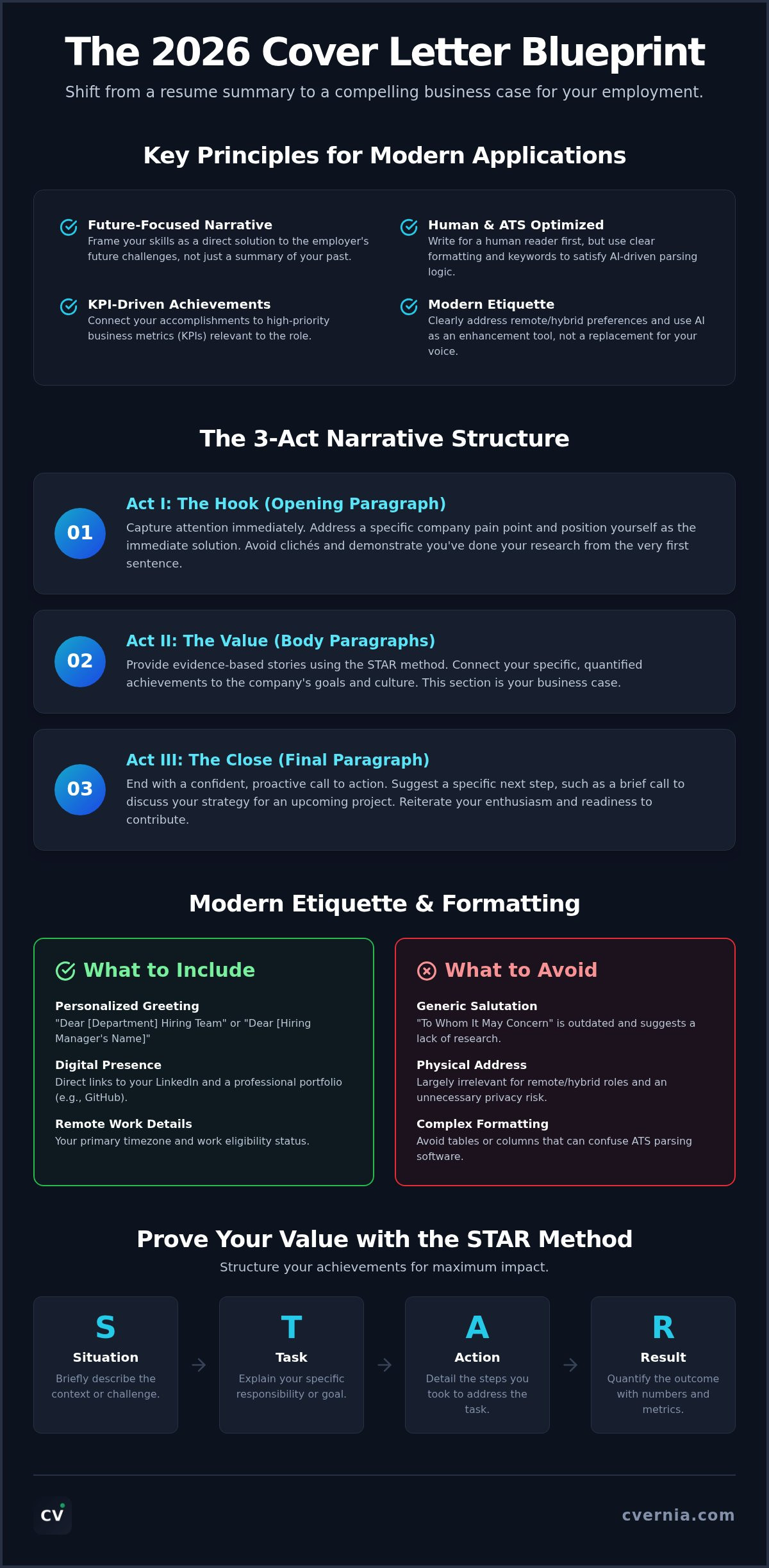
A Cover letter serves as your strategic introduction, but by 2026, its structure has evolved into a precision tool. Knowing what to include in a cover letter starts with the realization that every line must earn its place. You aren't just filling space; you're building a business case for your employment. This begins with a crisp header and ends with a confident call to action. Follow this three-act structure—Hook, Value, and Call to Action—to transform a standard document into a compelling narrative.
Header and Contact Information Standards
Your header acts as your digital business card. Include your LinkedIn profile and a direct link to your professional portfolio or GitHub repository. These are non-negotiable in modern hiring because they provide immediate proof of your skills. Physical addresses are now largely optional for remote roles. Recruiters care about your timezone and work eligibility, not your street name. Ensure your phone number and email are bot-readable by using standard fonts and avoiding complex tables that confuse ATS parsers. Keep the layout clean and professional to ensure your information is accessible to both humans and software.
The Professional Greeting in a Post-Gender Market
The phrase "To Whom It May Concern" is officially retired. It's impersonal and suggests a lack of research. In a post-gender market, focus on the role or the team rather than outdated honorifics. Address your cover letter without a name by using specific phrases like "Dear [Department] Hiring Team" or "Dear [Job Title] Search Committee." This shows you've done your homework without making assumptions about the recruiter's identity. If you can find the name of the hiring manager through LinkedIn or the company website, use it. Personalization remains a powerful way to build an immediate connection.
Once you've established the greeting, move quickly into your three-act narrative. Start with a hook that identifies a specific problem the company faces and how you intend to solve it. In the value section, connect your specific achievements directly to their current KPIs. Finally, close with a professional sign-off that balances warmth with authority. Phrases like "Best regards" or "Sincerely" remain the gold standard. Suggest a specific next step, such as a brief call to discuss your strategy for their upcoming project. This proactive approach demonstrates your readiness to contribute from day one.
Crafting the Narrative: Beyond the Resume Summary
Your cover letter shouldn't just repeat your CV; it should interpret it. While the previous section established the professional framework, the narrative is where you win the interview. Deciding what to include in a cover letter requires a shift in perspective. You aren't the protagonist of this story; the company's problem is. Your role is to present yourself as the specific solution to that problem. This transformation turns a standard document into a compelling business case for your employment.
The Opening Paragraph: Capturing Attention Immediately
Stop using the "I am writing to apply for" cliché. It's a missed opportunity to engage the recruiter. Instead, start with a bold statement that addresses a pain point. If the job description mentions a need for scaling operations, start with how you managed a 20% growth phase at your previous firm. This establishes your authority immediately. It shows you understand their needs and have the evidence to back it up. A confident and empathetic tone helps the hiring manager feel that their search might finally be over. You're not just looking for a job; you're offering a service.
The Middle Body: Evidence-Based Storytelling
Evidence is the currency of a modern application. Use the STAR method to structure your key stories. Describe the Situation, Task, Action, and Result with precision. Academic guides on how to organize a cover letter emphasize that specific examples carry more weight than vague adjectives. Focus on transferable skills that bridge the gap between industries if you're changing paths. Always maintain a policy of truthful representation. Exaggerating results might get you an interview, but it won't survive the vetting process. Truthful tailoring ensures your confidence is grounded in reality.
The "Why Us" section is where you demonstrate cultural and mission alignment. Research the company’s recent wins or their stated values. Explain how your professional philosophy mirrors their goals. This isn't about flattery; it's about fit. Close your letter with a proactive call to action. Don't wait for them to reach out. Suggest a time to discuss how your specific background can help them hit their upcoming KPIs. If you're feeling overwhelmed by the drafting process, using a platform for Tailored CV & Cover Letter Creation can help you organize these narrative threads into a cohesive, professional document.
The Technical Layer: Keywords and ATS Optimization
While the narrative builds a human connection, the technical layer ensures your application survives the initial screening. Modern Applicant Tracking Systems (ATS) evaluate cover letters to score your alignment with the job requirements. If your document is invisible to the scanner, it'll never reach a human desk. Understanding what to include in a cover letter from a technical perspective involves strategic placement and high machine readability. You must balance natural storytelling with the specific terminology the software is programmed to find. This digital gatekeeper is efficient but rigid; your document must be built for seamless compatibility.
Keyword Extraction and Alignment Strategies
Start by dissecting the job posting for recurring hard and soft skills. These terms aren't just suggestions; they're the search queries recruiters use to filter the application database. Identify the three most prominent requirements and weave them into your narrative. Focus on the first 100 words of your body paragraphs for maximum impact. This is high-priority real estate where parsing algorithms often look for core competencies. Avoid "keyword stuffing," which is the practice of listing words without context. Instead, integrate them into your achievements to maintain a professional flow. Learn how applicant tracking systems work to optimize your text for maximum visibility.
File Formats and Bot-Friendly Layouts
Design choices that appeal to humans can be disastrous for automated scanners. Avoid using images, charts, or multi-column layouts, as these often cause the parser to scramble your text into an unreadable mess. Stick to a single-column format with standard margins. Regarding file types, .docx remains a safe bet for compatibility, though modern PDFs with selectable text are generally accepted. If you can't highlight and copy the text in your document, a bot can't read it either. Use ATS compliant resume principles for your cover letter to ensure your layout is technically sound.
Focusing on these technical details removes the barriers between your talent and the hiring team. It's about preparedness and precision. When you know what to include in a cover letter to satisfy the algorithm, you gain the strategic advantage needed to secure that interview. This technical layer isn't just a hurdle; it's an opportunity to prove your alignment before a human even reads your name. It ensures your application is organized, efficient, and highly dependable in the eyes of modern recruitment technology.
Modern 2026 Etiquette: Remote, Hybrid, and AI
The rules of professional engagement have shifted. In 2026, a cover letter isn't just about your past; it's a demonstration of your digital fluency. Knowing what to include in a cover letter now involves addressing how you work, not just what you do. Transparency regarding your work environment and your use of technology builds the trust necessary for a modern partnership. This section explores how to handle these newer expectations with grace and authority.
Remote and Hybrid Work Context
If you're applying for a distributed role, address your operational readiness early. Briefly mention your established home office setup or your history of success in remote environments. This alleviates the recruiter’s concerns about your ability to self-manage. Highlight your mastery of digital communication tools and your comfort with asynchronous workflows. If the role requires occasional travel or future relocation, state your flexibility clearly. Proactively addressing these logistics shows you're prepared for the realities of 2026 work culture.
Using AI Tools Without Losing Your Voice
AI is a powerful ally, but it shouldn't be your ghostwriter. While a tailored cover letter generator is an excellent starting point for structure, the final word must be yours. Determining what to include in a cover letter when using AI requires a critical eye for detail. Recruiters can often sense when a letter lacks emotional resonance or human nuance. Use technology to enhance your clarity, not to replace your personality. Manual proofreading is essential to ensure the tone remains professional yet accessible. Most importantly, verify that no tool has inadvertently invented certifications or skills. Truthful representation is the cornerstone of a successful application.
Modern etiquette also encourages the use of digital portals. If you have a video introduction or a curated digital work sample, hyperlink them directly within your text. This provides immediate value and allows the hiring team to see your personality in action. It transforms a static document into an interactive experience. Disclosing your use of advanced application management tools can actually be a benefit. It signals that you are organized, efficient, and technologically advanced. You aren't just another applicant; you're a professional who uses the best tools available to ensure precision.
Ready to manage your professional journey with precision? Use our Career Application Management Platform to track every version of your letter and maintain a centralized dashboard for all your interview notes.
Streamlining Your Application with CVernia
Managing a modern job search is an exercise in data management. Once you understand what to include in a cover letter, the challenge shifts to keeping those details organized across dozens of applications. CVernia acts as your digital mentor, providing an Application Tracking Dashboard to monitor every version you send. This eliminates the risk of sending the wrong file or repeating a narrative that didn't land. By organizing your process, you move from a state of reactive stress to one of strategic readiness.
Version Management for Multiple Applications
Never send the same letter twice. CVernia’s tracking system ensures each application is a unique, tailored response to a specific job posting. Use the platform to iterate on your narrative based on recruiter feedback or previous outcomes. This iterative process allows you to refine your message while keeping your truthful resume and cover letter perfectly in sync. It's about maintaining consistency across your professional brand without sacrificing the individualization that modern hiring managers expect. Organized documentation ensures you never lose track of which value proposition you presented to which firm.
The Power of a Centralized Career Platform
Take control of your journey with the job search management system designed for the 2026 market. Beyond simple storage, the platform helps you manage interview notes and attachments in one secure place. This ensures you're always interview-ready, with your research and previous correspondences available at a click. If you need to dive deeper into advanced tailoring techniques, the Career Academy offers resources to sharpen your skills. Transitioning from an applicant to an interview-ready professional requires this level of preparedness.
Smart reapplication detection is a standout feature for those navigating competitive industries. The platform analyzes your previous versions to help you learn from your history. It ensures that when you decide what to include in a cover letter for a new role, you're building on a foundation of data-driven insights. This strategic ally doesn't just store your documents; it empowers your career progression by turning every application into a learning opportunity. You gain a high degree of individualization and a strategic advantage that keeps you ahead of the competition.
Secure Your Next Interview with Precision
Mastering the modern application process requires a blend of narrative storytelling and technical precision. You now understand that deciding what to include in a cover letter is about more than just listing skills; it's about proving you are the specific solution to a company's future challenges. By aligning your achievements with their KPIs and ensuring your document is optimized for both bots and humans, you position yourself as a high-value candidate. Remember to address remote work preferences and use digital tools to enhance your voice rather than replace it.
Your professional success depends on staying organized and truthful. CVernia provides the ATS compatibility analysis and application tracking you need to manage every version of your story with confidence. This truth-first career technology ensures your application is both professional and authentic. Start tailoring your truthful cover letter with CVernia today and move from uncertainty to total readiness. You have the skills and the strategy; now it's time to show the world what you can do.
Frequently Asked Questions
How long should a cover letter be in 2026?
Aim for 250 to 400 words, which typically fits on a single page. Recruiters in 2026 value efficiency and directness above all else. A three paragraph structure is often the most effective way to communicate your value without overwhelming the reader. Keep your sentences punchy and focused on results. if your letter exceeds one page, you risk losing the reader's attention before they reach your call to action.
Do I really need to write a cover letter if it is optional?
You should always write a cover letter even if the job portal marks it as optional. This document is your only chance to provide context that a resume cannot offer. It demonstrates your effort and genuine interest in the specific role. Skipping it suggests a lack of initiative, whereas submitting a tailored letter gives you a strategic advantage over candidates who chose the easier path and submitted only a CV.
Should I include my salary expectations in the letter?
Avoid including salary expectations in your cover letter unless the job posting explicitly requires it. Introducing compensation too early can limit your negotiating power or lead to premature rejection if your numbers don't align. Focus instead on the value you bring to the company. Save the financial discussion for the interview stage where you have more leverage and a better understanding of the total benefits package and company culture.
Can I use a template, or will hiring managers recognize it?
You can use a template for layout and structure, but you must customize the entire narrative. Hiring managers easily recognize generic text that has been copy-pasted from the web. When considering what to include in a cover letter, prioritize unique stories that prove your skills. Use a framework to stay organized, but ensure every sentence reflects your specific professional voice and the company's unique needs to avoid sounding like a bot.
What is the best way to address a hiring manager if their name is not listed?
Use a title-based greeting like "Dear [Department] Hiring Manager" or "Dear Search Committee" when a specific name isn't available. This is much more professional than using outdated phrases that feel lazy. You can often find the correct department head through a quick search on LinkedIn. Showing that you've attempted to identify the right person demonstrates preparedness and attention to detail, which are traits every hiring team values in a new recruit.
How many keywords should I include for ATS compatibility?
Target three to five high-priority keywords that appear most frequently in the job description. Natural integration is more important than the total number of words used. When deciding what to include in a cover letter for ATS compatibility, focus on hard skills and specific software mentioned in the posting. Spread these terms throughout your introductory and body paragraphs to ensure the algorithm recognizes your alignment with the role's core requirements without flagging you for stuffing.
Is it okay to use bullet points inside a cover letter?
Bullet points are highly effective for highlighting specific achievements or data-driven results within your body paragraphs. They break up large blocks of text and make your letter much easier to scan for busy recruiters. Limit yourself to three or four points to maintain a clean layout. Ensure each bullet follows a consistent structure, starting with a strong action verb to emphasize your direct contribution to previous projects or business goals.
What are the biggest red flags in a modern cover letter?
The biggest red flags include generic content, factual inaccuracies, and focusing entirely on your own needs rather than the company's problems. Hiring teams are trained to spot inconsistencies quickly.
- Submitting a letter with another company's name still in the text.
- Focusing on what the job will do for you instead of what you can do for the employer.
- Including fake certifications or exaggerated results that won't pass a background check.
- Poor formatting that makes the text unreadable for modern scanning software.


