
You've just finished a high-stakes third-round interview, but as you sit down to write your follow-up email, the specific details start to blur. You might struggle to recall whether it was the CTO or the Product Lead who mentioned the team's upcoming expansion into European markets. It's a common frustration that can stall even the most promising job search. When you're juggling multiple applications, your memory simply isn't a reliable filing cabinet for the nuanced cultural cues and technical requirements shared during a call. Learning how to organize interview notes effectively is often the difference between a generic follow-up and a strategic response that secures the offer.
We believe your preparation should be your greatest strength. This guide will show you how to transform scattered jottings into a structured career database that powers your performance across every round. You'll master a repeatable system for capturing deep insights, managing follow-up deadlines, and building a centralized record of your professional journey. Stop relying on luck and start building a digital command center that turns every conversation into a strategic advantage for your career.
Key Takeaways
- Implement the Three-Column Prep method to align your professional value with the company's core mission before you even join the call.
- Capture hidden cultural cues using the Key Insight method, focusing on details that aren't available in the standard job description.
- Discover how to organize interview notes using the 15-Minute Rule, ensuring you record critical feedback before your memory begins to fade.
- Link your post-interview reflections to specific CV versions to maintain a consistent narrative across multiple hiring rounds.
- Centralize your insights within a dedicated dashboard to replace disorganized spreadsheets and build a permanent record of your career journey.
Why Interview Organization is Your Secret Competitive Advantage
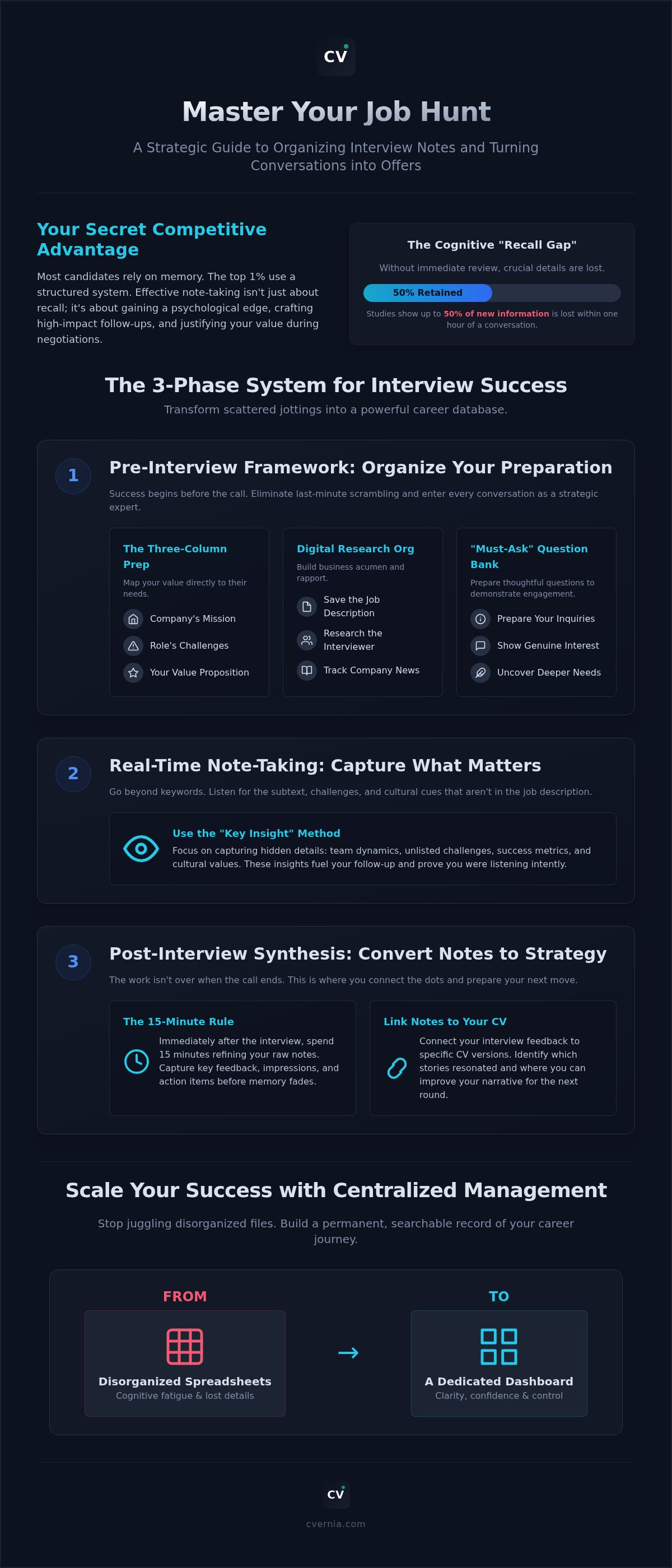
Think of your interview notes as a high-performance branding tool rather than just a memory aid. While most candidates rely on their intuition, the top 1% use a structured approach to gain a psychological edge. Research into cognitive retention suggests a significant "recall gap" where individuals often lose up to 50% of new information within just one hour of a conversation. By mastering how to organize interview notes, you bridge this gap and ensure that every nuanced detail remains accessible for your next move.
These records serve as the foundation for high-impact follow-up emails that reference specific, unlisted challenges mentioned by the hiring manager. Beyond the immediate thank-you note, these insights build a powerful knowledge base. When it comes time for salary negotiations, you can point to specific pain points you identified during the process to justify your value. You aren't just asking for a number; you're proposing a solution based on documented evidence.
The Mental Load of the Modern Job Search
Managing five or more active applications simultaneously creates immense cognitive fatigue. It's easy to mix up the specific goals of one startup with the corporate initiatives of another. Organization acts as a pressure valve. It reduces the persistent anxiety of forgetting a deadline or misremembering an interviewer's name. By shifting from a reactive survival mode to a proactive management style, you reclaim your professional confidence. Using professional note-taking systems allows you to step into every meeting with the clarity of a consultant rather than the uncertainty of a job seeker.
Notes as a Feedback Loop for Your CV
Every interview is a live test of your personal marketing materials. Pay close attention to which "truthful stories" trigger a positive reaction and which ones lead to follow-up questions. These interactions provide a direct feedback loop for your application documents. If multiple interviewers ask for clarification on a specific project, it's a clear signal to refine that entry on your ats compliant resume for future opportunities. Learning how to organize interview notes allows you to identify these patterns across different companies, helping you close gaps in your narrative and sharpen your competitive edge.
The Pre-Interview Framework: Organizing Your Preparation
Success begins long before the video call connects. When you understand how to organize interview notes before the conversation starts, you eliminate the frantic last-minute scramble. Start by implementing the Three-Column Prep method. Create three distinct sections: the Company’s mission, the Role’s specific challenges, and Your Value proposition. This structure forces you to map your truthful success stories directly to the job description requirements. It ensures that every anecdote you share is strategically aligned with what the hiring manager needs to hear. By following best practices for interview notes, you set a professional standard for yourself that recruiters will notice immediately.
Don't forget to research the hiring manager’s professional background. Look for shared connections or past projects that provide a natural opening for rapport. Documenting these details in your prep notes helps you build a genuine connection during the call. Mapping your preparation in this way transforms a standard interview into a high-level consultation where you're the expert solver of their problems.
Digital Research Organization
Don't rely on the live job listing. Companies often take down postings once they start interviewing, leaving you without a reference point. Save a copy of the job description immediately. Categorize recent company news or industry trends into a centralized dashboard to demonstrate your business acumen. Using a dedicated job interview tracker allows you to link this research to specific interview dates and versions of your CV. This level of detail transforms your search from a chaotic task into a streamlined operation. You can manage these moving parts effortlessly with an application management dashboard designed for high-stakes transitions.
The "Must-Ask" List
Prepare a master Question Bank. Organize your inquiries into three categories: Culture, Growth, and Team Dynamics. Aim to have 3-5 pre-written questions ready for every interviewer. This signals high engagement and intellectual curiosity. Strategic questions also serve as a diagnostic tool. By asking about team conflict resolution or turnover, you can reveal potential red flags before signing a contract. Your notes on their answers will become invaluable data points when you compare multiple offers later in the process.
Real-Time Note-Taking: What to Capture During the Call
The moment the interview begins, your focus shifts from research to active listening. Effective note-taking during a live call is a delicate balancing act. You need to record high-value information without sacrificing the human connection. Start by establishing proper etiquette. Always ask for permission by saying, "I'd like to take a few notes to ensure I capture our discussion accurately; is that alright with you?" This simple request signals professional respect and transparency. It also reframes your silence as a sign of engagement rather than distraction. While you listen, use a personal shorthand to keep your eyes on the camera or the interviewer. This approach is a core part of effective interview preparation, as it allows you to stay present while building your record.
Focus on the "Key Insight" method by capturing details that never appear in a standard job description. Listen for internal team dynamics, specific project roadblocks, or the manager's personal vision for the role. These "unspoken" details, such as the energy between team members or the tone used when discussing challenges, are just as important as the verbal answers. Understanding how to organize interview notes in real-time means prioritizing these unique insights over basic facts you already know from your research.
The 4 Essential Data Points
Ensure you leave the conversation with these four critical pieces of information. First, document the specific pain points the hiring manager emphasizes. These are the problems they expect you to solve. Second, record the names and roles of everyone in the interview loop. Third, clarify the exact timeline for next steps and decision-making. Finally, jot down any curveball questions that caught you off guard. These notes will become the foundation for your post-interview synthesis and future preparation sessions.
Analog vs. Digital Notes
Choose your tools based on the environment and your personal cognitive style. Many professionals prefer pen and paper for the tactile benefit; writing by hand often improves memory retention and feels less intrusive in face-to-face meetings. However, digital career management tools offer superior speed and searchability. If you choose a digital setup for a virtual interview, avoid using a loud mechanical keyboard. The clicking sound can be incredibly distracting for the person on the other end. Whichever method you select, the goal of learning how to organize interview notes is to create a reliable bridge between the live conversation and your long-term career database.
Post-Interview Synthesis: Converting Scrawls into Strategy
The 15-Minute Rule is your most powerful tool for long-term retention. Once the call ends, your memory begins to fade instantly, as we discussed regarding the recall gap. Dedicate the first quarter-hour post-interview to cleaning up your shorthand and expanding on your initial thoughts. This is the critical moment to refine your STAR stories. If a specific example didn't land as expected or triggered follow-up questions, record those details immediately. Use this feedback to adjust your narrative for the next round. Mastering how to organize interview notes at this stage ensures your reflections are accurate and actionable rather than vague memories.
Assign a "Culture Fit" score to the role while your emotional response is still fresh. Consider whether the team seemed genuinely collaborative or if there was an underlying tension. Recording these gut feelings helps you maintain objectivity later when you're comparing multiple offers. It's your turn to be the evaluator. This proactive reflection transforms you from a passive candidate into a strategic decision-maker.
The Candidate Scorecard
Stop letting companies be the only ones with a grading system. Create your own scorecard to evaluate the role against your core career values, such as technical growth, leadership style, or work-life balance. Compare this specific conversation to previous interviews within the same application. If the team's description of the role contradicts what the recruiter initially shared, your notes will highlight that discrepancy. This data helps you decide whether to invest more time in the process or politely withdraw before you're too deep in the loop.
Drafting the Strategic Thank-You
Your notes are the foundation for a thank-you note that actually gets noticed. Look for specific "Follow-up Hooks" in your records. Mention a unique project or a specific challenge the interviewer shared during the call. This demonstrates that you were listening intently and are already thinking about solutions. If you felt you under-explained a technical skill or missed a key point, use the thank-you note to briefly clarify that weak spot. This strategic touch-point reinforces your brand as a prepared and thoughtful professional.
Organized insights also provide a template for future success. You can use these refined stories to create cover letters for similar roles in the future, saving you hours of drafting time. To keep your reflections secure and accessible, use an interview notes management tool that links every insight to your specific application version. This organized approach ensures you're always learning from every interaction and moving closer to your next offer.
Scaling Your Success with Centralized Career Management
As your job search expands, manual tracking becomes a liability. Spreadsheets often fail because they can't effectively link qualitative data to specific document versions. When you're managing multiple active applications, you need to know exactly which CV version sparked which conversation. Understanding how to organize interview notes within a centralized system allows you to maintain this crucial context. By linking your reflections directly to the tailored CV and cover letter used for that specific role, you create a seamless narrative that spans the entire hiring process. It's the difference between a fragmented search and a cohesive career strategy.
This centralized approach also powers advanced features like Smart Reapplication Detection. If you apply to a high-growth company again in the future, you won't have to start from scratch. Your previous notes on team energy and technical requirements will be waiting for you. This strategic feedback loop turns every previous interaction into a competitive advantage for your next attempt. Learning how to organize interview notes effectively is not just a tactical fix; it's a long-term investment in your professional brand.
The Digital Command Center
A professional job search management system acts as your digital command center. It goes beyond simple text by storing attachments, interviewer contact info, and follow-up schedules in one secure location. Version management is the secret to a stress-free transition. You'll never have to guess which project you highlighted or which "truthful success story" you shared. This level of organization allows you to focus on the human side of the interview while the technology handles the logistics. You stay prepared, aligned, and ready to pivot as new opportunities emerge.
Preparing for the Next Step
Your organized archive remains valuable long after you sign the offer letter. The pain points you recorded during the interview process become the roadmap for your first 90 days in the role. Use these notes during your first performance review to demonstrate how you've solved the exact problems the hiring manager initially identified. You aren't just getting a job; you're building a Career Portfolio that documents your professional evolution over time. It's time to move beyond messy jottings and fragmented tools. Start organizing your journey with CVernia’s Application Dashboard and turn your interview insights into a permanent strategic asset.
Master Your Professional Narrative for Long-Term Success
Mastering how to organize interview notes is the final step in moving from a reactive job search to a proactive career strategy. You now have the framework to bridge the recall gap by using the 15-Minute Rule and the tools to turn real-time insights into high-impact follow-ups. By treating every conversation as a data point in your broader career journey, you ensure that no valuable detail is ever lost. Your preparation and reflection are what will ultimately set you apart in a competitive market.
Don't let your hard-won insights disappear into scattered notebooks or forgotten files. CVernia is designed to be your digital command center, offering Centralized Interview Notes Management and Secure Attachment Storage to keep your search streamlined. You can even leverage Smart Reapplication Detection to turn past efforts into future wins. Start Organizing Your Interviews with CVernia today and build the structured foundation your career deserves. You've got the skills and the system; now it's time to go out and secure the offer.
Frequently Asked Questions
Is it unprofessional to take notes during a job interview?
Taking notes is a sign of high engagement and professional respect. It demonstrates that you value the interviewer's time and are committed to capturing the details accurately. To maintain rapport, always ask for permission at the start of the call. A quick request like "I'd like to jot down some key points, is that okay?" works perfectly. This transparency ensures your silence is interpreted as focus rather than disinterest.
What is the best way to organize interview notes for multiple companies?
Using a centralized digital dashboard is the most effective way to manage multiple applications simultaneously. Avoid scattered notebooks or separate documents that lead to confusion between different company cultures. Map your notes to specific application IDs and the exact CV version you used for each role. This structured approach helps you maintain a clear mental boundary between opportunities. It also ensures you're always referencing the correct pain points during follow-up conversations.
How much detail should I write down during the interview?
Focus on capturing high-level insights rather than transcribing every word. Document specific pain points the manager emphasizes, the names of potential teammates, and the timeline for next steps. Use a personal shorthand to keep the process fast so you can maintain eye contact. You don't need to record facts already in the job description. Instead, prioritize the unique details about team energy and cultural cues that will inform your final decision.
Can I use a laptop to take notes during an in-person interview?
Pen and paper are usually preferred for in-person meetings because a laptop screen can create a physical barrier between you and the interviewer. Writing by hand also helps with memory retention and feels more personal. If you must use a laptop, ensure the screen is lowered so it doesn't block your face. Avoid loud typing sounds that can disrupt the flow of conversation. Always explain why you're using a device to avoid appearing distracted.
How do I organize my notes for a virtual interview on Zoom or Teams?
Position your digital note-taking window directly below your webcam to maintain the appearance of eye contact while you type. This setup allows you to glance at your preparation materials without looking away from the screen. If you prefer analog, keep your notepad at eye level. Learning how to organize interview notes in a virtual setting requires a balance of tech-savviness and active listening. Ensure your microphone is muted when you're typing to eliminate background noise.
What should I do with my interview notes if I don’t get the job?
Archive your notes in a secure career database rather than deleting them. These records contain valuable feedback on which stories resonated and which technical gaps you need to address. If the company grows and you apply again, these insights become a strategic advantage. You can use old notes to refine your next application or prepare for a different role. This habit turns every rejection into a learning opportunity that strengthens your overall professional brand.
How can I use my notes to write a better thank-you email?
Use your notes to pull a specific hook from the conversation that demonstrates you were listening intently. Mention a unique challenge the interviewer shared or a project they seemed particularly proud of. This level of detail makes your thank-you email feel personalized rather than generic. It also allows you to briefly clarify any answers you felt were incomplete during the call. Your notes provide the evidence needed to reinforce your alignment with the team's goals.
Is there an app specifically for organizing interview notes?
Yes, a dedicated career application management platform is the ideal solution for modern job seekers. These tools allow you to link how to organize interview notes directly to your CV versions and application status. Look for features like secure attachment storage and smart reapplication detection. This technology replaces messy spreadsheets with a streamlined dashboard. It ensures your insights are always accessible, organized, and ready to be used as a strategic asset throughout your professional journey.


