
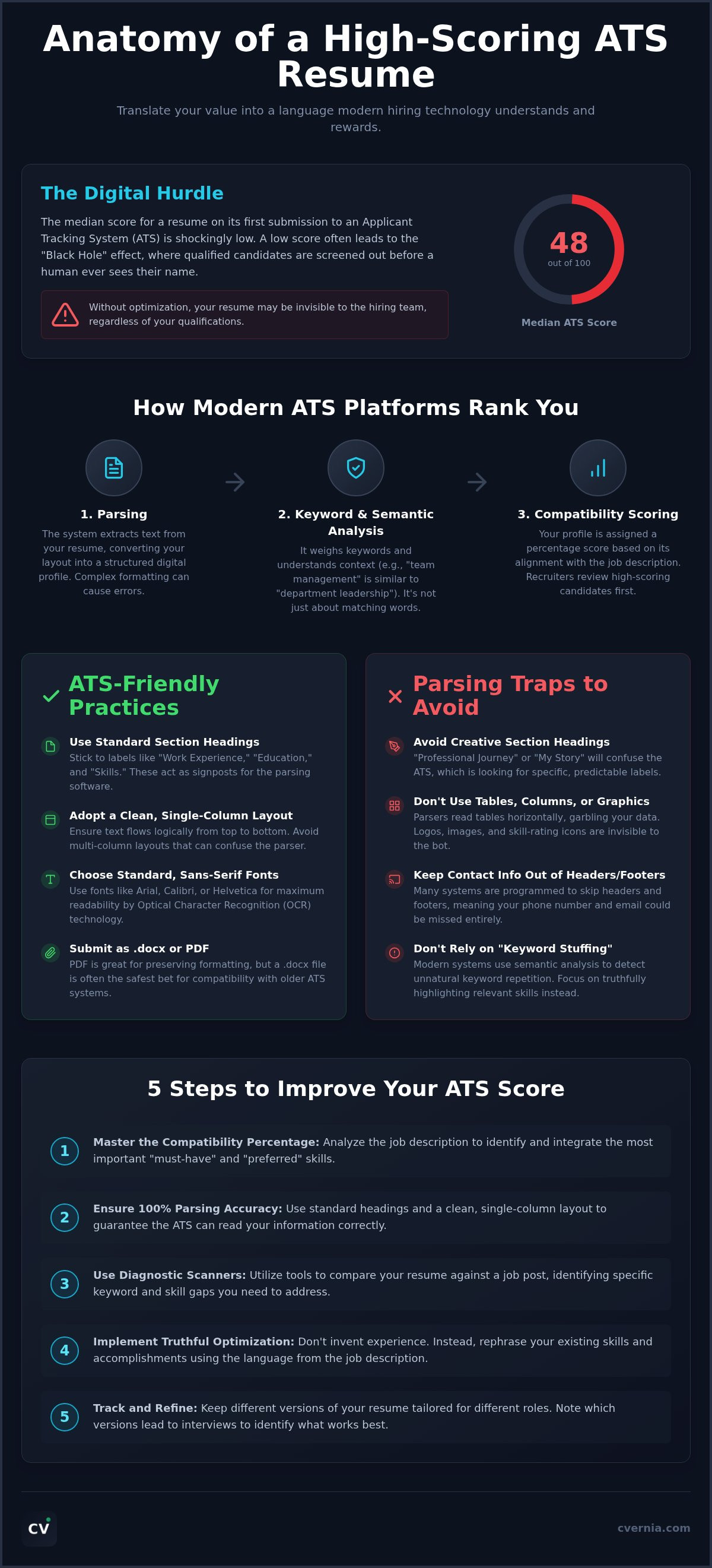
The median score for a resume on its first submission to an Applicant Tracking System is a mere 48 out of 100. If you've ever felt the sting of an instant rejection email from a job you were perfectly qualified for, you've experienced this gap firsthand. It's exhausting to waste time on complex formatting that only gets mangled by a bot. Learning how to improve ats resume score results isn't about tricking the system. It's about translating your unique value into a language that modern hiring technology understands and rewards.
You deserve a recruitment process that works as hard as you do. This guide provides the exact structural and content optimizations required to pass through platforms like Greenhouse or Workday with ease. You'll learn to identify the specific keywords that trigger a match and build a repeatable strategy for every single application. We'll move beyond outdated keyword stuffing to focus on semantic alignment and structural clarity. By the end, you'll possess a resume that doesn't just survive the initial scan but positions you as a top-tier candidate ready for the interview.
Key Takeaways
- Master the compatibility percentage to understand exactly how recruitment bots rank your profile against specific job descriptions.
- Adopt standardized section headings and clean layouts to ensure 100% parsing accuracy across major platforms like Greenhouse and Workday.
- Discover how to improve ats resume score by using professional diagnostic scanners to identify and bridge hidden keyword gaps in your CV.
- Implement a repeatable, truthful optimization process that highlights your real skills; don't rely on deceptive tactics that modern AI can easily detect.
- Streamline your job search by tracking resume versions and interview notes to identify which structural changes are driving the most success.
What is an ATS Resume Score and Why Does it Matter?
An ATS score is a digital compatibility rating. It measures the alignment between your professional history and the specific requirements found in a job posting. When you apply for a role, the software calculates a percentage based on how well your qualifications match the employer's needs. To understand how applicant tracking systems work, you must view them as sophisticated databases that organize thousands of applications into a manageable list for hiring managers.
By 2026, the technology has evolved significantly. While older systems simply counted how many times a word appeared, modern platforms use semantic understanding to grasp the context of your experience. They recognize that "managing a team" and "leadership of a department" represent similar skill sets. When you research What is an Applicant Tracking System?, you'll find it's no longer just a gatekeeper; it's a ranking tool. A high score doesn't guarantee a job, but it ensures your CV appears at the top of the recruiter's dashboard rather than being buried at the bottom of a digital pile.
How Modern ATS Platforms Rank Candidates
The ranking process begins with parsing. This technology converts your carefully designed layout into a structured text profile. If your resume uses complex tables or unusual fonts, the parser might fail, leaving you with a blank or garbled profile. Once the text is extracted, the system applies keyword weighting. Not all terms are equal; a "must-have" technical skill carries more weight than a "preferred" soft skill. Recruiters then use these scores to prioritize their day. They don't have time to read every application, so they focus their energy on candidates who achieve a high compatibility percentage first. Learning how to improve ats resume score results is the most direct way to bypass these initial digital filters.
The Consequences of a Low Compatibility Score
A low score often leads to the "Black Hole" effect. This happens when a qualified candidate is technically screened out before a human ever sees their name. It's a frustrating cycle that fuels application fatigue and wastes your valuable time. In many corporate hiring environments, manual reviews are a luxury reserved for the top 10% to 20% of scorers. If your CV doesn't meet the system's structural or keyword expectations, it stays in the database, invisible to the hiring team. Improving your score isn't about changing your history; it's about making your existing expertise visible to the software that controls access to the interview room.
The Anatomy of a High-Scoring ATS Resume
A high-scoring resume is a masterpiece of invisible engineering. While you might be tempted to use a creative layout to stand out, remember that the software is your first audience. Bots don't appreciate unique design; they search for standardized markers that categorize your history into predictable fields. Understanding how to improve ats resume score results starts with your section headings. Use "Work Experience" instead of "Professional Journey" and "Education" instead of "Academic Background." These standard labels act as signposts that allow the parser to map your career accurately.
Complex graphics, tables, and multi-column layouts are the primary reasons qualified candidates fail the initial scan. When a parser encounters a table, it often reads the text horizontally across the cells, creating a garbled mess of data. According to MIT's guide to ATS-friendly resumes, you should avoid using headers and footers for essential contact information. Many systems simply skip these areas, meaning a recruiter might never see your phone number or email address even if you're a perfect match.
Structural Essentials for Flawless Parsing
File formats play a critical role in your success. While PDF is the industry standard for maintaining visual integrity, a .docx file is often the safest fallback for older systems. Stick to modern, sans-serif fonts like Arial, Calibri, or Helvetica. These are easily readable by optical character recognition (OCR) technology. Keep your margins at a standard one inch and avoid using images or icons to represent skills. A star rating for "Python" might look sleek to a human, but it's completely invisible to a bot. For a precise check on your document's readability, you can use CVernia's ATS analysis tool to see exactly how a machine views your layout.
Content Alignment and Keyword Strategy
Modern 2026 systems reward semantic alignment over simple repetition. Identify "Anchor Keywords" in the job description; these are the core skills or certifications mentioned multiple times. Use semantic variations to cover all bases. If a listing asks for "Project Management," include that exact phrase, but also mention "PMP" or "project lifecycle" to demonstrate depth. This "Truthful Tailoring" approach ensures you meet the software's requirements without inventing experience. Balance your hard technical skills with the specific soft skills mentioned in the ad, such as "stakeholder communication" or "cross-functional leadership," to maximize your compatibility percentage. This strategic layering is the most effective way to understand how to improve ats resume score outcomes for every application you submit.
How to Use an ATS Scanner to Identify Hidden Gaps
An ats scanner acts as a diagnostic bridge between your professional experience and the recruiter's requirements. Instead of guessing why your applications aren't landing, these tools provide a data-driven look at your CV's digital performance. They simulate the exact parsing process used by major corporations, allowing you to see your document through the eyes of the machine before a human ever receives it.
Start your analysis by uploading your current resume alongside the specific job description you're targeting. The system performs a side-by-side comparison to highlight gaps in your professional narrative. According to Columbia University's guide to ATS, aligning your language with the job posting's specific terminology is the most effective way to ensure your skills are recognized. The scanner will identify which requirements you've met and which ones remain unaddressed.
Pay close attention to the "Heat Map" provided in your report. This visual tool shows which keywords have a high frequency in the job ad but are missing from your document. You should also watch for technical "Red Flags." These often include non-standard date formats, like using "Spring 2024" instead of "03/2024," or contact information hidden in image-based headers that the parser cannot read. Addressing these technical glitches is a vital step in learning how to improve ats resume score metrics before you hit the submit button.
Interpreting Your Compatibility Report
Distinguish between "Missing Keywords" and "Formatting Errors" as you review your results. A keyword gap means you possess the skill but didn't name it correctly; a formatting error means the system can't read your data at all. Aim for a score around 80%. Over-optimizing for a perfect 100% can make your resume look like a bot wrote it, which often turns off human recruiters during the manual review phase. Use the best ai resume checker to polish your professional summary, ensuring it stays human-centric while still hitting the right technical notes.
Manual vs. Automated Checking
Try the "Ctrl+F" test for a quick pulse check on core terms. If a job mentions "Agile" six times and your resume has it zero, you have an immediate fix. However, manual checks can't catch parsing errors or complex semantic weighting. Automated scanners are essential for high-volume applications where speed and accuracy matter. Always pair tech analysis with a final human readability check. Your goal is a document that satisfies the software but remains compelling to the hiring manager. This balanced approach is the secret to how to improve ats resume score results while maintaining your professional integrity.
5 Steps to Improve Your ATS Resume Score Without Inventing Experience
Improving your score isn't about fabrication. It's about clarity. Many candidates worry they lack the "right" skills when they actually just lack the right vocabulary. Learning how to improve ats resume score results effectively requires a shift in mindset; you are translating your real-world impact into a digital format that 2026 hiring algorithms can index. Start by auditing your current document with a professional analysis tool to establish a baseline. This diagnostic approach allows you to fix structural flaws before you focus on content.
Step 1: The Structural Clean-up
Strip away the visual noise. Remove images, charts, and non-standard symbols like star ratings or progress bars. These elements often confuse the parser, leading to a garbled profile. Standardize your date formats to a consistent MM/YYYY structure. This ensures the ATS calculates your tenure correctly, preventing a "years of experience" mismatch. Place your most critical skills and current job title in the top third of the page. This area is high-priority real estate for both bots and human recruiters who scan quickly.
Step 2: Semantic Keyword Integration
Map your skills to the specific terminology used by the employer. If the job description emphasizes "Strategic Account Management," ensure that exact phrase appears in your document. Use a dedicated "Skills" section as a repository for technical terms and certifications. This section helps the parser categorize your expertise quickly. Write a core value proposition that includes a specific industry stat. For example, mention how you "managed budgets exceeding $500,000" to provide immediate, searchable context for your seniority level.
Step 3: Quantifying Impact for Human and Bot
Numbers speak louder than adjectives. A statement like "Increased sales by 20%" scores significantly higher than "Responsible for sales" because it provides a measurable data point for the algorithm to weight. Use action verbs like "orchestrated," "developed," or "optimized." These are terms that ATS algorithms associate with high performance and leadership. Ensure all numbers and symbols, such as percentages or dollar signs, are formatted simply for machine readability. Avoid using complex fractions or spelled-out numbers that might be missed during the scan.
If you don't succeed on the first try, use reapplying for a job after rejection strategies to refine your approach. Each rejection is a data point. Use it to iterate on your keywords and structure. This balanced approach is the most sustainable way to understand how to improve ats resume score metrics while building a genuine professional brand. You can analyze your CV with CVernia's ATS Analysis tool to ensure every version of your resume is stronger than the last.
Beyond the Score: Managing Your Application Journey with CVernia
Achieving a high compatibility rating is a major milestone, but managing the data that follows is where many candidates falter. A job search management system acts as your central command center, preventing application burnout by organizing every moving part of your search. Instead of digging through folders for the specific CV version you sent to a recruiter, you can access your entire history from a single, streamlined dashboard. This organization allows you to focus your energy on interview preparation rather than administrative tasks.
Understanding how to improve ats resume score results is an iterative process that requires tracking and reflection. CVernia’s smart reapplication detection allows you to compare current submissions against previous attempts. If you received a lower score for a similar role in the past, the system identifies the specific gaps you bridged in your new version. This feature turns every rejection into a diagnostic data point, ensuring you don't repeat the same structural or keyword mistakes. Use these insights to refine your strategy until your success becomes a repeatable process.
Centralizing Your Career Assets
Effective career management requires more than just a good resume. You need a secure environment to store the diverse assets that define your professional brand. CVernia allows you to manage multiple CV versions tailored for different job categories, ensuring you always send the most relevant profile. Centralizing your interview notes and attachments in one dashboard keeps your preparation focused and professional. When the bot approves you, these notes become your primary tool for impressing the human recruiter. Additionally, the Career Academy provides resources for long-term development, helping you grow your skills well beyond the initial application phase.
Taking Action: Your Checklist for the Next Application
Before you hit submit, perform a final "pre-flight" check to ensure your document is ready for the 2026 hiring landscape. Use the CVernia ATS scanner to verify that your latest edits haven't introduced any parsing errors or hidden "Red Flags." Consistency is key; ensure your cover letter alignment matches your optimized resume to present a cohesive professional narrative. This double-check prevents simple technical glitches from derailing a perfectly qualified application.
- Run a final scan to confirm your compatibility percentage meets your target.
- Verify that all contact information is located in the main body of the document.
- Check that your job titles match the specific terminology used in the ad.
- Optimize your application journey with CVernia today.
By treating your job search as a managed project rather than a series of disconnected tasks, you gain a significant competitive advantage. You are no longer just guessing how to improve ats resume score outcomes. You are executing a strategic plan backed by data and supported by a platform designed for your success. Take control of your career path by moving from uncertainty to total readiness.
Take Control of Your Career Trajectory
Success in the 2026 hiring landscape requires a blend of technical precision and professional authenticity. You've learned that mastering how to improve ats resume score results isn't about gaming a system; it's about ensuring your real-world achievements are visible to the software that manages global recruitment. By standardizing your document structure and aligning your language with semantic job requirements, you move from the digital "black hole" to the top of the recruiter's dashboard.
Your journey doesn't end with a single application. Continuous improvement is the key to long-term career growth. Utilize a smart reapplication detection system to learn from every submission and keep your progress organized with a centralized application tracking dashboard. Our truthful-first CV tailoring technology ensures you present your best self without ever compromising your integrity. Master your job applications with CVernia’s ATS analysis tools. You possess the skills. Now, it's time to make sure the world sees them.
Frequently Asked Questions
What is a good ATS resume score to aim for?
Aim for a compatibility score of 80% or higher. While a perfect 100% might seem ideal, it often signals over-optimization to human recruiters. Research indicates the median score for a first submission is just 48 out of 100. Reaching the 80% threshold ensures you satisfy the algorithm's requirements while maintaining a natural, readable tone for the hiring manager who reviews your profile after the initial digital screen.
Can an ATS read resume columns or tables?
Most modern systems still struggle to parse columns and tables accurately. When a parser encounters these elements, it often reads text horizontally across the entire page, which scrambles your data into an unreadable mess. To ensure a flawless parse, stick to a single-column layout. This simple structural choice is one of the most effective ways to understand how to improve ats resume score results without changing your professional history.
Does the file name of my resume affect the ATS score?
Your file name acts as a searchable metadata tag within the recruiter's database. Avoid generic titles like "Resume_Final_2.pdf" and use a professional format such as "Firstname-Lastname-JobTitle-Resume." This practice makes it easier for hiring managers to find your document after it has been indexed. A clear, descriptive file name reinforces your professional brand before the recruiter even opens the document to view your specific qualifications.
Is it better to use PDF or Word for ATS compatibility in 2026?
Both formats are widely accepted in 2026, but .docx remains the safest choice for universal compatibility. While PDFs preserve your design perfectly, some older parsing engines still encounter errors with complex PDF layers. If you're applying to a large Fortune 500 company using legacy software, a Word document ensures every character is indexed correctly. For smaller, tech-forward firms, a clean PDF is typically sufficient for successful parsing.
How often should I update my resume for a higher ATS score?
Update your resume for every single application you submit. Tailoring your CV to match the specific "Anchor Keywords" of a job description is the most reliable method for how to improve ats resume score outcomes. Even small adjustments to your professional summary or skills list can significantly impact your ranking. Use a repeatable process to align your real-world experience with the employer's unique terminology for each new role.
Can an ATS scanner detect if I used AI to write my resume?
Modern 2026 ATS platforms can often detect AI-generated content through pattern analysis and consistency checks. Some systems now cross-reference your resume against your LinkedIn profile to flag discrepancies in tone or career trajectory. While AI tools are helpful for drafting, always perform a manual edit to ensure your unique voice shines through. Authenticity remains your greatest asset in a landscape increasingly dominated by automated text and standardized templates.
Should I use "invisible" white text for keywords to boost my score?
Never use invisible white text to hide keywords in your resume. This outdated tactic is easily detected by modern software, which displays all text in a standardized format for the recruiter. If the system finds a hidden block of keywords that don't appear in the visible document, it will likely flag your application as deceptive. Focus on truthful, semantic integration within your work experience and skills sections to build lasting trust.
How do I handle career gaps so they don’t hurt my ATS score?
Address gaps by focusing on years rather than specific months to soften the visual impact. If you had a significant break, include a brief line explaining the period, such as "Career Break: Professional Development" or "Family Management." Highlight any freelance projects, certifications, or volunteer work completed during that time. Modern systems reward honesty and continuous learning over a perfectly linear timeline that lacks any personal or professional interruptions.


