
Nearly 99% of Fortune 500 companies now use an Applicant Tracking System (ATS) to screen candidates before a human recruiter ever sees a single word. If you've spent hours polishing your career history only to receive an instant, automated rejection, you aren't alone. It's exhausting to feel invisible while searching for how to get my resume past the ats filter only to find contradictory advice that leaves you more confused than when you started.
We know that the "black hole" of online applications is the most draining part of your professional journey. You deserve the peace of mind that comes with knowing your hard work is actually being seen. This guide provides the exact formatting and semantic keyword strategies you need to ensure your resume reaches a human every time. We will explore 2026 parsing trends for market leaders like Workday and Greenhouse, debunk common myths about algorithmic "shredding," and show you how to align your experience for maximum technical readability. Gain the strategic advantage you need to move from uncertainty to a confirmed interview.
Key Takeaways
- Don't let the "black hole" stop you; instead, treat the ATS as a searchable database that rewards structured data and clear formatting.
- Ensure technical readability by using single-column layouts and standard fonts that prevent critical parsing errors in older systems like Taleo.
- Master the exact keyword strategies needed for how to get my resume past the ats filter, focusing on both hard skills and semantic matches.
- Simplify your application management by tracking tailored CV versions in a central dashboard to keep your professional narrative consistent.
Understanding the ATS 'Filter' Myth vs. Reality
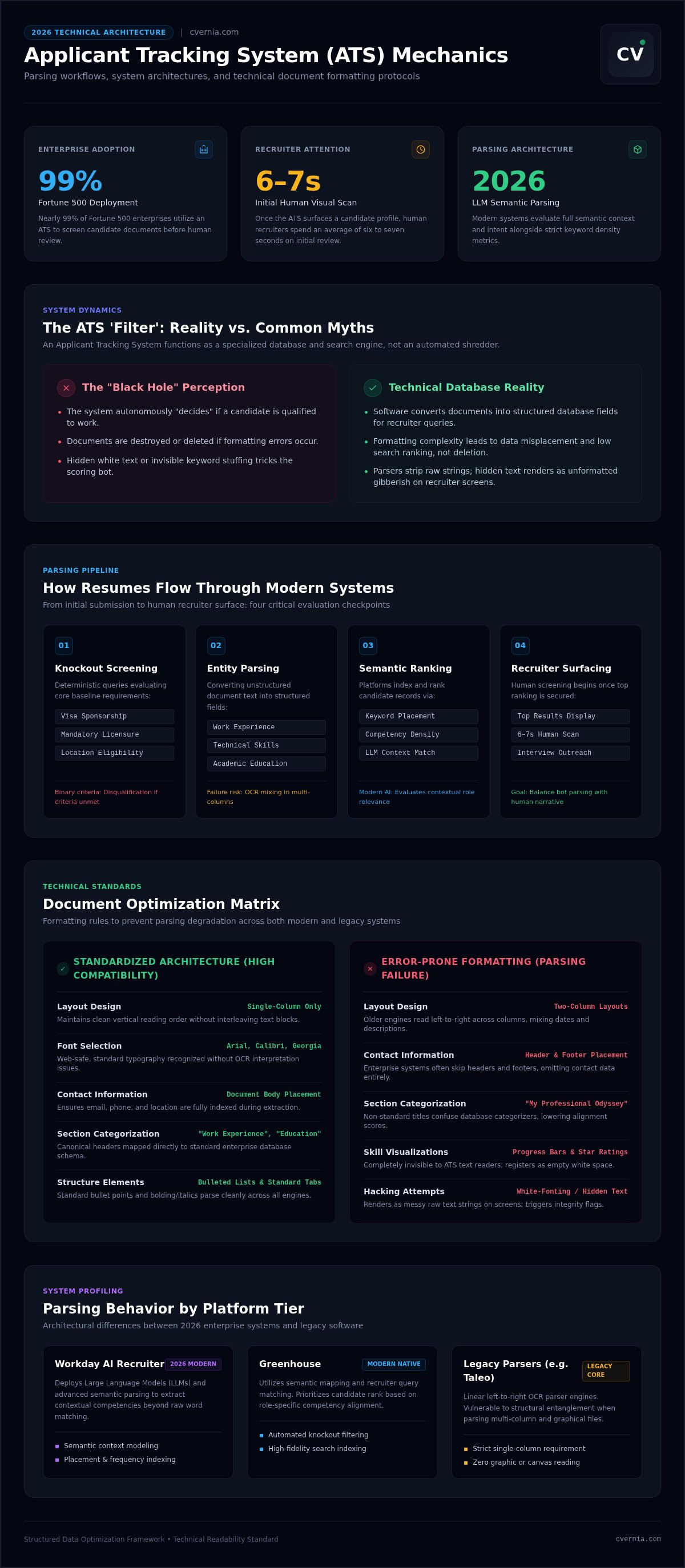
The term "filter" often suggests a machine that exists solely to delete your hard work. In reality, applicant tracking systems are sophisticated digital databases designed to help recruiters organize thousands of applications. Think of it as a specialized search engine for talent. When you apply for a role, the system doesn't "decide" if you're good enough. It simply scans your document to see where you fit within the company's hiring pipeline.
This scanning process is called parsing. The software attempts to convert your PDF or Word document into structured data fields like "Work Experience," "Skills," and "Education." If your formatting is too complex, the data ends up in the wrong place or becomes unreadable. This leads to a low ranking, not a deletion. Essentially, ATS compatibility is the degree to which a resume's data can be accurately extracted and categorized by these systems.
How Modern Systems Like Greenhouse and Workday Rank You
Modern platforms like Greenhouse and Workday AI Recruiter have evolved significantly by 2026. They now use Large Language Models (LLMs) and semantic parsing to understand the context of your experience rather than just looking for exact word matches. However, the most immediate "filter" is often a set of knockout questions. These are the deterministic queries about visa sponsorship, years of mandatory licensure, or location requirements that can trigger an automated rejection if you don't meet the baseline criteria.
Once you pass those initial questions, the system ranks you based on keyword frequency and placement. Recruiters use search queries to find candidates who match the job description. If you're wondering how to get my resume past the ats filter, the answer lies in appearing at the top of these search results. Higher rankings go to candidates whose profiles show high semantic alignment with the specific competencies the recruiter is hunting for.
Why 'Beating' the System is the Wrong Mindset
Many candidates waste time trying to "trick" the software with hidden text or white-fonting. Don't do this. Modern parsers extract raw text strings, which means hidden blocks often render as unformatted gibberish on the recruiter's screen, immediately flagging your application for lack of integrity. Your goal shouldn't be to defeat a bot; it should be to achieve perfect alignment. You want the system to categorize your skills so clearly that a recruiter can find you in seconds.
Remember that the software is only the first step. Once the system surfaces your profile, a human recruiter will spend roughly six to seven seconds on an initial visual scan. If your resume is a wall of repetitive keywords with no narrative flow, you'll lose the human's interest immediately. Balance technical optimization with professional storytelling. For a deeper dive into the mechanics, read our guide on How Applicant Tracking Systems Work: A 2026 Guide to CV Compatibility.
Formatting for Bot Readability: The Technical Essentials
Clean structure is the foundation of a successful application. When you're researching how to get my resume past the ats filter, start with your choice of font. Stick to web-safe, professional options like Arial, Calibri, or Georgia. These are easily recognized by Optical Character Recognition (OCR) software. Avoid the temptation of a two-column layout. While it looks modern to a human, many older parsers read across the page from left to right, mixing your job titles, dates, and descriptions into a tangled, unreadable mess.
Keep your contact information in the body of the document rather than the header. Many enterprise systems skip headers and footers entirely during the parsing phase, which could leave a recruiter with no way to reach you. Use clear, standard section titles. Label your history as "Work Experience" and your schooling as "Education." Creative headings like "My Professional Odyssey" confuse the software and lower your compatibility score. This technical alignment is a critical step in how to get my resume past the ats filter. For a deeper technical dive, MIT's guidelines for ATS-friendly formatting offer excellent insights into why simplicity wins.
The Graphics and Icons Warning
Visual flair often comes at a high technical cost. Progress bars for skills or star ratings are completely invisible to an ATS. The software sees a blank space where your expertise should be. Similarly, canvas-based graphics and text boxes frequently generated by graphic-heavy design editors continue to cause critical parsing errors. Use simple tabs or bulleted lists to organize your data instead. Bolding and italics are generally safe to use for emphasis, provided they don't obscure the underlying text string. If you're unsure about your layout, using a dedicated CV compatibility tool can help you spot these invisible errors before you hit submit.
File Types: PDF vs. .docx in 2026
In 2026, the choice between PDF and .docx depends on the age of the employer's system. Modern platforms like Greenhouse and Ashby handle text-based PDFs with high accuracy, preserving your visual design for the human recruiter. However, legacy systems like Taleo or older instances of Workday still struggle with PDF layers. If a job portal doesn't explicitly request a PDF, a .docx file remains the most reliable fail-safe for technical readability. To help you decide which format fits your target company, check out our ATS Resume Checker Guide 2026: Choosing the Right Tool to Beat the Bot.
Strategic Keyword Optimization: Speaking the Recruiter's Language
Once your formatting is technically sound, you must focus on the language that bridges the gap between your experience and the recruiter's search query. Understanding how to get my resume past the ats filter requires a shift from general descriptions to targeted alignment. Recruiters use the job description (JD) as a blueprint, searching the database for specific hard skills and qualifications. While soft skills like "collaboration" are valuable, modern systems prioritize measurable expertise such as "Python," "Salesforce," or "GAAP Accounting" during the initial ranking phase.
Pay close attention to the "Exact Match" rule. Even though 2026 AI systems are smarter, many recruiters still rely on specific Boolean strings. If a JD explicitly asks for "Project Management," using the phrase "Managing Projects" might result in a lower match score in older systems. Following best practices for integrating job description keywords naturally ensures you stay on the right side of the software while remaining appealing to the human reader. Most importantly, remember that truthful representation is non-negotiable; never invent experience or skills to match a keyword, as discrepancies will be caught during the interview or background check.
Analyzing the Job Description Like a Bot
Start by deconstructing the target JD to identify core competencies. Differentiate between "Required" qualifications, which act as knockout criteria, and "Preferred" skills that boost your ranking. Use a keyword extraction tool or simply scan the text for the most frequent nouns and verbs. Sometimes, your job title needs a "translation" to be searchable. If your previous company used a creative title like "Brand Evangelist," consider adding the industry-standard equivalent, such as "Marketing Manager," in parentheses to ensure the parser recognizes your seniority level.
Contextual Keywords: The 2026 Update
Modern AI-driven systems in 2026, including the latest versions of Greenhouse and Workday, now look for keywords within a specific work context. A simple "Skills Cloud" or list at the bottom of your resume is no longer sufficient. Instead, integrate your keywords into your bullet points using action-result phrasing. For example, instead of listing "SEO" as a standalone skill, write: "Increased organic traffic by 40% through targeted SEO optimization and keyword research." This demonstrates to the parser that you possess the skill and shows the human recruiter the impact of your work. This contextual relevance is the most effective way to solve the puzzle of how to get my resume past the ats filter while building immediate trust with hiring teams.
The 5-Step Workflow to Get Your Resume Past the Filter
Success in modern hiring requires a repeatable, data-driven process. When you're mastering how to get my resume past the ats filter, you need more than just a list of keywords; you need a system that ensures technical accuracy at every stage. Follow this five-step workflow to move from an invisible applicant to a top-tier candidate.
- Start with a clean, ATS-friendly base template. Use the single-column layout we discussed to prevent the "Double Column Trap" that ruins parsing.
- Deconstruct the target job description. Isolate the mandatory certifications and specific software proficiencies that act as knockout criteria.
- Tailor your professional summary and skills. Align your opening statement with the core mission of the role to trigger semantic matches.
- Run a compatibility check. Use a dedicated ATS resume scanner to identify any technical blind spots or missing keywords.
- Save and track this specific version. Document exactly which file you sent to which employer to maintain a consistent narrative during the interview.
Validation: Using a Resume Checker
An "ATS Score" is a numerical representation of how well your document matches the job description's data points. It isn't a grade on your career; it's a measure of alignment. High scores suggest the software has successfully extracted your core competencies. If your report shows "missing keywords," don't just dump them into a list. Integrate them into your work history to show context and impact. For a complete strategy on managing these versions at scale, see The Ultimate Job Search Management System Guide: Scaling Your Career in 2026.
The Final Human Polish
Technical readability gets you through the door, but human readability gets you the interview. Once the system ranks you, a recruiter will likely perform a 6-second visual scan. Make your most relevant keywords "pop" by using bolding for job titles and bullet points for achievements. Check for "ghosting" by ensuring your contact information is parsed correctly in the system's preview mode. If the bot can't find your phone number, the recruiter won't either. Analyze your CV compatibility now to ensure your contact details and skills are perfectly visible to both machines and humans.
Scaling Your Strategy with CVernia’s Application Management
Applying for one job is a project; applying for fifty is a full-time management task. While standard advice suggests keeping a manual spreadsheet, these static tools can't handle the dynamic requirements of modern recruitment. You need a centralized platform that does the technical heavy lifting for you. CVernia acts as your digital mentor, providing an organized dashboard where you can oversee every tailored version of your professional history. This level of organization is the final piece of the puzzle when learning how to get my resume past the ats filter at scale.
Version management is critical because modern ATS databases in 2026 retain every document you've ever submitted to a specific company. If your dates or titles conflict across different versions, a recruiter will see those discrepancies immediately. Our smart reapplication detection feature recognizes prior submissions to the same employer. It helps you maintain a consistent narrative while still optimizing for the specific job description at hand. This ensures that your drive for technical alignment never compromises your professional integrity or credibility.
From Application to Interview
Successful candidates use data to refine their approach. By tracking your compatibility scores across different industries, you can quickly identify which markets respond best to your unique skill set. If our ATS analysis identifies a consistent gap in your profile, you can turn to our Career Academy to find the learning resources needed to bridge it. Once you secure an interview, your preparation is already halfway done. You'll have immediate access to the specific resume version, cover letter, and job description that triggered the recruiter's interest, allowing you to speak with total confidence during the call.
Taking Control of Your Career Data
Stop digging through messy desktop folders or trying to remember which PDF you uploaded to which portal. A centralized Career Application Management Platform replaces chaos with clarity. You can store interview notes, manage attachments, and track the status of every submission in one secure location. This streamlined process gives you the peace of mind that your CV is technically readable and strategically aligned for every role you target. Move from uncertainty to readiness by using tools designed for the modern hiring landscape. Start your journey with CVernia and master the ATS today.
Master Your Professional Narrative for 2026
You've gained the technical blueprint to move your application from a hidden database entry to a recruiter's top choice. By treating the ATS as a partner in alignment rather than an obstacle to overcome, you've unlocked a more efficient path to your next role. Clean, single-column formatting and semantic keyword placement are your most powerful tools in this process. You now understand exactly how to get my resume past the ats filter by focusing on technical readability and contextual impact.
Centralizing your search with smart version management and truth-focused CV tailoring ensures your story remains consistent across every submission. Our centralized application tracking dashboard removes the stress of disorganized folders, letting you focus on the interview ahead. Optimize Your Resume with CVernia's ATS Checker to validate your alignment and gain a strategic advantage. Your expertise is too valuable to remain invisible. Step forward with confidence, knowing you're fully prepared for the modern hiring landscape.
Frequently Asked Questions
Can the ATS read my resume if it's in PDF format?
Modern systems like Greenhouse and Workday parse text-based PDFs with high accuracy in 2026. This format is excellent for preserving your visual design for human recruiters. However, you must avoid "image-only" PDFs created by scanners, as these appear as blank pages to the software. If you are applying to a company using older legacy systems like Taleo, a .docx file remains the safest choice for guaranteed technical readability.
What are 'knockout questions' and how do I pass them?
Knockout questions are deterministic screening queries about your eligibility, such as visa status, mandatory certifications, or location requirements. These act as the first hard filter in the application process. The only way to pass them is to meet the baseline criteria for the role. Always answer these questions truthfully; providing false information to bypass a filter will lead to an immediate rejection once the discrepancy is discovered during background checks.
Is it okay to use 'white fonting' to hide keywords in my resume?
You should never use white fonting or hidden text. Modern parsers extract raw UTF-8 text strings and strip away visual styling. This means your hidden keywords will render as unformatted gibberish on the recruiter's review screen, immediately flagging your application for a lack of integrity. Focus on integrating keywords naturally into your work history instead. Authentic alignment is always more effective than trying to trick the software with outdated hacks.
How many keywords should I include to pass the filter?
Focus on relevance rather than a specific number. Aim to include the 15 to 20 most critical hard skills and competencies found in the job description. Excessive keyword stuffing can actually lower your ranking in 2026 AI-driven systems that prioritize semantic context. Use action-result phrasing to show how you applied these skills. This approach ensures you satisfy the software's search requirements while providing a compelling narrative for the hiring manager.
Does the ATS check my social media profiles too?
Most standard systems do not automatically crawl your private social media, but many modern platforms like Ashby or Lever offer data enrichment features. These tools can pull public information from your LinkedIn profile to verify your professional history. It's vital to keep your LinkedIn data consistent with your resume. Discrepancies between your online presence and your application can raise red flags for recruiters during the manual review stage of the hiring process.
What happens to my resume after it passes the ATS filter?
Once your document passes the initial technical check, it is surfaced to a human recruiter. They typically spend roughly six to seven seconds on a visual scan to decide if you move to the next round. This is why learning how to get my resume past the ats filter is only the first half of a successful strategy. Your document must be just as readable and persuasive for a person as it is for the software.
Should I use a different resume for every job application?
Tailoring your resume for every application is essential for achieving a high compatibility score. You don't need to rewrite your entire history, but you should adjust your professional summary and key skills to mirror the specific language used in the job description. Using a centralized platform like CVernia allows you to manage these different versions efficiently. This prevents you from submitting contradictory information to the same employer's database over multiple application attempts.
Can I use a resume builder and still be ATS-friendly?
You can use a resume builder as long as it produces clean, text-based code rather than canvas-based graphics. Many design-heavy builders create files that look great but are unreadable to enterprise parsers. CVernia’s tools are specifically designed to maintain high technical compatibility while providing a professional look. Our platform ensures your data is structured correctly, giving you the confidence that your application will be accurately categorized by any modern recruitment system.


