

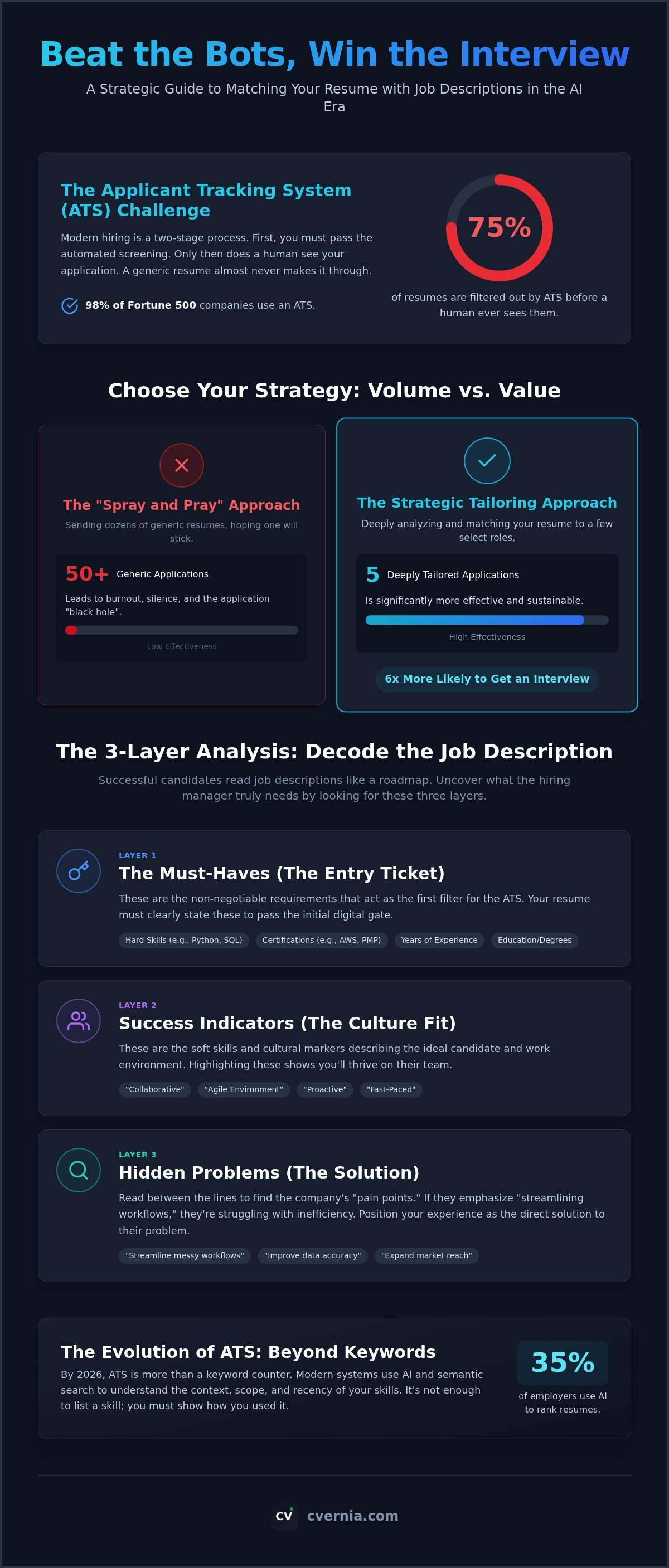
98% of Fortune 500 companies now use an Applicant Tracking System (ATS) to screen candidates, yet 70% to 80% of resumes are filtered out before a human ever sees them. It's a frustrating reality for many professionals. You spend hours meticulously matching resume to job description requirements, only to receive an automated rejection minutes after hitting submit. It's natural to feel like you're shouting into a void or that you need to "game the system" to stand a chance.
We understand that your career is more than just a list of keywords. You shouldn't have to choose between being honest and being seen. This guide will teach you how to translate your real-world achievements into the digital language recruiters prioritize. You'll learn to win more interviews while maintaining your professional integrity. We'll also explore how to streamline your workflow so you can manage multiple application versions without losing your mind. By the end, you'll have a strategy that satisfies both the robots and the humans behind the screen.
Key Takeaways
- Adapt to the 2026 hiring landscape by moving beyond simple keyword counting toward a sophisticated semantic search strategy.
- Utilize a three-layer analysis framework to decode job descriptions and pinpoint the exact "must-have" requirements hiring managers need.
- Streamline your application process by matching resume to job description details using a master resume approach that highlights your specific relevance.
- Maintain your professional integrity by learning the critical difference between translating your experience and fabricating skills.
- Organize your career journey with centralized version management tools that eliminate the chaos of tracking multiple tailored applications.
Why Matching Your Resume to the Job Description is Non-Negotiable
Resume matching is the strategic process of aligning your professional history with the specific requirements of a job posting. In the current hiring market, a generic document is essentially invisible. If you aren't matching resume to job description details, you are likely part of the 70% to 80% of applicants who get filtered out before a human even glances at their file. This isn't about "gaming" a system; it's about ensuring your value is actually legible to the people who want to hire you.
Think of your application as facing a "Double Gate." The first gate is an Applicant Tracking System (ATS), an automated gatekeeper designed to manage high volumes of candidates. The second gate is the human recruiter. To win, you must satisfy the robot's need for data and the human's need for a compelling story. If you fail the first gate, the human never knows you exist. If you pass the robot but fail to persuade the human, the effort is wasted.
The Evolution of the ATS in 2026
By 2026, simple keyword counting is a relic of the past. Modern systems now use semantic search and AI reasoning to evaluate the "scope" and "recency" of your skills. They don't just look for the word "management"; they analyze the surrounding text to see if you led a team of five or a department of fifty. Understanding how applicant tracking systems work is the first step in creating a resume that speaks this new digital language. Since 35% of employers now use AI to rank resumes, your content must show contextual relevance. This means your skills should be presented as direct solutions to the specific problems outlined in the job description.
The Cost of the "Spray and Pray" Approach
Many job seekers fall into the "spray and pray" trap, sending dozens of generic resumes every week. This approach often leads to the "black hole" effect, where you receive nothing but silence or instant rejections. The psychological toll is heavy. It creates a cycle of burnout and a sense of defeat. Research indicates that submitting five deeply tailored applications is significantly more effective than blasting out 50 generic ones. In fact, tailoring makes you six times more likely to get an interview. While you optimize for these digital systems, remember that truthful representation is your most valuable asset. We focus on highlighting your genuine strengths without ever resorting to fabrication. This ensures that when you do reach that human recruiter, you can back up every claim with absolute confidence.
The 3-Layer Analysis: Decoding the Job Description
To master the art of matching resume to job description requirements, you must learn to see a job posting through the eyes of a hiring manager. Most applicants skim for salary and location. Successful candidates perform a deep dive. This 3-layer analysis helps you uncover the roadmap hidden within the text, ensuring your application speaks directly to the company's current needs.
Layer 1: The Must-Haves. These are the non-negotiables. They include hard skills, specific certifications, and minimum years of experience. Think of these as the entry price for the role. If the job description lists "AWS Certification" or "5 years of Project Management," the system will prioritize these markers. You need to present these clearly and truthfully to pass the initial digital gate.
Layer 2: The Success Indicators. This layer covers soft skills and cultural markers. Words like "collaborative," "agile," or "proactive" aren't just fluff. They describe the environment where you'll be working. By identifying these, you can choose which of your past achievements best demonstrate your ability to thrive in their specific culture.
Layer 3: The Hidden Problems. This is the most strategic layer. Read between the lines to find the "pain points." If a posting emphasizes "streamlining messy workflows," the company is likely struggling with inefficiency. Positioning yourself as a problem solver who has tackled that exact challenge makes you an irresistible candidate. It transforms your resume from a list of duties into a targeted solution.
Identifying Primary and Secondary Keywords
Start by identifying the high-frequency terms. These are your primary keywords. They serve as the main filters for the hiring system. Focus on the top five skills mentioned in the first few paragraphs. These are the priority. Secondary keywords are differentiator skills; they might appear once or twice but add depth to your profile. Using a CV compatibility and ATS analysis tool can help you visualize these keyword densities so you don't miss a critical requirement.
Understanding Context and Hierarchy
The order of requirements in a job description is rarely random. The first three bullets in the "Responsibilities" section usually represent the bulk of the daily work. You should mirror this hierarchy in your own document. Align your strongest impact statements with these top-tier goals. Don't forget to match the tone of the posting. If the language is formal and corporate, keep your summary professional. If it's punchy and innovative, let that energy reflect in your writing. This alignment builds an immediate sense of familiarity with the recruiter.
Step-by-Step: How to Match Your Resume Effectively
Creating a tailored application shouldn't feel like reinventing the wheel. Start by building a "Master Resume." This is a comprehensive, multi-page document containing every role, project, and skill you've ever acquired. When you begin matching resume to job description details, you simply select the most relevant pieces from this master file and paste them into a fresh version. This keeps your workflow efficient and ensures you never forget a key achievement.
Titles matter for digital parsing. If your previous company used unconventional titles like "Happiness Hero," a recruiter or an ATS might not understand your level of authority. It's acceptable to adapt your title to a standard industry equivalent for clarity. For example, "Happiness Hero (Customer Success Lead)" ensures both the bot and the human recognize your expertise. This isn't about deception; it's about translating your experience into the standard vocabulary of your industry.
The Professional Summary Makeover
Your summary is the first thing a human reads. It must be a punchy, three-sentence hook. The first sentence should state your current role and years of experience. The second sentence should directly address the job description's primary requirement. The third sentence provides a high-level achievement using the Problem-Action-Result (PAR) method. This structure ensures your document meets ats compliant resume standards while immediately signaling your value to a hiring manager.
Skill Section Optimization
Organize your skills into three distinct categories: Technical, Tools, and Transferable. This helps the ATS categorize your profile correctly. Technical skills are your core competencies, like financial modeling or software development. Tools are the specific platforms you use, such as SAP or Greenhouse. Transferable skills include leadership or cross-functional communication. This modular approach makes it easy to swap skills in and out based on the specific job posting.
Avoid the "Match Rate" trap. While you want a high compatibility score, aiming for a 100% keyword match can look suspicious to recruiters. It often signals that a candidate is simply trying to game the system rather than presenting a truthful career history. Aim for a match score between 75% and 85%. If you have a skill mentioned in the JD that you haven't used in your current role, include it if you can truthfully defend it. This approach keeps your application honest and effective, positioning you as a high-quality candidate rather than a keyword-stuffed bot.
Truthful Tailoring: Aligning Skills Without Compromise
Many candidates feel pressured to "game the system" by exaggerating their experience. You might see advice on forums suggesting you should do whatever it takes to get past the bot. We disagree. At CVernia, we believe truthful representation is the only sustainable path to a long term career. If you get an interview for a role you can't actually perform, you're simply wasting your time and the recruiter's. Trust is the foundation of every professional relationship; it starts with the very first digital scan of your document.
There is a vital distinction between translation and fabrication. Fabrication is claiming a certification you don't have. Translation is the process of matching resume to job description requirements by using the employer's specific vocabulary to describe your real achievements. You aren't changing what you did; you're changing how you describe it so the hiring software understands your value. Skill translation is a professional necessity that ensures your actual capabilities are recognizable to hiring software, not an ethical compromise.
Avoid "black hat" tactics like keyword stuffing or using white text to hide keywords in your margins. Modern systems are sophisticated. As of 2026, 19% of hiring managers use AI specifically to screen out applications before a human review. These tools easily detect hidden text and formatting tricks. If you're caught trying to trick the system, you'll likely be permanently banned from the company's candidate pool. It's much safer to focus on high quality, visible content that demonstrates genuine alignment.
The Ethics of Resume Optimization
Your goal isn't just to get an interview; it's to get the right job. When you focus on honest tailoring, you build immediate credibility. If you find a genuine gap in your experience while matching resume to job description details, don't ignore it. Use our Career Academy & Learning Resources to identify the certifications or skills you need to bridge that gap for real. This proactive approach turns a potential rejection into a roadmap for your professional growth.
Leveraging Transferable Skills
You can often bridge experience gaps by identifying "Skill Equivalence." For example, if a job description asks for "Account Management" but your background is in "Customer Success," you likely have the required skills. Both roles focus on relationship building, retention, and problem solving. The key is to provide evidence. Don't just list the skill; show it. Use a bullet point to describe a specific time you managed a client relationship to achieve a measurable result. This "Show, Don't Just Tell" rule proves your competence without needing to invent a new job title. To see how your current skills stack up against a specific role, use our CV compatibility and ATS analysis tool for an instant, honest assessment.
Scaling Your Success: Version Management and Tracking
Many job seekers find themselves staring at a desktop cluttered with dozens of PDF versions, each named something like "Resume_Final_v2_Marketing_Google.pdf." This manual approach is a recipe for disaster. When you're consistently matching resume to job description details for multiple roles, it's easy to lose track of which specific achievements you highlighted for which company. If a recruiter calls you unexpectedly, you need to know exactly what version of your professional story they are holding. Manual tracking fails because it can't keep up with the speed of a modern career transition.
Transform this chaos into a streamlined workflow by using a job search management system. This isn't just about storage; it's about strategic organization. Our platform includes Smart Reapplication Detection, which helps you identify when a previous tailored version is a high match for a new role or when you need to start fresh. This ensures you aren't wasting time duplicating effort while maintaining a high level of precision across all applications.
Version Control for the Modern Job Seeker
Adopt a clear naming convention that includes the company name and the date of submission. This simple habit prevents the "wrong file" error that can end an application instantly. Storing your interview notes and specific job descriptions alongside the tailored resume version ensures you have a complete context for every opportunity. CVernia’s dashboard centralizes this entire process, allowing you to see your entire application history at a glance. It acts as your trusted companion, keeping you organized so you can focus on your performance rather than your file folders.
Preparing for the Human Interview
The work you did matching resume to job description requirements is your best preparation for the interview itself. Before the call, review the specific "Impact Statements" you included in that version. These are the exact points the recruiter wants to discuss. Ensure your LinkedIn profile supports these claims without being an exact clone; it should provide a broader view of your professional brand. Once your resume is perfectly aligned, the next logical step is to create a tailored cover letter that expands on these themes. Connecting your tailored documents to a job interview tracker allows you to walk into every conversation with absolute confidence, knowing your digital presence and your verbal story are in perfect harmony.
Take Control of Your Career Journey
The hiring landscape of 2026 requires more than just a generic list of skills. It demands a strategic translation of your experience that satisfies both advanced AI filters and discerning human recruiters. By mastering the 3-layer analysis and prioritizing truthful alignment, you transform your application from a static document into a dynamic solution for a hiring manager's problems. Remember that matching resume to job description details isn't a one-time chore; it's a scalable workflow that grows with your career.
Stop struggling with the black hole of automated rejections. You deserve a partner that handles the technical heavy lifting while you focus on the roles that truly matter. Our platform provides the ATS-ready analysis and Smart Version Management you need to stay organized and effective. We stand by our Truthful Tailoring Guarantee, ensuring your professional brand remains authentic and powerful.
Start Matching Your Resumes with CVernia Today
Your next big opportunity is waiting. With the right tools and a clear strategy, you're no longer just another applicant. You're the candidate they've been looking for.
Frequently Asked Questions
Is it better to match keywords exactly or use synonyms?
Use exact keywords where possible, but modern 2026 systems understand synonyms through semantic search. Prioritize the specific terminology used in the job description to ensure maximum compatibility with the initial filters. If the JD says Customer Relationship Management, you should use that full phrase. Using exact terminology ensures you meet the primary filter requirements while providing essential context for human readers who scan for those specific terms.
How much of my resume should I change for every job application?
Aim to tailor approximately 20% to 30% of your resume for each application. Focus your efforts on the Professional Summary, the Skills section, and the first few bullet points of your most recent role. This targeted approach is more efficient than a total rewrite. It allows you to maintain a core Master Resume while ensuring the most visible parts of your document align with the hiring manager's top priorities.
Can an ATS tell if I am using AI to match my resume?
Yes, modern systems can often detect AI-generated content through pattern recognition and linguistic analysis. In 2026, 80% of hiring managers report they can spot a resume written entirely by AI. Since 35% of employers use AI to rank applications, you should use technology as a tool for matching resume to job description details, not a replacement for your voice. Review every automated suggestion to ensure it reflects your unique professional identity.
What is a "good" ATS compatibility score?
A score between 75% and 85% is typically considered the sweet spot for most mid-to-senior level roles in 2026. Scoring 100% can actually trigger red flags for keyword stuffing or system manipulation. Focus on hitting the high-priority must-have skills identified in your analysis. This range demonstrates strong alignment with the role's requirements while maintaining the natural, human-centric flow that recruiters look for during the manual review.
Should I change my job titles to match the job description?
You should only adapt your job title if your current one is non-standard or confusing, and you must always keep it truthful. If your official title is Digital Alchemist but you perform the duties of a Senior Data Analyst, you can list it as Digital Alchemist (Senior Data Analyst). This provides the necessary clarity for the ATS to categorize your seniority correctly without misrepresenting your actual employment record at your previous company.
How do I match my resume if I am making a career change?
Focus on transferable skills and Skill Equivalence rather than direct industry experience if you are changing fields. Identify the core competencies required in the new role and find where you have demonstrated those same abilities in your previous career. For example, a teacher transitioning to corporate training should emphasize Curriculum Development. Use your summary to bridge the gap, explaining how your past successes solve the specific problems mentioned in the posting.
Does the formatting of my resume affect how well it matches the JD?
Yes, complex formatting can prevent the ATS from correctly reading and matching your content. Stick to a clean, single-column layout and avoid using tables, text boxes, or images within your file. As of 2026, standard .docx files have a lower failure rate than PDFs in many systems. Simple formatting ensures that every keyword you've included while matching resume to job description requirements is actually parsed and counted toward your score.
What happens if I apply to the same company with two different resume versions?
Most modern systems will flag duplicate applications and show both versions to the recruiter. This can be beneficial if the roles are distinct, but it can look inconsistent if the versions contradict each other. Use a centralized platform to manage your versions. This helps you ensure that while each document is tailored, your core facts and qualifications remain consistent across all submissions to the same employer.


