
Did you know that 80% of hiring managers admit to ghosting candidates at some point? It's a staggering reality in the 2026 job market, where the average posting attracts over 200 applications. You've likely felt that familiar sting of silence after submitting a CV you're proud of. It's frustrating to feel ignored, yet the fear of sounding pushy often keeps you from reaching out. You want to stay on their radar without appearing desperate.
This guide teaches you exactly how to follow up on a job application with professional precision. We'll move past the anxiety of the unknown by giving you a clear, data-backed strategy. You'll learn how to transform your outreach from a simple reminder into a strategic value-add that recruiters actually respect. We'll cover the ideal 2026 timeline for contact, provide templates designed to get replies, and introduce a system to keep your high-volume search organized. It's time to stop guessing and start managing your career journey with confidence. By using an application tracking dashboard and following a proven rhythm, you'll ensure no opportunity slips through the cracks.
Key Takeaways
- Redefine your follow-up as a strategic value-reaffirmation rather than a simple status check to establish professional authority.
- Adopt the 5-day rule to ensure your outreach aligns with the standard 2026 recruiter review cycle.
- Master how to follow up on a job application by prioritizing professional email channels and personalized LinkedIn connections.
- Centralize your search data with an Application Tracking Dashboard to manage high-volume outreach without losing track of key contacts.
- Utilize Smart Reapplication Detection to determine when to pivot your strategy for a specific company or role.
The Follow-Up Framework: Why Professional Persistence Wins
Understanding how to follow up on a job application begins with shifting your mindset. Many job seekers view this step as a nuisance or a sign of desperation. You might worry that an extra email will annoy a busy recruiter. In reality, professional persistence is a powerful indicator of high motivation and cultural alignment. Recruiters are looking for candidates who are genuinely invested in the role, not just those who are casting a wide net. Instead of viewing your outreach as a "status check," treat it as a value-reaffirmation. You're not just asking if they received your resume; you're reminding them why your specific skills solve their current problems.
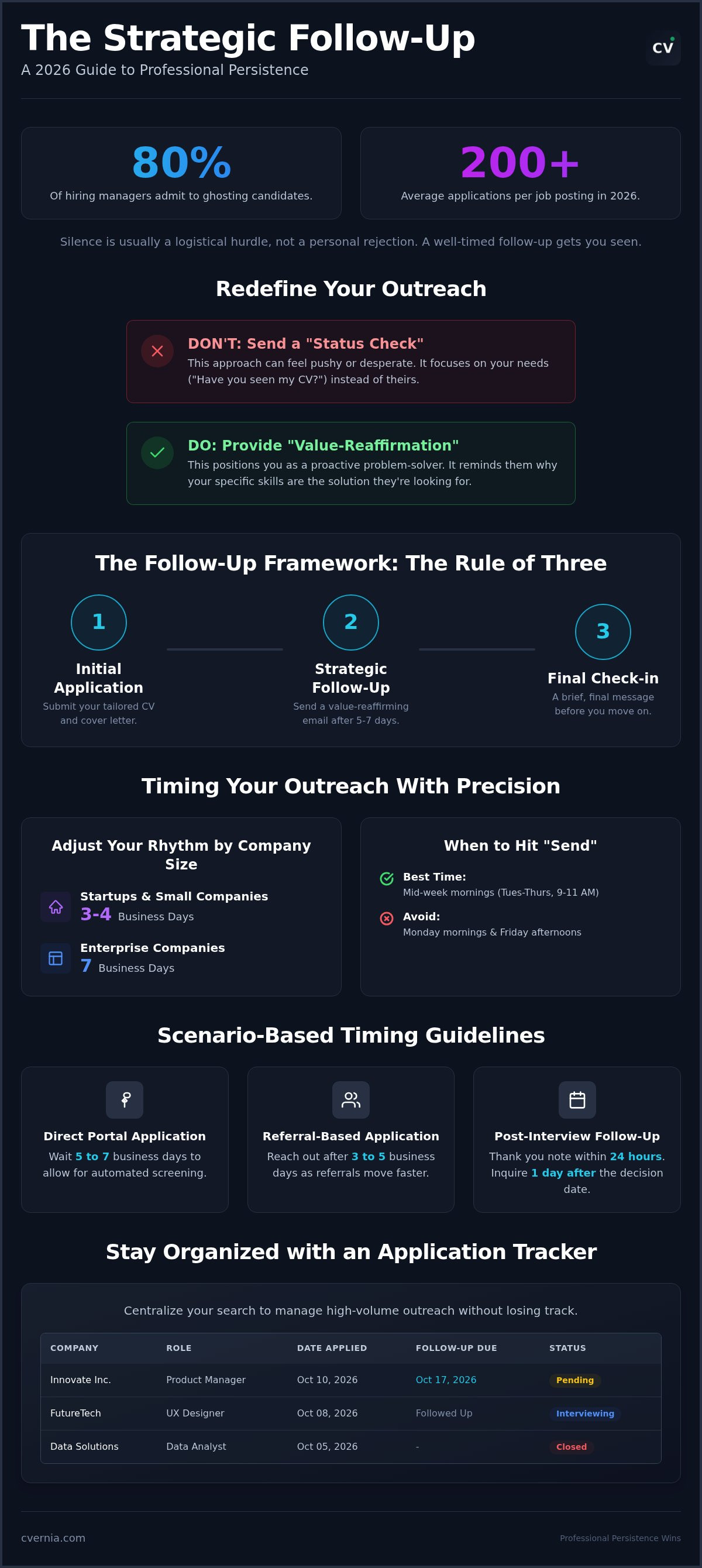
Adopt the "Rule of Three" to maintain professional boundaries while maximizing visibility. This framework consists of your initial application, one strategic follow-up, and a final check-in before moving on. While much focus is placed on the job interview process itself, the preceding follow-up phase is often where candidates lose momentum. The professional follow-up is a strategic touchpoint within the modern 2026 recruitment cycle that bridges the gap between digital submission and human connection.
The Psychology of the Hiring Manager
Hiring managers aren't ignoring you because they've rejected you. They're often simply buried under a mountain of data. It's helpful to understand how applicant tracking systems work to see why your profile might be temporarily stalled. These systems categorize hundreds of applicants, and a well-timed follow-up can pull your name from the digital pile into a human's direct view. Silence is usually a logistical hurdle. It's rarely a personal commentary on your qualifications.
Setting Realistic Expectations for 2026
The 2026 hiring landscape moves fast, yet the median time to your first interview remains around 29 days. With the average job posting receiving over 200 applications, you must be patient but proactive. Mastering how to follow up on a job application requires balancing this patience with a systematic approach. If you haven't heard back within 5 to 7 business days, it's time to act. Use your ATS compatibility score as a confidence booster. If you know your CV is technically aligned with the role, your follow-up carries more weight. Recognizing "dead lead" signals, such as a posting being removed without any contact after three weeks, allows you to pivot your energy toward more promising opportunities without looking back.
Timing Your Outreach: When to Send Your First Follow-Up
Timing isn't just about patience. It's about precision. Sending an email too early makes you look anxious; waiting too long makes you look disinterested. Adopt the 5-day rule as your baseline for initial applications. This window allows the hiring team to process the first wave of candidates while keeping your name fresh in their minds. When you demonstrate professional persistence, you show that you're serious about the role without being overbearing.
Company size dictates your rhythm. Startups often have smaller HR teams and might move with lightning speed or complete chaos. You can usually reach out after 3 or 4 business days there. Enterprise companies, however, have rigid layers of approval. Give them the full 7 business days before checking in. Avoid hitting "send" on Monday mornings or Friday afternoons. Your message will either get buried in the weekend backlog or ignored as people head for the exit. Aim for mid-week mornings to ensure your email sits at the top of a fresh inbox.
Scenario-Based Timing Guidelines
Mastering how to follow up on a job application requires adjusting your approach based on how you applied. Use these benchmarks to stay on track:
- Direct portal applications: Wait 5 to 7 business days to account for high-volume automated screening.
- Referral-based applications: Reach out after 3 to 5 business days, as internal recommendations often move through the system faster.
- Post-interview status: Send a thank you note within 24 hours. If they provided a decision date, wait exactly one business day after that date passes before inquiring about the status.
Using Interview Notes to Perfect Your Timing
Listen for specific clues during your initial screening calls. If a recruiter mentions they are "interviewing through the end of the week," mark that date. Use a job interview tracker to set automated reminders based on these verbal timelines. This prevents you from guessing when to reach out and ensures you respect their internal process. If you have a high ATS compatibility score, mention that you're checking in to see if any further documentation is needed to support your application. Avoid "over-following" by limiting yourself to two follow-up messages. If silence persists after the second attempt, it is best to pivot your energy toward new opportunities. You can manage these timelines effortlessly with a centralized dashboard that tracks every interaction for you.
Choosing Your Channel: Email vs. LinkedIn vs. Phone
Selecting the right channel is just as vital as the message itself. While social media and instant messaging have changed how we communicate, the professional inbox remains the primary decision-making hub for recruiters. Email is asynchronous, searchable, and respects the boundaries of a busy hiring team. When you're deciding how to follow up on a job application, prioritize email for your first move. It provides a formal record of your interest and allows the recipient to respond when their schedule permits.
LinkedIn serves as a powerful secondary layer. It's best used to build a social connection rather than to demand an immediate status update. If you haven't heard back via email after your initial follow-up, moving to LinkedIn can help you stay on their radar. However, calling a recruiter is often viewed as a "relic" of the past. In 2026, a surprise phone call can feel intrusive. Reserve the phone for high-stakes roles where you've already established a direct rapport with the hiring manager. Mastering the art of Following Up With Grace And Panache means knowing which door to knock on and when to simply leave a professional note.
The Perfect Follow-Up Email Structure
Your email needs to be concise and high-value. Start with a clear subject line like "Follow-up: [Job Title] Application - [Your Name]" to ensure it doesn't get lost. Skip the generic "just checking in" and include a value-add paragraph. Mention a recent company win or a relevant industry news piece that aligns with the role. This shows you're engaged with their brand, not just your own search. End with a simple call to action. Ask a direct question that's easy to answer, such as "Are you still accepting applications for this role?" or "Is there any additional documentation I can provide?"
LinkedIn Outreach for 2026
LinkedIn etiquette requires a softer touch. If you decide to send a connection request, keep your note under 200 characters. Focus on why you want to connect with them specifically, rather than just asking about your application status. Use the platform to verify if the role is still active by checking the "Recently Posted" sections or seeing if the hiring manager has shared any updates. Identifying the right person is key. If the recruiter is silent, a polite note to a potential peer in the department can sometimes provide "insider" clarity on the hiring timeline. This multi-channel approach ensures you're visible without being perceived as a stalker. Learning how to follow up on a job application across different platforms requires balance, but it's the best way to ensure your profile isn't buried in a single crowded inbox.
How to Organize Job Applications for Strategic Follow-Ups
Manual tracking is a recipe for missed opportunities. As your application volume increases, a basic spreadsheet quickly becomes a graveyard of outdated information. You cannot effectively manage how to follow up on a job application if you're hunting through sent folders to remember which version of your CV a recruiter received. Centralizing your data is the only way to maintain a strategic advantage. You need a single source of truth that tracks the company name, the specific role, the date you applied, and the contact person.
Setting "Outreach Alarms" is the secret to professional persistence. These reminders ensure you never miss a follow-up window, allowing you to hit that 5 to 7 day gold standard mentioned earlier. Without a system, you're just guessing. With one, you're executing a plan. Version control is equally critical. If you've tailored your documentation for a specific role, you must know exactly what the hiring manager is looking at before you send that follow-up note. It's about preparedness and precision.
Beyond the Spreadsheet: The Modern Dashboard
Static spreadsheets are a 2010 solution to a 2026 problem. They don't link to your templates or store your interview notes effectively. Transitioning to a job search management system allows you to scale your search without losing the personal touch. You can link your follow-up templates directly to each application entry, making outreach a 30-second task instead of a 10-minute chore. Keeping your attachments and interview notes in one searchable location ensures you're always prepared for a surprise call or a scheduled screening.
A Step-by-Step Organization Workflow
Efficiency comes from a repeatable process. This workflow simplifies how to follow up on a job application by removing the guesswork from your daily routine. Follow these steps to stay ahead:
- Step 1: Log every application immediately upon submission to prevent data gaps.
- Step 2: Note the specific Hiring Manager's name to personalize your future outreach.
- Step 3: Set a 7-day calendar reminder for your first value-add follow-up message.
- Step 4: Archive the entry only after a definitive "No" or 30 days of total silence.
You can start organizing your job search today with our centralized dashboard and take the stress out of tracking your progress.
Mastering the Long Game with CVernia’s Smart Tracking
Executing a high-volume search requires more than just a calendar. You need a centralized hub that understands the nuances of modern recruitment. CVernia’s Application Tracking Dashboard automates your follow-up reminders, ensuring you hit every strategic window without second-guessing your progress. By integrating your stored interview notes and career academy resources, you can personalize every outreach attempt with ease. This level of preparation positions you as the organized, ready-to-work candidate that recruiters prioritize in a competitive market. It shows you aren't just looking for any job; you're looking for the right fit.
One of the most complex hurdles is managing multiple interactions with the same firm over several months. Our Smart Reapplication Detection allows you to see exactly when it’s time to try a different approach. If you’ve applied to three roles at one company, you shouldn't send identical follow-up notes. This feature helps you identify when your strategy needs to shift from a value-reaffirmation to a broader networking conversation. It’s about mastering how to follow up on a job application over the long term, ensuring you remain a fresh prospect rather than a repetitive one.
Leveraging Version Management
Sending the same generic follow-up twice is a critical error. It signals a lack of attention to detail that can undermine even the best credentials. CVernia allows you to track exactly which tailored CV was sent to which company. This ensures your follow-up aligns perfectly with the specific claims and skills you highlighted in your initial submission. You can manage multiple active follow-up threads simultaneously while maintaining the precision of a one-on-one interaction. When you know exactly what you promised in your cover letter, your follow-up becomes a natural extension of that conversation.
Closing the Loop: From Follow-Up to Offer
Not every follow-up leads to an immediate interview, but every professional interaction builds your reputation. If you receive a "not right now" response, use it as a bridge to a future opportunity. Your final check-in should be a polite closing of the loop that leaves the door open. Use a template that expresses gratitude and asks to stay in touch for future openings. This turns a potential dead end into a long-term lead in your tracking system. You'll be surprised how many offers come from candidates who stayed professional during a previous rejection.
A strong 2026 final check-in looks like this: "Hi [Name], thank you for the update. While I’m disappointed this role isn’t a match at this time, I’d love to stay connected for future opportunities that align with my background in [Skill]. I'll keep an eye on your careers page. Best, [Your Name]."
Ready to take control of your outreach? Organize your job search today with CVernia’s Application Tracking Dashboard.
Take Control of Your Career Momentum
Mastering how to follow up on a job application is more than just a task; it's a strategic advantage that demonstrates your professional authority. By shifting your mindset from "checking in" to "reaffirming value," you establish yourself as a candidate who is both proactive and respectful of the hiring process. Remember to respect the 5-day rule and choose your communication channels with precision. Consistency and organization are the keys to surviving a high-volume search without burning out. You don't have to navigate this journey alone.
Equip yourself with tools designed for the modern landscape. Our Centralized Application Tracking Dashboard and Smart Reapplication Detection ensure you never lose track of a lead or repeat a stale message. With ATS-optimized CV Analysis, you can reach out with the confidence that your documentation is perfectly aligned with the role. Stop guessing your next move and start managing your search like a pro. Start tracking and organizing your applications with CVernia today. Your next great opportunity is waiting for that perfect final touch. You've done the hard work; now it's time to close the loop with confidence.
Frequently Asked Questions
How long should I wait to follow up after a job application?
Wait five to seven business days before reaching out to the hiring team. This timeframe gives recruiters enough space to review initial submissions while keeping your profile fresh in their minds. If you're applying to a smaller startup, you might reach out after four days. For large enterprise companies, wait the full business week. Use this time to prepare your value-add talking points instead of just checking the status.
Is it annoying to follow up on a job application?
No, a polite and well-timed follow-up is rarely annoying and often signals high motivation. Recruiters deal with hundreds of applicants and sometimes miss top-tier talent in the shuffle. Your outreach serves as a professional nudge that brings your CV to the top of the pile. As long as you respect the five-day window and keep your message concise, you're demonstrating the persistence and interest that hiring managers value.
What should I say in a follow-up email if I haven’t heard back?
Focus on providing value rather than just asking for an update. Mention a recent company achievement or an industry trend that relates to the role you're seeking. Keep the email under 100 words and include a clear subject line with the job title and your name. Ask a simple question about the hiring timeline to make it easy for the recruiter to reply without feeling unnecessary pressure.
Should I follow up on LinkedIn or via email?
Email should always be your primary channel because it's the professional standard for recruitment records. It's searchable and less intrusive than social media platforms. Use LinkedIn only as a secondary option if you haven't received a response after two email attempts. When using LinkedIn, send a short connection request that focuses on building a professional relationship rather than demanding an immediate status update on your current application.
How many times should I follow up before giving up?
Follow the "Rule of Three" framework for your outreach. This includes your initial application, one strategic follow-up after a week, and a final check-in ten days later. If you still hear nothing after three attempts, it's best to pivot your energy toward other opportunities. Persistence is a virtue, but over-following can damage your reputation. Learning how to follow up on a job application requires knowing when to move on.
What if I find a typo in my application after I already followed up?
Don't panic or send a separate correction email immediately. If the typo is minor, like a misplaced comma, you should ignore it. However, if it's a major error in your contact information or a key skill, mention it briefly in your next scheduled follow-up. You can attach a corrected version of your CV and frame it as an updated profile that includes your most recent professional accomplishments.
Can I follow up if the job posting has already been removed?
Yes, you should still follow up if you've already submitted your application. Postings are often removed once a company has a sufficient candidate pool, but the internal hiring process is still ongoing. Reaching out shows you're still interested even after the public window has closed. It's a great way to differentiate yourself from candidates who assume the role is filled and stop their outreach efforts prematurely.
How do I find the hiring manager’s email address for a follow-up?
Start by checking the original job description or the company's "About Us" page for clues. If the name isn't listed, use LinkedIn to identify the department head or the internal recruiter. Tools like company directories or professional networking sites can help you deduce the firm's standard email format. Mastering how to follow up on a job application often requires this extra bit of digital detective work to find the right contact.


