
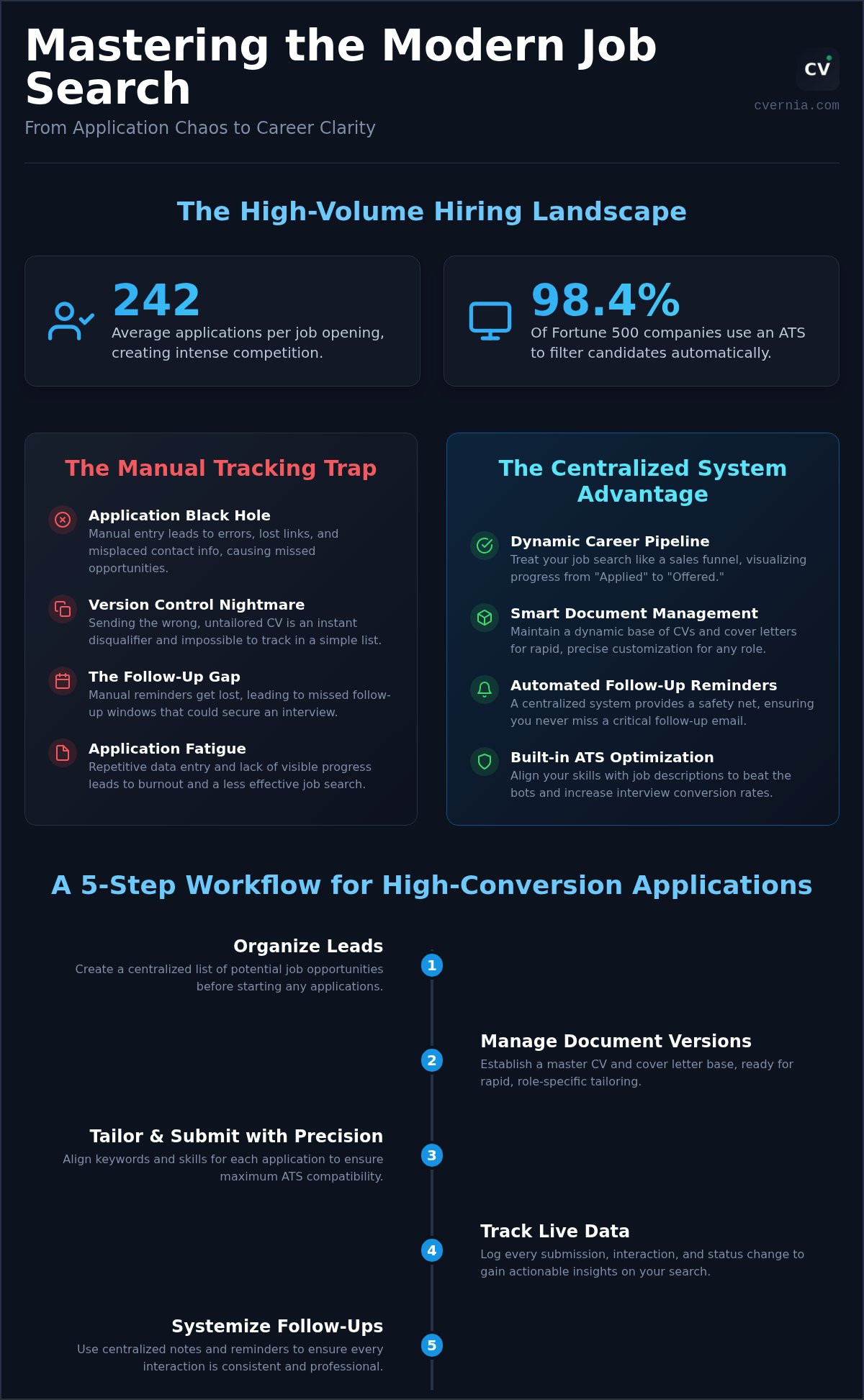
Did you know that the average job opening in 2026 attracts 242 applications, and a staggering 98.4% of Fortune 500 companies use an Applicant Tracking System (ATS) to filter them? It's no wonder you feel overwhelmed by the sheer volume of data entry and the pressure to tailor every single document. You've likely felt the sting of losing track of which CV version went where or realized too late that you missed a crucial follow-up. Finding the best way to manage multiple job applications is no longer a luxury; it's a necessity for survival in this competitive market.
Transform your chaotic search into a high-conversion machine by adopting a centralized tracking strategy. You deserve a system that works as hard as you do, providing clarity where there was once confusion. This article teaches you how to move beyond messy spreadsheets and embrace a sophisticated dashboard approach. Explore smart version management, ATS optimization techniques, and the modern tools that ensure you're always prepared for the next interview call. Take control of your professional journey and reduce your application fatigue today.
Key Takeaways
- Replace time-consuming spreadsheets with a centralized system to avoid the application black hole and prevent missed follow-up windows.
- Implement a five-step workflow that organizes your leads and document versions before you submit a single application.
- Discover the best way to manage multiple job applications by aligning your CV tailoring with live tracking data to boost interview conversion rates.
- Master ATS compatibility by maintaining a dynamic document base that allows for rapid, precise customization for every role.
- Use smart reapplication detection and centralized notes to ensure your interactions with recruiters remain consistent and professional.
Why Manual Tracking Fails in a High-Volume Job Market
The "Application Black Hole" isn't just a metaphor; it's a productivity killer. When you apply to 50 or more roles without a structured system, your mental bandwidth evaporates. You begin to feel the weight of repetitive data entry, which leads to immediate application fatigue. Burnout sets in quickly when you can't see your progress or visualize your pipeline. While many seekers rely on basic spreadsheets, this method carries massive hidden costs. Manual entry is notoriously prone to error. You might misplace a contact name, mix up a deadline, or lose the link to the original job description. These small mistakes lead to missed follow-up windows that could have been your ticket to an interview.
You'll achieve higher success rates by treating your job search like a professional sales funnel. This approach requires organization, precision, and the right tools to move leads from "applied" to "offered." Finding the best way to manage multiple job applications means moving away from static rows of data and toward a dynamic system that tracks every interaction. Instead of just "applying," you are now managing a career pipeline. This shift in perspective allows you to focus on high-value tasks, such as networking and interview prep, rather than fighting with a manual spreadsheet.
The Version Control Nightmare
Sending the wrong CV version is an instant disqualifier. Hiring managers expect precision. If your resume highlights project management for a role that requires technical coding, you've already lost. Tracking which keywords you used for specific scans becomes impossible in a manual list. Modern recruitment relies on beating the Applicant Tracking System (ATS) by aligning your skills with specific job descriptions. Generic CVs simply don't pass the filter anymore. You need a system that remembers which version of your story you told to which company, ensuring every interaction feels personalized and intentional.
The Follow-Up Gap
Many candidates lose potential offers simply because they forget to touch base after an initial screening. While a well-timed follow-up can significantly increase your visibility, manual reminders often get buried in crowded personal calendars or lost in cluttered inboxes. A centralized workspace provides a psychological safety net that clears this mental clutter. When you aren't worried about forgetting a deadline, you can focus entirely on your interview performance. This organization transforms your search from a source of high stress into a manageable, professional project that builds confidence rather than anxiety.
Choosing Your System: Spreadsheets vs. Application Platforms
Deciding how to track your progress is a pivotal moment in your career journey. You might start with a simple spreadsheet, thinking it's the most cost-effective path. It isn't. While Excel or Google Sheets appear to be "zero-cost," they demand hours of manual updates and lack the intelligent features needed to compete in 2026. If you're spending more time formatting cells than preparing for interviews, you've lost the efficiency battle. Finding the best way to manage multiple job applications requires a tool that understands the modern recruitment cycle and respects your time.
Determining the best way to manage multiple job applications means choosing between static data and dynamic intelligence. The rise of the Career Application Management Platform has changed the hiring game. These systems don't just store data; they provide actionable insights. You'll stop guessing why you aren't getting callbacks and start seeing patterns in your search performance. When evaluating systems, look for features that handle the heavy lifting for you. This includes built-in ATS checking, centralized attachment management, and dedicated spaces for interview notes. These tools ensure you stay organized and responsive, even when juggling dozens of leads.
When a Spreadsheet is Enough
Use a spreadsheet if your search is extremely low-volume. If you only submit one or two applications a month, the manual overhead is manageable. You'll enjoy total customization and offline access without a learning curve. However, you'll quickly encounter the limitations of this "free" tool. Spreadsheets can't store your files securely or integrate with employer portals. They won't alert you to a missing follow-up or check your CV for keyword density. For most modern professionals, the lack of automation becomes a significant bottleneck that slows down career growth.
The Case for Dedicated Platforms
Dedicated platforms shine when you manage five or more active applications simultaneously. They act as a digital mentor, providing automatic reminders and smart reapplication detection. This ensures you don't accidentally apply for the same role twice or send an outdated CV to a company you've already contacted. By centralizing your CVs, cover letters, and interview prep in one tab, you reclaim your mental focus. Storing interview notes directly alongside the job description means you're never scrambling for context during a surprise recruiter call. You'll have every detail ready in seconds. You can explore how a modern dashboard simplifies this process to stay organized and ahead of the competition.
A 5-Step Workflow for Modern Application Management
Establishing a disciplined workflow is the best way to manage multiple job applications and avoid the stress of a disorganized search. You need a routine that moves you from a passive seeker to an active manager of your career progression. Follow these five steps to transform your approach from a chaotic scramble into a high-conversion machine.
- Step 1: Centralize your leads. Before you hit "Apply," gather every job listing into your dashboard. This prevents you from losing track of interesting roles across multiple job boards.
- Step 2: Tailor and store. Never send a generic CV. Customize your documents for each role and save the specific version used so you can reference it later.
- Step 3: Track the application state. Move applications through stages like "Submitted," "Interviewing," or "Rejected." This visualization helps you see where your pipeline is strongest.
- Step 4: Manage notes in real-time. Record recruiter names, salary discussions, and specific company research directly within your tracking system.
- Step 5: Refine your strategy. Use your data to improve. If your response rate is below the 10% benchmark common in the tech industry, it's time to adjust your keywords or target different sectors.
Document Tailoring and Storage
Precision is your greatest advantage in the 2026 hiring landscape. Use an ATS resume checker for every single submission to ensure your CV aligns with the specific requirements of the role. Organization is equally vital. Adopt a strict naming convention, such as Role_Company_Date, to find files instantly. Always save the original job description as a PDF. Listings often disappear once a company stops accepting applications, and you'll need that text to prepare for your interview later.
Active Interview Management
Success in the final stages requires deep context. Utilize a dedicated job interview tracker to store interviewer names and your pre-call research in one accessible place. After every conversation, record your reflections while the details are still fresh. Note which questions were difficult and which parts of your experience resonated most. Linking specific CV versions to these interview notes ensures you never contradict the information you initially provided, keeping your professional narrative consistent and dependable.
Managing CV Versions and Beating the ATS
Many job seekers fall into the trap of searching for the "One Perfect CV." In 2026, this document simply doesn't exist. Instead, you need a dynamic base that you can rapidly adapt for every specific role you target. Understanding how applicant tracking systems work is essential for managing keyword density effectively. This isn't about gaming the system; it's about ensuring your real experience is readable by the machines that gatekeep the hiring process. The best way to manage multiple job applications is to treat your CV as a living document that evolves with every submission you make.
Tracking your history with specific employers is equally critical to your success. Smart Reapplication Detection helps you avoid the embarrassment of submitting conflicting information to different departments within the same company. It's vital to balance optimization with absolute truthfulness. Never fall into the trap of inventing fake skills to please an algorithm. Instead, focus on highlighting your genuine accomplishments using the specific terminology recruiters use in their listings. This alignment creates a bridge between your experience and their needs without compromising your professional integrity.
The Mechanics of Version Management
Divide your resume into "Master" sections, such as your education and core contact details, and "Custom" sections, like your professional summary and key skills. This modular approach allows you to swap out content quickly without rebuilding the entire file from scratch. Track which versions of your professional story generate the most callbacks to refine your personal branding over time. Robust version control prevents "application overlap" confusion by ensuring you always know exactly which professional narrative a specific recruiter is looking at when they call you.
ATS Compatibility as a Management Metric
Use compatibility scores to decide where to invest your time and energy. If a role has a low score despite your best tailoring efforts, it might not be the right fit for your current skill set or career level. Visualizing your "ATS readiness" across your entire pipeline helps you spot gaps in your strategy before they lead to rejections. Don't forget to tailor your cover letter to match each specific CV version for a cohesive and professional application package. You can start optimizing your application versions today to increase your interview conversion rate and reduce search stress.
Scaling Your Career with CVernia's Management Suite
Harnessing a professional suite is the best way to manage multiple job applications when you're serious about career growth. CVernia acts as your digital mentor, providing the structure you need to move from uncertainty to total readiness. By consolidating your efforts, you eliminate the mental friction of switching between tabs and files. You'll find that having an Application Tracking Dashboard isn't just about organization; it's about empowerment. It gives you the clarity to see where your strategy is working and where it needs adjustment. This centralized approach ensures you're always a step ahead of the competition.
Empowering your search requires more than just a list of jobs; it requires a strategy for advancement. The Career Academy within CVernia helps you move beyond basic tracking and into the area of strategic career development. You'll learn how to interpret hiring trends and refine your personal branding based on real-world feedback. This centralized "digital mentor" provides the ultimate competitive advantage in 2026 by combining cutting-edge technology with human-centric guidance. It's the difference between blindly applying and strategically positioning yourself for success.
Smart Reapplication Detection serves as a critical safeguard for your professional reputation. It prevents embarrassing repeat mistakes, such as:
- Applying for the same role through different recruitment portals.
- Forgetting a previous rejection and submitting an identical CV.
- Failing to account for previous feedback from the same hiring manager.
- Sending conflicting salary expectations to different departments.
This feature ensures your interactions remain consistent and professional at every touchpoint. When you target the same high-tier companies over time, this historical context becomes your greatest asset. You'll build a narrative of growth and persistence rather than one of disorganized desperation.
Your Centralized Career Hub
Your dashboard serves as a comprehensive career hub where every detail is at your fingertips. Manage your attachments and integrate interview notes directly into your application timeline to maintain a perfect record of every conversation. This benefit-first logic ensures that you spend less time on administration and more time on high-impact activities. You'll stop feeling overwhelmed and start feeling like an organized professional in total command of your search. By using a Career Application Management Platform, you transform your workflow into a repeatable, successful process.
Ready to Take Control?
Centralized management drastically reduces the hours wasted on repetitive tasks and document searches. It allows you to focus your energy where it matters most: connecting with hiring managers and acing your interviews. Don't let a disorganized spreadsheet stand between you and your dream job. Move away from stressful manual methods and embrace the efficiency of a modern career suite. You can start your professional transformation today by exploring how a sophisticated dashboard simplifies the best way to manage multiple job applications. Take the first step toward a more organized, successful, and stress-free career journey.
Take Command of Your Career Future
You've seen how manual tracking creates a bottleneck that slows your professional growth. Moving beyond messy spreadsheets is the only way to stay competitive in the modern hiring landscape. By centralizing your leads and mastering version control, you transform a stressful search into a high-performance pipeline. Implementing a structured workflow ensures you never miss a follow-up or send the wrong document again. Adopting a specialized dashboard is truly the best way to manage multiple job applications without losing your peace of mind.
You can achieve this clarity right now. Benefit from tools like Smart Reapplication Detection, ATS Compatibility Analysis, and Integrated Interview Notes to give yourself a strategic advantage. It's time to replace uncertainty with preparedness. Start organizing your job search today with CVernia's Application Tracking Dashboard. You have the talent and the experience; now you have the system to match. Step into your next interview with the confidence of a candidate who is perfectly organized and ready to lead.
Frequently Asked Questions
What is the most efficient way to track 20+ job applications?
Use a centralized dashboard rather than manual logs. Centralization allows you to see the status of every application at a glance. It eliminates the need to cross-reference multiple emails or browser bookmarks. By grouping your data in one secure location, you reduce the mental load associated with high-volume searches. This structured approach is widely considered the best way to manage multiple job applications for active career seekers in 2026.
Is it better to use Excel or a dedicated job tracker for my search?
Dedicated job trackers outperform Excel because they offer specialized features like ATS compatibility analysis and automatic reminders. While spreadsheets are customizable, they require manual data entry that leads to errors and fatigue. A professional platform automates your workflow by linking your CV versions directly to your application history. This integration provides a level of organization and speed that static rows of data simply cannot match for modern professionals.
How do I keep track of different CV versions for different roles?
Adopt a modular version management system that stores specific CVs alongside their respective job listings. Use a consistent naming convention that includes the company name and the date of submission. This practice ensures you always know exactly which skills you highlighted for a particular recruiter. By maintaining a centralized history, you avoid the confusion of application overlap and present a consistent professional narrative during every callback you receive.
Can I reuse the same cover letter for multiple job applications?
Always tailor your cover letter to match the specific requirements of each role. Generic letters often fail to pass initial ATS filters and signal a lack of intent to hiring managers. Use a generator to create a unique base for every submission while maintaining your core professional identity. This customization demonstrates your alignment with the company's specific needs and significantly increases your chances of securing a formal interview.
How often should I follow up on a job application I haven't heard back from?
Send a polite follow-up email approximately 10 to 14 days after your initial submission. This timeframe respects the recruiter's schedule while demonstrating your continued interest in the position. If you still don't receive a response after another week, it's usually best to focus your energy on new opportunities. Consistent tracking helps you time these reminders perfectly so you stay visible without becoming a nuisance to the hiring team.
What should I do if I apply for the same company twice by mistake?
Address the mistake professionally if you are contacted by a recruiter. Most modern platforms include smart reapplication detection to prevent this error before it happens. If a duplicate submission occurs, be honest about your enthusiasm for the brand during your screening call. Professionalism and transparency are key. Explain that you wanted to ensure your most updated profile was available for their review to maintain your credibility throughout the process.
How does an application tracker help with interview preparation?
An application tracker serves as a central repository for your research, interview notes, and the original job description. Having these details linked to your specific CV version allows you to prepare with precision. Review exactly which keywords and accomplishments you shared with the employer before the call begins. This level of preparedness is the best way to manage multiple job applications while ensuring you deliver a high-impact performance during the final stages.


