
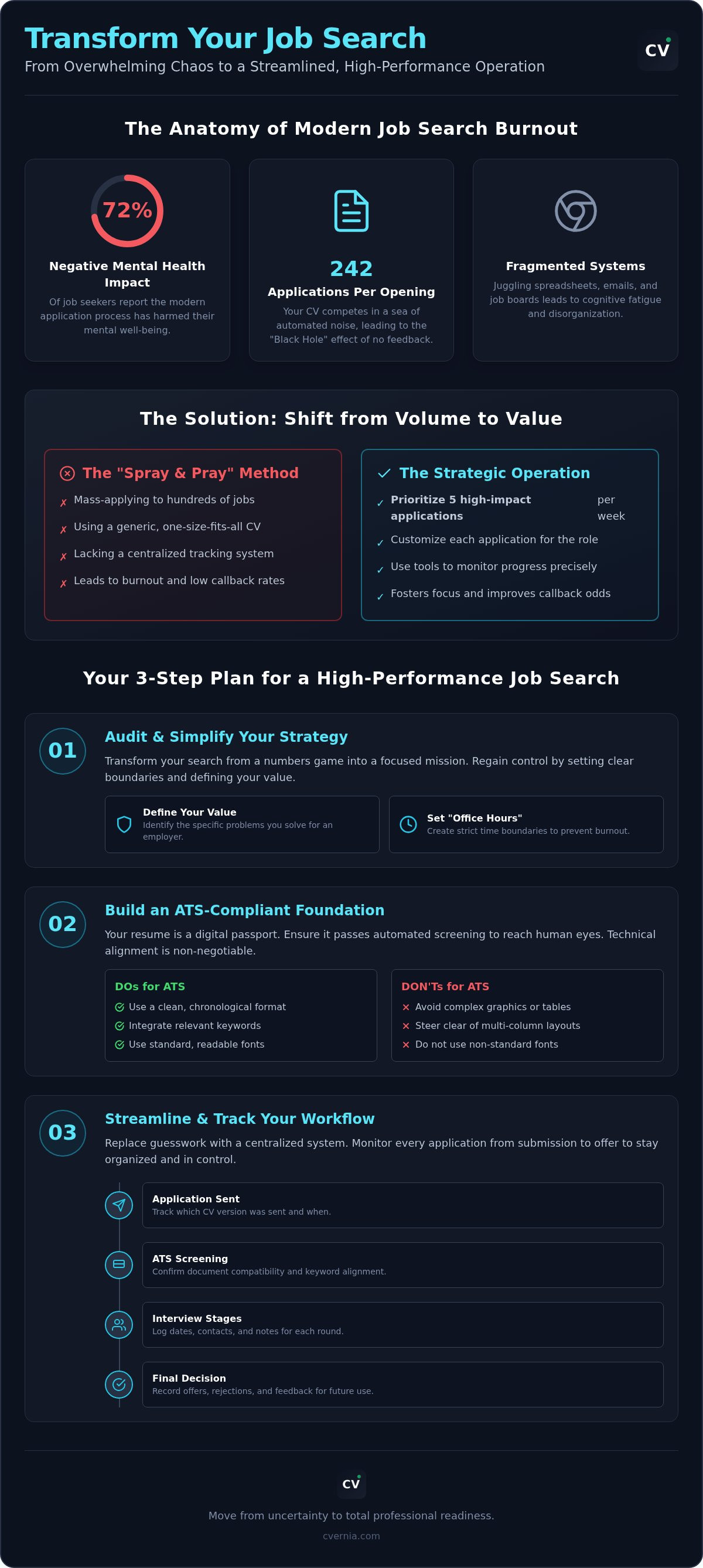
Did you know that 72% of job seekers in 2026 report that the modern application process has negatively impacted their mental health? With the average job opening now attracting 242 applications, it is no surprise if you are feeling overwhelmed by job search tasks that seem to lead nowhere. You are likely exhausted by repetitive data entry and the nagging anxiety that your CV is simply disappearing into an automated black hole. It is difficult to maintain your confidence when your hard work feels like a chaotic, unmanageable chore.
We understand that this stress is not a sign of personal failure; it is a symptom of a fragmented hiring landscape that demands a more sophisticated approach. This guide will help you transform that chaos into a streamlined, high-performance operation. You will learn how to replace application fatigue with a repeatable, low-stress daily routine and a centralized system to track every milestone. We will explore modern organizational strategies that ensure your CV reaches human eyes, moving you from a state of uncertainty to total professional readiness.
Key Takeaways
- Escape the volume trap by prioritizing five high-impact applications per week instead of mass-applying to every opening.
- Regain your focus when feeling overwhelmed by job search pressure by adopting a centralized system for your applications.
- Audit your professional documents to ensure they meet the specific technical requirements of modern ATS filters.
- Set strict "office hours" for your search to maintain a healthy work-life balance and prevent burnout.
- Replace guesswork with precision by using tracking tools that monitor your progress from initial application to final interview.
Why You Are Feeling Overwhelmed by Job Search in 2026
The current job market is a paradox of high opportunity and intense technical friction. While job openings remain steady with a ratio of 1.0 openings per unemployed worker, the number of applications per opening has more than doubled since 2022. This surge is largely driven by AI recruitment tools that allow candidates to apply to hundreds of roles with a single click. For you, this means your carefully crafted application is competing in a sea of automated noise. It is no wonder you are feeling overwhelmed by job search tasks when the "Volume Trap" suggests that applying to more jobs is the only solution. In reality, mass-applying only increases your mental load without improving your odds of a callback.
The psychological impact of the "Black Hole" is equally draining. When you spend hours tailoring a CV only to receive zero feedback, it creates a sense of profound powerlessness. This lack of transparency, combined with fragmented data spread across spreadsheets, emails, and LinkedIn messages, leads to massive cognitive fatigue. You aren't just looking for work; you're managing a complex, disorganized data project without the right tools.
The Anatomy of Job Search Burnout
Application fatigue often starts with physical exhaustion or a deep sense of cynicism about your career prospects. This state, often categorized as Occupational burnout, occurs when the mental energy you invest far outweighs the rewards you receive. You might find yourself stuck in "busy work," such as scrolling job boards for hours, rather than "productive effort," like networking or refining your personal brand. It's vital to recognize that recruiter ghosting isn't a reflection of your worth. In 2026, many online postings are "ghost jobs" that aren't even active, making it easy to take silence personally when it's actually a systemic flaw.
Why Your Current System Might Be Failing You
If you're constantly switching between ten different job boards and losing track of which CV version you sent where, your system is working against you. This fragmentation is a primary reason for feeling overwhelmed by job search activities. A major source of anxiety stems from not knowing how applicant tracking systems work in a market dominated by AI screening. Without understanding these digital gatekeepers, you might be relying on one-size-fits-all resumes that are automatically filtered out before a human ever sees them. Modern success requires a shift from chaotic volume to a centralized, data-driven strategy.
Step 1: Audit and Simplify Your Application Strategy
Stop the "spray and pray" method immediately. It's the fastest way to start feeling overwhelmed by job search tasks and leads to a cycle of low-quality results. Instead, adopt the 5-job-per-week rule. By committing to only five high-impact applications every seven days, you give yourself the mental space to customize every detail for the roles you actually want. This shift transforms your search from a desperate numbers game into a focused, strategic operation that commands respect from recruiters.
Audit your current professional documents. Are they highlighting your Core Value Proposition, or are they just a list of previous duties? You must identify the specific problems you solve for an employer to narrow your search focus effectively. Set strict time boundaries for your hunting activities. Decide your "office hours" and close the laptop when they end. This structure is essential to deal with stress and burnout, ensuring you remain a sharp, high-value candidate rather than an exhausted applicant.
Building an ATS-Compliant Foundation
Keywords are the currency of modern recruitment in 2026. An ats compliant resume acts as a digital passport that ensures your credentials are accurately parsed and ranked by hiring software before a human ever sees them. Avoid complex graphics, multi-column layouts, or non-standard fonts that trigger parsing errors. Stick to a clean, chronological format that allows the software to identify your skills instantly. This technical alignment replaces anxiety with the confidence that your profile is actually reaching the right eyes.
Narrowing Your Search Parameters
Use platform filters aggressively to block out the noise of irrelevant "Recommended Jobs" that clutter your feed. Implement a "Tiered Application" approach by prioritizing roles where you match 80% or more of the requirements. This prevents you from feeling overwhelmed by job search clutter and ensures your energy is spent where you have the highest probability of success. Before you click "Apply," spend ten minutes evaluating the company culture through recent employee reviews. It's better to skip a mismatched role now than to face the regret of a toxic environment later.
Managing multiple versions of your CV for these different tiers can become a logistical nightmare. You don't want to send a management-focused resume to a technical lead role by mistake. Using a centralized application management platform allows you to organize every version of your documents and track exactly which one was sent to which company, keeping your workflow clean and professional.
Step 2: Streamline Your Workflow with Centralized Management
A manual spreadsheet is often where productivity goes to die. If you are feeling overwhelmed by job search logistics, it's likely because your data is scattered across browser tabs, email folders, and local hard drives. You need a "Single Source of Truth." This centralized approach ensures that every application, CV version, and recruiter contact lives in one accessible dashboard. Instead of wondering which version of your resume you sent to that tech startup, you can verify it in seconds. This level of organization eliminates the mental friction that leads to burnout.
Managing multiple CV versions is a technical necessity in 2026. You shouldn't have to hunt through your "Downloads" folder to find the specific tailored document you used for a high-priority role. A centralized system allows you to link specific cover letters directly to job descriptions. This creates a clear audit trail for your career journey. Automating your follow-up calendar is another vital step. It removes the "Did I send that?" anxiety by prompting you exactly when to reach out, ensuring you never miss a critical touchpoint with a hiring manager.
Establishing a Job Search Management System
A robust job search management system is more than just a list of names and dates. It is a strategic tool that integrates your documents with your timeline. By using smart reapplication detection, you can optimize your efforts for long-term targets without repeating past mistakes. This prevents you from feeling overwhelmed by job search redundancy. It allows you to focus on new opportunities while maintaining a professional history of your previous interactions with top-tier companies.
Tracking the Interview Journey
Success doesn't end with the application; it begins there. Using a dedicated job interview tracker allows you to prepare with precision. Record the specific questions you were asked immediately after every call. This practice reduces future stress by creating a personal database of interview insights. You can also manage post-interview attachments, such as thank-you notes and digital portfolios, in the same location. Having these assets ready for quick deployment keeps your momentum high and your professional image polished.
Storing interview notes and attachments in one accessible location transforms your preparation. You can review previous conversations to ensure your messaging remains consistent across multiple rounds. This level of preparedness is what separates high-value candidates from the rest of the pack. It replaces the chaos of a fragmented search with the calm of a managed process.
Step 3: Managing the Mental Load and Avoiding Burnout
Mental resilience is not just a personality trait; it is the direct result of a well-structured workflow. If you are feeling overwhelmed by job search pressure, you must stop treating your career transition as a 24-hour lifestyle. Implement the "Office Hours" Method by setting strict boundaries on when you engage with job boards and when you step away. Treating your search like a 9-to-5 job allows your brain to recover, which prevents the chronic exhaustion that leads to poor decision-making. When you encounter rejection, reframe "No" as "Not this one." This shift in perspective helps you maintain the momentum needed to find the right cultural fit.
Building a support network is another critical defense against isolation. Connect with fellow job seekers to share resources and vent frustrations. You will quickly realize that the hurdles you face are systemic, not personal. Tracking "Small Wins" provides a dopamine boost that "Job Offers" alone cannot sustain. Celebrate metrics like reaching out to a new contact or perfecting a difficult interview answer. These are the building blocks of a successful search that keep you moving forward during the long weeks of a typical 2026 hiring cycle.
Reframing the Search Process
Success in the modern market requires looking beyond the final result. Track your "Applications Sent" and "Networking Calls" as primary success metrics to maintain a sense of daily accomplishment. Schedule "Digital Detox" days where you completely disconnect from recruitment platforms and professional social media. This break is essential to stop the "Comparison Game" on LinkedIn. People only post their highlight reels; your behind-the-scenes progress is still valid and valuable, even if it hasn't resulted in a public announcement yet.
Skill Development as a Stress Reliever
Turning downtime into a period of growth provides a powerful sense of agency. Use our Career Academy to close specific skill gaps and stay competitive as hiring requirements evolve. Learning to master a tailored cover letter generator can significantly reduce the time you spend on repetitive drafting tasks. This efficiency helps you stop feeling overwhelmed by job search requirements and allows you to focus on high-level interview strategy. By taking control of your learning, you transform a period of unemployment into a proactive phase of career development on your own terms.
Ready to replace chaos with a professional management strategy? Centralize your application workflow with CVernia and take the stress out of your daily routine.
Regain Your Confidence with CVernia's Management Tools
By now, you understand that feeling overwhelmed by job search tasks is a logistical problem, not a personal failure. You have the strategy and the mindset required to succeed in 2026. CVernia provides the infrastructure to execute those strategies with professional precision. Our platform centralizes your entire journey, replacing fragmented stress with a single, high-performance dashboard that acts as your digital mentor. You can finally stop managing your career from messy browser tabs and start leading it from a position of strength.
Our technology is designed to alleviate the inherent stress of the modern hiring landscape. We move beyond simple list-making to provide a comprehensive management suite that tracks every stage of your journey. Whether you are analyzing CV compatibility or organizing interview notes, the focus remains on your empowerment. We help you transition from a state of uncertainty to total professional readiness by providing the tools that recruiters expect high-value candidates to use.
Your All-in-One Career Dashboard
Stop the spreadsheet madness today. Managing applications, interview notes, and attachments in one place saves you hours of administrative labor and mental energy. This efficiency is especially critical when you are handling multiple versions of tailored CVs for different roles. With CVernia, you can see exactly which document was sent to which recruiter at a glance. This level of organization ensures that your dedicated "office hours" are spent on high-value networking rather than hunting for lost files or forgotten email threads.
Data-Backed Application Readiness
The fear of the automated "Black Hole" disappears when you use our ATS Analysis tool. Instead of guessing if your resume will pass the digital gatekeeper, you receive an immediate compatibility score based on modern recruitment technology. This data-driven confidence allows you to submit every application knowing it is technically optimized for human eyes. We emphasize truthful, high-quality document creation, ensuring your professional brand remains authentic while meeting the rigorous standards of 2026 hiring systems. You deserve to know that your hard work is actually being seen.
Our Smart Reapplication feature provides a unique strategic advantage by tracking your past versions and outcomes. This allows you to learn from previous efforts and refine your approach for future roles. Combine this with our Career Academy, where you can stay ahead of the latest hiring trends and close specific skill gaps. You are no longer searching in the dark. CVernia stands by you as a reliable partner, helping you manage the chaos and reclaim your career momentum.
Take control of your professional future and stop feeling overwhelmed by job search clutter. Start organizing your search with CVernia today and experience the clarity of a managed career journey.
Master Your Career Journey with Confidence
Transitioning to a new role in 2026 doesn't have to be a source of constant anxiety. You've learned how to bypass the volume trap by prioritizing quality over quantity and how to protect your mental health with strict office hours. By auditing your documents for technical compatibility and establishing a single source of truth, you can stop feeling overwhelmed by job search logistics and start focusing on your long-term growth. Organization is the ultimate antidote to the chaos of the modern hiring landscape.
Empower your transition with tools built for the modern professional. Utilize our Centralized Application Tracking Dashboard to eliminate fragmented data and rely on Real-time ATS Compatibility Analysis to ensure your CV reaches human eyes. Access our Integrated Career Academy for Professional Growth to stay ahead of evolving industry trends. Take the stress out of your job search with CVernia's all-in-one platform. You have the talent and the strategy; now you have the partner to help you succeed. Your next great opportunity is within reach.
Frequently Asked Questions
How do I deal with the anxiety of not hearing back from employers?
Shift your focus from outcomes to actions by tracking your efforts in a centralized dashboard. In 2026, many online postings are "ghost jobs" that remain active without a real hiring need, making the lack of response a systemic issue rather than a personal failure. By maintaining a clear record of your submissions, you replace uncertainty with a sense of completion for every task you perform.
Is it better to apply for fewer jobs with higher quality applications?
Yes, adopting a "Quality over Quantity" strategy is far more effective than mass-applying to every opening. Limit yourself to five high-impact applications per week to reduce the mental load of repetitive data entry. This approach allows you to tailor every document for maximum ATS compatibility. High-quality applications significantly increase your callback rate because they demonstrate a precise match for the role's requirements.
How can I keep track of which version of my CV I sent to which company?
Use a centralized version management tool rather than relying on manual file names on your hard drive. A dedicated dashboard allows you to link specific CV versions and tailored cover letters directly to each job entry. This organization prevents the common mistake of sending the wrong document to a recruiter. It ensures you are always prepared for an interview by knowing exactly what professional story you presented.
Why does job searching feel like a full-time job?
The modern search is technically demanding because it requires constant tailoring, technical optimization, and complex data management. When you are feeling overwhelmed by job search tasks, it is often because you are managing a fragmented workflow across multiple platforms. The cognitive labor of tracking follow-ups and interview rounds adds to this burden. Centralizing these tasks through a management platform can significantly reduce the "full-time" pressure.
How many hours a day should I spend looking for a job?
Aim for three to four hours of focused work during set "office hours" to maintain your productivity. Spending more time often leads to diminishing returns and increased burnout. Use this window for high-value activities like networking or deep-tailoring your applications. By setting strict boundaries, you ensure that your search remains a manageable part of your day rather than a constant source of stress that drains your energy.
Can using an application tracker actually reduce my stress levels?
Yes, a centralized tracker removes the mental burden of "remembering" application details and follow-up deadlines. Seeing your progress visualized on a dashboard provides a sense of control and accomplishment. It replaces the chaos of scattered spreadsheets with an organized, repeatable routine. This clarity is essential for anyone feeling overwhelmed by job search friction, as it transforms an opaque process into a visible and manageable pipeline.
What should I do if I feel like giving up on my job search?
Take a scheduled digital detox for 48 to 72 hours to reset your mental perspective. Rejection in 2026 is often a technical mismatch rather than a reflection of your professional worth. Revisit our Career Academy to gain new skills that boost your confidence. Shifting your focus to learning a new tool or networking with a supportive peer group can provide the fresh momentum you need to continue.
How do I explain a long gap in my resume during a stressful search?
Reframe the gap as a period of intentional career development and skill acquisition. Mention specific courses you completed or professional projects you managed during this time. Employers in 2026 value continuous learning and resilience. By presenting your time off as a proactive choice to refine your personal brand, you demonstrate maturity and preparedness rather than a lack of activity during a difficult hiring market.


