
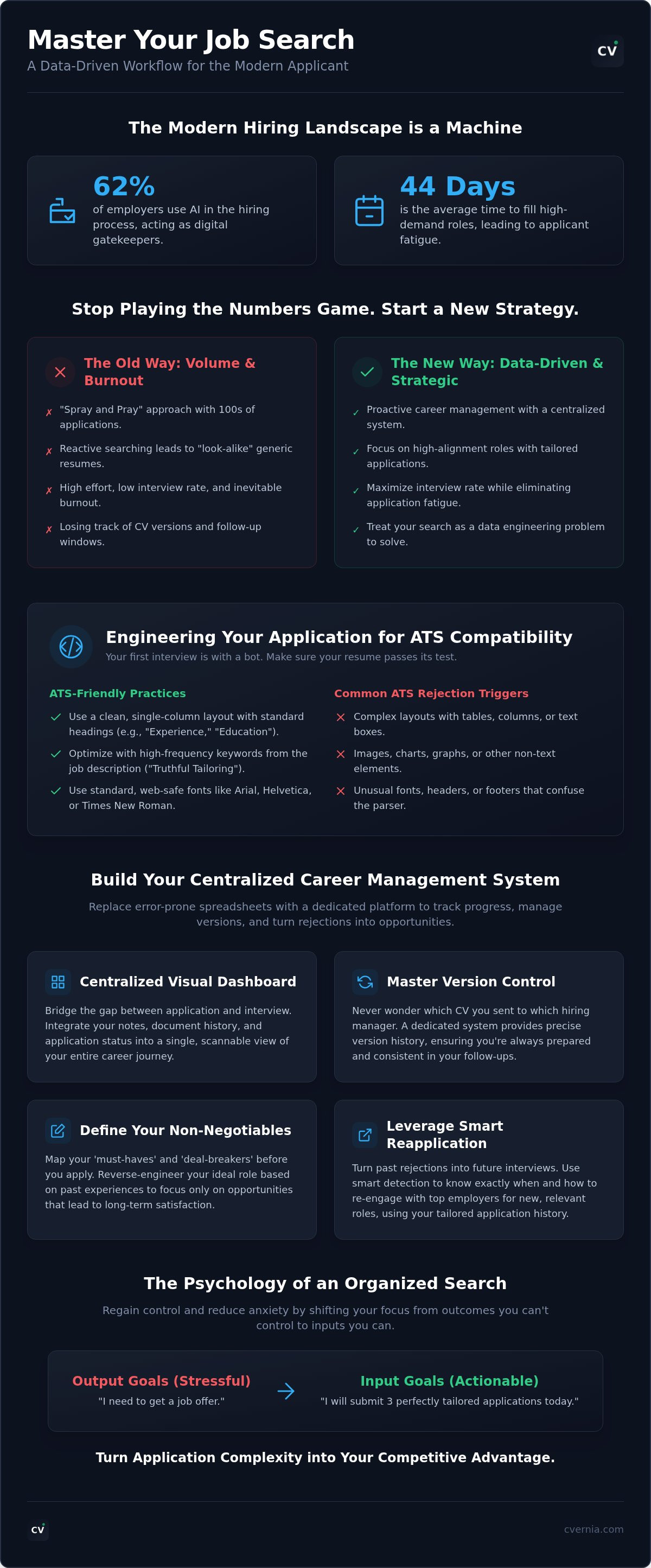
Did you know that 62% of employers now use AI for almost every stage of the hiring process? With the average time to fill high-demand roles stretching to 44 days, it's easy to feel like a ghost in the machine. You've likely felt the exhaustion of manually tailoring every document, only to wonder if your resume even reached a human. It's frustrating to lose track of CV versions while trying to figure out how to manage job search effectively in this digital environment.
We know that the current market feels overwhelming. This guide helps you master a data-driven workflow that eliminates application fatigue and maximizes your interview rate through smart organization. You'll learn to shift from a high-volume approach to a sophisticated, systems-first strategy that puts you back in control. We'll show you how to build a clear visual dashboard of your career journey, turning the complexity of 2026 hiring into your greatest competitive advantage.
Key Takeaways
- Transition from a volume-based numbers game to a data-driven strategy that eliminates burnout and focuses on high-alignment roles.
- Learn how to manage job search effectively by optimizing your CV for ATS gatekeepers using the principle of "Truthful Tailoring" for maximum impact.
- Replace error-prone manual spreadsheets with a centralized Career Application Management Platform to track your progress and manage version history with precision.
- Leverage smart reapplication detection to turn past rejections into future opportunities by identifying exactly when and how to re-engage with top employers.
- Bridge the gap between application and interview by integrating your notes and document history into a single, visual career dashboard.
Rethinking the Numbers Game: Why Search Strategy Beats Volume
The idea that you need to blast out 100 applications a day is a dangerous fallacy. This "spray and pray" method is a recipe for burnout, not a paycheck. When you treat the job search process like a lottery, you lose the precision needed to actually win. High-volume searching leads to "look-alike" applications that recruiters easily ignore. You'll find yourself exhausted, staring at a silent inbox, and wondering why your efforts aren't yielding results.
Success requires you to transition from a reactive searcher to a proactive Career Manager. This means treating your search as a data engineering problem rather than a chore. Learning how to manage job search effectively starts with a shift in mindset. You aren't just looking for a job; you're managing a professional transition that requires a centralized system. Without organization, even the most qualified candidates fail to land interviews because they lose track of CV versions or miss critical follow-up windows.
A disorganized search is often the primary reason talented professionals remain unemployed. If you can't remember which version of your resume you sent to a specific hiring manager, you've already lost the competitive edge. Adopting a "Never Search Alone" framework helps you align your roles with your actual career goals. It ensures that every application you submit is a strategic move toward a specific target, rather than a desperate reach for any available opening.
Identifying Your 'Must-Haves' and 'Deal-Breakers'
Don't wait for the interview to decide if a role is right for you. Map your non-negotiables before you even begin. Think about the positions you've disliked in the past. What made them unbearable? Use those insights to reverse-engineer your ideal work environment. If you hated micromanagement, prioritize roles that emphasize autonomy. Validate your salary and title expectations with current market data to ensure your search remains grounded in reality. This clarity saves time and prevents you from applying to roles that will eventually lead to dissatisfaction.
The Psychology of the Organized Search
Application anxiety stems from a perceived lack of control. You can't force an employer to call you, but you can control your daily workflow. Shift your focus from "output goals," like getting a job, to "input goals," such as submitting three perfectly tailored applications. This structured routine reduces the mental burden and keeps you moving forward. By building a "trusted companion" system to offload the stress of tracking details, you free up your brain to focus on what matters most: nailing the interview. Organization isn't just about spreadsheets; it's about maintaining the mental stamina needed to cross the finish line.
Engineering Your Application Toolkit for ATS Compatibility
An Applicant Tracking System (ATS) isn't just a database; it's the digital gatekeeper of your professional future. Since 62% of employers anticipate using AI for most hiring stages by 2026, understanding this software is non-negotiable. It scans your documents for specific criteria before a human ever sees them. If you want to learn how to manage job search effectively, you must treat your CV as a piece of technical documentation designed for both bots and people. This ensures your hard-earned experience actually reaches a recruiter's desk.
Formatting often matters more than your actual experience during the initial screening. Complex layouts, images, or unusual fonts can confuse the system and lead to automatic rejection. Engineering Your Application Toolkit for ATS Compatibility requires a clean, hierarchical structure that the software can parse easily. Focus on standard headings and clear dates. Don't let a creative design choice hide your qualifications from the algorithm. It's better to be readable than fancy when the first viewer is a machine.
Practice the principle of "Truthful Tailoring" to bridge the gap between your skills and the job requirements. This doesn't mean inventing experience; it means translating your history into the specific language the employer uses. Align your bullet points with the job description to demonstrate immediate relevance. It's about clarity and alignment, ensuring the system recognizes your existing value without compromising your professional integrity.
How to Scan for ATS Compatibility
Use technology to identify high-frequency keywords within a job description. This allows you to measure your compatibility score before you hit the submit button. Using an ats compliant resume is the baseline for 2026 applications to ensure your data is readable by modern recruitment software. By linking each CV version to a specific job description, you create a clear data trail for your search.
Generating Tailored Professional Documents
Your strategy should extend beyond the CV to include every touchpoint with a potential employer. A tailored cover letter generator can help you build role-specific narratives that connect your past achievements to the company's future needs. Move beyond generic templates to create a compelling story that shows you understand the role's specific challenges. Ensure consistency across your CV, cover letter, and LinkedIn profile to build a cohesive personal brand. This unified approach makes you appear organized and prepared. To streamline this entire process, you can use a centralized platform to manage every version of your toolkit in one place.
Choosing Your Management Method: Spreadsheets vs. Platforms
Choosing your management method is a pivotal moment in your career transition. Many applicants start with a basic table because it's familiar, but this often leads to a fragmented mess of email flags and buried folders. If you want to understand how to manage job search effectively, you must realize that tracking a company name is only 20% of the work. The real challenge lies in managing the data behind the application. You need to know which CV version you sent, the specific keywords you used, and the interview notes you've gathered along the way. Using the best job interview tracker ensures these pieces of information are always linked to your document history.
Centralized platforms offer a strategic advantage that fragmented folders simply cannot match. They act as a "trusted companion," keeping every CV version in one secure location. This organization eliminates the panic of searching through your "Sent" folder minutes before a call. It moves you away from a reactive state and into a position of professional confidence. You aren't just tracking applications; you're managing your personal brand with precision.
The Limits of Manual Spreadsheets
Spreadsheets are flat files that fail to capture the dynamic nature of a modern search. They can't easily track your "reapplication" status or alert you when it's time to follow up. If you're using a manual system, you're likely wasting hours on data entry that could be spent networking. There's also a significant risk of version confusion. Imagine arriving at an interview only to realize you can't access the specific CV version the recruiter is holding. Spreadsheets also lack the ability to provide "compatibility insights" that help you understand why certain roles aren't moving forward.
The Advantages of a Centralized Dashboard
A centralized dashboard transforms your search into a visual journey. It provides automated status updates and organizes your interview notes in a way that is easily accessible from any device. You can see your entire "funnel" from the first click to the final offer. This visibility allows you to identify bottlenecks in your process and adjust your strategy in real time. By centralizing your attachments, you ensure that the right CV is always paired with the right job description. This level of organization offloads the mental burden of tracking, allowing you to focus entirely on your interview performance.
Mastering Version Control and Smart Reapplication
High-performing job seekers treat their application materials like software releases. They don't just "save as" a new file; they implement version control to track exactly what works and what doesn't. If you want to learn how to manage job search effectively, you must stop viewing your CV as a static document. It's an evolving asset. By managing multiple versions, you can pinpoint which professional "hook" or summary statement triggered a response from a specific industry. This data-driven approach turns every rejection into a learning opportunity rather than a dead end.
Smart reapplication detection is another critical layer of a systems-first strategy. It prevents you from making repetitive mistakes at the same company. When a role doesn't work out, use a 5-step process to iterate on your approach. First, review the specific CV version used for the failed application. Second, audit your interview notes to find questions that stumped you. Third, update your skills section to better reflect the job's actual requirements. Fourth, cross-reference your new version against the original job description. Finally, log these changes in your central system to avoid repeating past errors. This cycle ensures that every new application is stronger than the last.
Building Your Version Library
Success depends on rigorous organization. Use clear naming conventions like "FinTech_ProductManager_Senior_2026" to keep your library navigable. This level of detail allows you to see which versions are moving through your funnel and which are stalling. Don't just track the file; track the results. If one version has a high interview rate while another has zero, you've found your winner. Organizing your interview notes within the same system helps you identify common gaps in your pitch. It allows you to refine your narrative for the next big opportunity with total confidence.
The 'Smart Reapplication' Workflow
Timing is everything when re-engaging with a previous employer. Most companies have "cool-off" periods, but these vary by role and department. Understanding how applicant tracking systems work is vital here. These systems often flag duplicate profiles or previous rejections, which can hinder your progress if you aren't careful. Use your management system to track these timelines so you know exactly when to reapply with an improved version. You can leverage smart reapplication detection to ensure your next attempt is perfectly timed and significantly more compatible than the first. This proactive management transforms a "no" into a "not yet," keeping your career journey moving forward.
Implementing Your Centralized Career Management System
Setting up your CVernia dashboard is the final step in moving from chaos to professional command. This isn't just a tool for tracking dates; it's a comprehensive hub that links your interview preparation directly to your application history. By seeing exactly which CV version led to which interview, you gain a level of insight that manual methods can't provide. Implementing such a robust job search management system ensures you're building a career-long asset rather than just a temporary fix. It allows you to identify patterns in your success and replicate them for every future opportunity.
If your search reveals specific skill gaps, don't wait for a rejection to address them. Use the Career Academy to access learning resources that align with the requirements you're seeing in job descriptions. This proactive approach turns your search into a period of professional growth. You'll enter interviews not just as a candidate, but as a specialist who has actively refined their expertise to meet 2026 market demands. This is the most powerful way to understand how to manage job search effectively while maintaining your momentum.
Daily and Weekly Search Rituals
Success in a modern search requires consistent, structured habits. Establish a 30-minute morning dashboard review to prioritize your follow-ups and respond to new inquiries immediately. This ritual keeps you ahead of the competition and ensures no lead goes cold. On a weekly basis, perform a data audit to see which CV versions are generating the most "bites" in your funnel. Use these insights to double down on the strategies that work. When an interview is confirmed, use your centralized note system to review the specific narrative you've built for that company, ensuring your pitch is perfectly aligned with your submitted documents.
Transitioning to Your New Role
Your management system remains valuable even after you sign the offer letter. Archive your search data so you can reference your successful CV versions and interview notes during future career pivots. This "Career Portfolio" acts as a living history of your professional value. Before you close the chapter on your search, run through a final checklist to ensure your next move is a strategic step forward.
- Archive all tailored CVs and cover letters for future reference.
- Save interview notes to remember the challenges you promised to solve.
- Update your centralized dashboard with your new start date and salary details.
Maintaining this organization ensures you're always prepared for the next stage of your professional journey, even when you aren't actively looking.
Take Control of Your Professional Narrative
Mastering the 2026 hiring landscape requires a shift from frantic activity to systematic precision. By prioritizing role alignment over application volume and engineering your documents for ATS compatibility, you've already bypassed the most common hurdles. You now understand that your CV is a dynamic asset that requires rigorous version control and a centralized hub to thrive. These strategies ensure your expertise isn't lost in a digital black hole while you focus on high-impact opportunities.
Knowing how to manage job search effectively is about more than just organization; it's about reclaiming your mental energy. Instead of wrestling with manual spreadsheets, you can focus on your interview performance and professional growth. Leverage tools like the Centralized Application Tracking Dashboard, ATS Compatibility Analysis, and Smart Reapplication Detection to turn every data point into a strategic advantage. You're no longer just a candidate; you're a proactive career manager in total command of your journey.
Start managing your job search effectively with CVernia's centralized platform.
Your next career milestone is within reach. With the right systems in place, you aren't just searching for a job; you're successfully navigating your professional future with confidence.
Frequently Asked Questions
How do I organize my job search without a spreadsheet?
The best alternative to a spreadsheet is a dedicated Career Application Management Platform. Unlike flat files, these centralized systems link your CV versions to specific job descriptions and interview notes automatically. This eliminates the risk of broken formulas and prevents version confusion. It's the most reliable way to maintain a clear visual dashboard of your progress without the stress of manual data entry or lost local files.
What is the most effective way to track job applications in 2026?
The most effective method is using a centralized dashboard that integrates ATS analysis and smart reapplication detection. Since 62% of employers now use AI for screening, you need a tool that mirrors their technology. This allows you to monitor your funnel from the initial click to the final offer. It's the modern standard for anyone learning how to manage job search effectively in a tech-driven landscape.
Can an ATS tell if I have applied to the same company before?
Yes, modern Applicant Tracking Systems use email addresses and unique identifiers to flag duplicate profiles. They often store your entire document history and previous rejection data. If you reapply too soon or with a conflicting narrative, the system might automatically filter you out. Using smart reapplication detection helps you time your next attempt perfectly to avoid these algorithmic traps and maintain your professional reputation.
How many versions of my resume should I have?
You should maintain one "Master CV" and create tailored versions for each specific role or industry vertical. High-performing seekers often manage five to ten core versions simultaneously. Each version should focus on different professional hooks that align with specific job descriptions. Tracking these versions in a centralized library ensures you always know which narrative triggered a response from a recruiter, allowing for better interview preparation.
How much time should I spend managing my job search vs. applying?
Aim for a 20/80 split where 20% of your time goes to system management and 80% to high-quality applications. Effective management actually reduces the time spent on repetitive tasks like manual tailoring. By spending 30 minutes each morning on a dashboard review, you ensure your follow-ups are prioritized. This efficiency allows you to focus on the input goals that lead to interviews rather than getting lost in paperwork.
Is it worth using a paid platform for job search management?
Investing in a professional platform is worth it if you value time and data precision. While LinkedIn Premium Career costs $39.99 per month, a management platform provides specialized tools for document versioning and ATS analysis. It's a strategic investment in your career-long asset. The reduction in application fatigue and the increase in interview conversion rates typically outweigh the subscription costs for corporate professionals who want a competitive edge.
What happens if I lose track of which CV version I sent to an employer?
Losing track of your CV version can lead to a disastrous interview where your pitch contradicts your written history. Recruiters report that look-alike applications are rising, so being able to recall your specific narrative is vital for credibility. If this happens, check your sent emails immediately. To prevent this, use a centralized system that automatically attaches the correct file version to each job entry in your dashboard.
How do I manage interview notes effectively during a busy search?
Use an integrated interview tracker that allows you to attach notes directly to the job application record. This ensures your preparation is always grounded in the specific requirements of that role. Documenting the questions you were asked and the feedback you received helps you refine your pitch for future rounds. It's a key part of understanding how to manage job search effectively as you move toward a final offer.


