
What if the biggest obstacle between you and your next role isn't your experience, but your organization? With 62% of employers using AI for most hiring stages by 2026, the margin for error has vanished. You've likely felt the frustration of sending the wrong CV version or missing a critical interview follow-up because your tracking system was a messy pile of bookmarks. It's draining to treat your career like a series of random events instead of a strategic operation. Mastering job application pipeline management is the only way to stop the leak in your professional funnel.
You deserve a process that works as hard as you do. We'll show you how to transform your search into a high-conversion career engine by centralizing your data and mastering the science of the chase. This guide provides a clear roadmap to building a dashboard that tracks every tailored document and interview note with absolute precision. We'll also explore the mechanics of version control and status visibility; these tools ensure you always present your best self to recruiters. It's time to move from uncertainty to total readiness with a system built for the modern landscape.
Key Takeaways
- Transition from passive job hunting to a systematic workflow that treats your career search as a strategic, high-conversion operation.
- Master job application pipeline management by implementing "Stage Gates" and data-driven weekly targets to maintain consistent momentum.
- Identify and clear the ATS bottleneck by using compatibility analysis to understand exactly why applications stall at the initial stage.
- Boost your interview conversion rates by standardizing follow-up cadences and centralizing your notes for every professional conversation.
- Scale your search efficiently using smart reapplication detection and a single dashboard to manage all CV versions and critical attachments.
What is Job Application Pipeline Management?
Job application pipeline management is a systematic workflow designed to track, analyze, and optimize every stage of your career transition. It marks the shift from passive job hunting to active strategic management. Instead of simply reacting to job boards, you treat your search as a professional operation where every move is recorded and every outcome is measured. This approach ensures you never lose a high-value opportunity to a forgotten email or a disorganized folder.
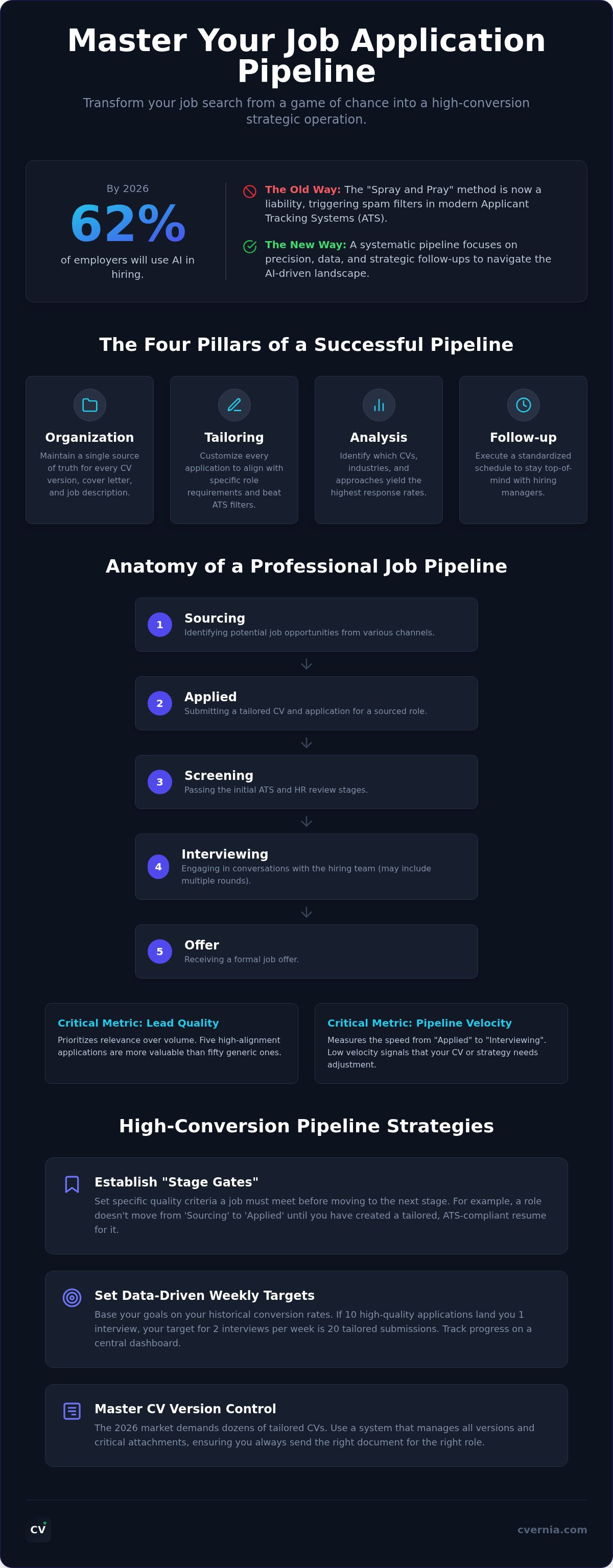
By 2026, the "spray and pray" method has become a liability. With 62% of employers now using AI for various hiring stages, generic applications are instantly filtered out. High-volume, low-quality submissions trigger "spam" flags in modern recruitment software, effectively blacklisting candidates who don't prioritize precision. Success now depends on four core pillars:
- Organization: Maintaining a single source of truth for every CV version and job description.
- Tailoring: Customizing every document to align with specific role requirements.
- Analysis: Identifying which industries or CV styles are yielding the highest response rates.
- Follow-up: Executing a standardized schedule to stay top-of-mind with hiring managers.
The 2026 Shift: Why Spreadsheets No Longer Work
Manual data entry is the fastest route to "tracker fatigue." Relying on basic spreadsheets often leads to missed deadlines and outdated information. In the current hiring climate, you're likely managing dozens of different CV versions tailored for specific Applicant Tracking System (ATS) requirements. A static document can't provide real-time compatibility scores or alert you when it's time to re-engage with a recruiter. You need a dynamic dashboard that visualizes your progress and highlights where your pipeline is stalling.
Anatomy of a Professional Job Pipeline
A healthy pipeline moves through five distinct stages: Sourcing, Applied, Screening, Interviewing, and Offer. Professional job application pipeline management focuses on two critical metrics: lead quality and pipeline velocity. Lead quality prioritizes relevance over volume; it's better to have five high-alignment applications than fifty generic ones. Pipeline velocity measures how fast you move from "Applied" to "Interviewing." If your velocity is low, it's a clear signal that your CV tailoring needs adjustment. By monitoring these stages, you gain the visibility required to fix bottlenecks before they derail your career goals.
Designing a High-Conversion Pipeline Strategy
Effective job application pipeline management requires a shift from high-volume quantity to high-impact conversion. While recruiters use the Talent Pipeline Management (TPM) framework to secure workforce talent, you must apply similar logic to manage your career search. Start by setting weekly application targets based on your historical conversion rates. If it typically takes ten submissions to land one interview, and you want two interviews per week, your target is twenty high-quality applications. Use a centralized application dashboard to keep these targets visible and your data organized.
Establish "Stage Gates" to maintain quality control throughout your funnel. These are specific criteria a job entry must meet before moving to the next column. For example, a role shouldn't move from "Sourcing" to "Applied" until you've verified the salary range and created an ats compliant resume tailored to that job description. Prioritize your efforts by calculating a match score based on your skills and excitement level. This ensures your energy goes toward roles where you have the highest probability of success.
Mapping Your Personal Funnel Stages
Customize your pipeline stages to reflect the reality of your specific industry. A software engineer might include a "Technical Assessment" stage, while a designer needs a "Portfolio Review" gate. Define exactly what "Done" means for each phase to ensure consistency. For the "Interviewing" stage, "Done" might mean the thank-you note is sent and notes are logged. Set up automated reminders to trigger follow-up tasks exactly 48 hours after every stage transition. This prevents opportunities from cooling off due to simple forgetfulness.
Version Control: Managing Multiple CVs
The complexity of the 2026 hiring market makes managing CV versions for multiple job applications a mandatory skill. Never rely on generic filenames like "Resume_Final_2.pdf." Instead, use a standardized naming convention such as [Company_Role_Date_Version]. This precision prevents the professional disaster of sending a document tailored for a competitor. Link every specific file version directly to its job entry in your job application pipeline management system. This creates a clear audit trail, so you know exactly which version of your story the recruiter is currently reading before you hop on a call.
Optimizing Pipeline Health with ATS Analysis
The "Applied" stage is where most job searches lose momentum. This stagnation often stems from the ATS bottleneck. If you've been tracking your search but haven't seen movement, you must understand how applicant tracking systems work to diagnose the failure. In 2026, job application pipeline management isn't just about moving cards across a board; it's about ensuring those cards meet the technical requirements of the employer's software.
Use a "Match Score" as your primary lead qualifier. Before you spend an hour customizing a cover letter, check your compatibility. If your score is below 70%, your pipeline health will suffer from low-conversion bloat. Focus your energy on high-value roles where your profile naturally aligns. Integrating these scores into your job application pipeline management workflow allows you to focus only on roles where you have a genuine advantage.
Diagnosing Stalled Applications
Applications often stall because systems like Greenhouse or Workday can't parse your data correctly. Check for formatting errors like complex tables or non-standard fonts that break modern parsers. If you're being rejected within minutes, it's likely an automated filter based on "knockout questions" or missing certifications. Practice "Truthful Tailoring" by optimizing your keywords based on actual experience. Never invent skills; instead, use the exact terminology the recruiter's AI expects to see for the skills you already possess. This ensures your profile stays visible to human recruiters who only review the top-ranked candidates.
Leveraging Compatibility Scores
Modern ATS analysis has evolved beyond simple keyword matching to semantic relevance. This means the system understands the context of your achievements rather than just counting words. Use your compatibility score to decide if a job is worth the effort. If a role requires significant tailoring for a low match, it might be better to move that lead to your "Archive" column. This keeps your funnel clean and efficient. When you land a screening call, use your compatibility data as a cheat sheet. It highlights exactly which of your strengths resonated with the system, allowing you to double down on those points during the conversation.
Advanced Pipeline Tactics: Follow-ups and Interview Data
Successful job application pipeline management doesn't end when you hit "submit." It evolves as you enter the interview room. You need a system that captures the nuance of every conversation. Most candidates lose momentum here because they fail to document the qualitative data that wins offers. Treat every interview as a data-gathering mission. This information helps you navigate the current role and sharpens your strategy for future opportunities. You're not just looking for a job; you're building a personal database of market intelligence.
Implement the 48-hour rule for every interaction. Send a thank-you note within 24 hours; then use the 48-hour mark to log the specific feedback or "vibes" you felt during the call. This data is vital for refining your CV for the next lead in your pipeline. If you notice recruiters consistently ask about a specific skill you haven't highlighted enough, update your master CV immediately. This constant iteration ensures your profile stays competitive in a rapidly shifting market. Use interview note management tools to turn every conversation into a strategic advantage.
Building an Interview Knowledge Base
Capture real-time notes to identify patterns across different companies. Recording common questions helps you spot industry-specific trends and prepares you for future high-stakes conversations. The best job interview tracker must include a centralized notes section to house this intelligence. Store your company-specific research right next to the job entry. This ensures you're never scrambling for facts five minutes before a call. You appear more prepared, confident, and professional when your research is integrated into your workflow.
Organization is critical when you reach the offer stage. Keep offer letters, benefit packages, and contracts in one centralized dashboard. This visibility allows you to compare multiple opportunities side-by-side without digging through endless email threads. Managing these attachments effectively gives you a significant advantage during salary negotiations. You can quickly reference specific clauses or perks to ensure you're getting the best possible deal.
The Strategic Follow-up Cadence
Standardize your outreach to stay top-of-mind without becoming a nuisance. Use a three-step sequence: the immediate thank-you, the one-week "check-in," and the "final follow-up" at the two-week mark. While templates provide a useful structure, you must always include a personalized detail from your interview notes to stand out. Track specific contact people and hiring managers within each job entry to ensure your messages reach the right inbox. This level of detail transforms a chaotic search into a precision-engineered career engine that produces consistent results.
Scaling Your Search with CVernia’s Management Platform
Scaling a job search from five applications to fifty requires a robust infrastructure. Manual tracking eventually breaks under the weight of multiple CV versions, varying interview dates, and complex follow-up tasks. CVernia provides a professional-grade Career Application Management Platform that acts as your digital mentor, organizing every detail of your journey. By centralizing your documents, notes, and attachments in one dashboard, you eliminate the mental load of organization. Effective job application pipeline management becomes effortless when your tools handle the logistics for you.
You need a system that grows with your ambitions. Instead of reacting to individual job postings, you'll manage a portfolio of opportunities with the same precision as a corporate recruiter. This high-level visibility ensures that no "lead" goes cold and every interaction is backed by data. It's about moving from a state of constant catching up to a position of total preparedness.
Smart Reapplication and Version Control
Reapplication is a high-yield strategy that most candidates mismanage. If you didn't land a role six months ago, your improved skills and updated experience might make you the perfect candidate today. CVernia’s Smart Reapplication Detection tracks your previous attempts, ensuring you know exactly when and how to re-engage with a company. This system prevents embarrassing duplicate submissions and helps you refine your approach based on historical data. You can link specific CV versions to each application, ensuring the right story reaches the right recruiter every time. This level of version control prevents the professional disaster of sending unoptimized documents to your dream employer.
Your Centralized Career HQ
Your career data is sensitive and deserves a secure, private home. CVernia offers a centralized dashboard where you can store everything from initial job descriptions to final offer letters and benefit packages. This HQ provides instant access to interview preparation and guidance tools, keeping you ready for unexpected screening calls. It's a single source of truth that replaces scattered folders and lost bookmarks.
Beyond simple tracking, you can access the Career Academy to sharpen your skills and move from "Applied" to "Hired" at a much faster pace. These learning resources provide the strategic edge needed to navigate the 2026 hiring environment with absolute confidence. Stop letting your career growth happen by accident. Transform your search into a precision-engineered engine that reflects your true professional value. Start managing your job application pipeline with CVernia today.
Take Control of Your Career Future
You've moved beyond the "spray and pray" era into a landscape defined by precision and AI logic. Mastering job application pipeline management isn't just about tracking dates; it's about leveraging data to outpace the competition. By centralizing your documents, diagnosing ATS bottlenecks, and standardizing your follow-up cadence, you transform a stressful search into a predictable engine for success. These strategies ensure that every move you make is calculated and every opportunity is maximized.
Ready to elevate your professional journey? CVernia is trusted by professionals worldwide to streamline complex career transitions. Benefit from ATS-optimized document generation and smart version control that ensures you never send the wrong file again. Our platform also features smart reapplication detection to help you capitalize on every previous connection with total accuracy. Master your career journey with CVernia’s application dashboard and start seeing higher interview conversion rates today.
Your dream role is waiting for the most organized version of you. Step into your next interview with the confidence of a candidate who has every detail under control. You've got the talent; now you have the system to prove it.
Frequently Asked Questions
What is the best way to track job applications in 2026?
Use a centralized career management platform rather than manual spreadsheets to keep pace with modern hiring speeds. A dedicated dashboard provides real-time visibility into your application status and document versions. It ensures you never miss a follow-up deadline or send an unoptimized CV. This approach replaces tracker fatigue with a streamlined, automated workflow that keeps your focus on high-value interview preparation and networking.
How many stages should a job application pipeline have?
A standard high-conversion pipeline typically includes five to six key stages for maximum clarity. These usually consist of Sourcing, Applied, Screening, Interviewing, and Offer. Depending on your specific industry, you might add specialized gates like Technical Assessment or Portfolio Review. Defining exactly what "Done" means for each stage maintains consistency. This structure allows you to visualize exactly where your progress stalls and where you need to adjust.
Can I use a CRM for job application pipeline management?
You can adapt a sales CRM, but a dedicated career platform is far more effective for job application pipeline management. Standard CRMs lack native features like ATS compatibility analysis or smart version control for tailored CVs. While they track contacts well, they don't help you optimize your documents for specific job descriptions. A specialized career dashboard integrates these essential recruitment mechanics directly into your daily workflow.
How do I manage different versions of my CV for different jobs?
Adopt a strict naming convention and link each file directly to its specific job entry in your dashboard. Use a format like [Company_Role_Date_Version] to ensure you always reference the correct document. Centralizing these files prevents the disaster of sending a generic version to a high-priority lead. This level of organization allows you to review exactly what the recruiter sees before every screening call or interview session.
What should I do if my job application pipeline is stalled?
Diagnose the bottleneck by analyzing your conversion rates at each stage of the funnel. If you aren't landing interviews, your CV tailoring or ATS compatibility scores likely need immediate improvement. If you're stalling after the first call, review your interview notes to identify recurring questions you might be struggling to answer. Adjusting your strategy based on these specific data points helps you restart momentum and move closer to an offer.
Is it worth reapplying to a company that rejected me before?
Reapplying is a high-yield strategy if you have gained new skills or the company's needs have shifted since your last attempt. Many organizations value persistence and professional growth over time. Use smart reapplication detection to track your previous history and ensure your new attempt highlights your most recent achievements. This approach demonstrates your ongoing interest and professional development; it often leads to a different outcome in a new hiring cycle.
How do I integrate interview notes into my job tracker?
Log your reflections and recruiter feedback immediately after every call within your centralized dashboard. Recording patterns in the questions asked helps you build a personal knowledge base for future interviews. This practice ensures you have a clear record of what resonated with the hiring team. Having these notes at your fingertips allows you to compare different offers side-by-side based on more than just the base salary.
What are the most important metrics to track in a job search pipeline?
Focus on lead quality and pipeline velocity to measure your job application pipeline management success. Lead quality measures how well your skills align with the roles you target; pipeline velocity tracks how quickly you move between stages. Monitoring your "Applied-to-Interview" conversion rate is also critical. These metrics provide a clear picture of your efficiency and help you decide where to invest your time for the highest return.


